While the NFL steals the spotlight when it comes to amateur drafts, the other three major sports have their own version and while not as popular and promoted as their football counterparts are, some amazing talent has still come out of each league’s respective draft classes.
The NFL began their draft process in 1936. Baseball had their first much later in 1965. 11 years after football started calling on collegiate players to join their ranks, Pro basketball began their version of a draft. Finally, there is the NHL and close to baseball’s first year of a process pro hockey began in 1963.
1965 - RICK MONDAY (KANSAS CITY ATHLETICS)
Major League Baseball’s first ever amateur draft pick was a man who became famous for one simple heroic incident. Rick Monday was the selection by the Kansas City Athletics after playing for Arizona State University. On Sunday, April 25, 1976, Monday, by then playing for the Chicago Cubs, found himself in the outfield of the Los Angeles Dodgers, his team’s opponent that day.
Two protesters made their way into the outfield with an American flag then tried to try to set it on fire. Seeing what was taking place, Monday raced to these two clowns and grabbed the flag away from them stopping the unpatriotic act.
Officials running Dodger Stadium at once played “God Bless America” and then on the scoreboard when Chicago had their turn at bat, the words “Rick Monday…You made a great play” flashed for everyone to see.
Monday was presented with that flag and used it to promote fund raisers for military charities. 50 years later Monday was honored at Dodgers Stadium as he brought out that same flag to the field.
Rick Monday played for 19 years in Major League Baseball and knocked out 1,619 hits with 241 home runs. While being drafted by Kansas City he also played for the Oakland A’s when the team moved to California but also wore a Cubs jersey for five seasons and finished his career in 1984 with the Dodgers.
1966 - STEVE CHILCOTT (NEW YORK METS)
One year after the drafting of Rick Monday, the New York Mets had the first overall pick in the draft and used it on a kid fresh out of high school, Steve Chilcott. Chilcott was a catcher who went to the minor leagues first out of Antelope Valley High School in Lancaster, California.
Unfortunately, he never made it to the majors. I guess you can say that it was baseball’s first draft bust.
1967 - RON BLOMBERG (NEW YORK YANKEES)
Our next number one pick became baseball’s first Designated Hitter when that rule was put into place in 1973. Ron Blomberg was drafted by the Yankees, and he filled that first DH role. In 1967 Blomberg was the third top pick since the draft for baseball had begun two years earlier.
By position he was a first baseman, but his MLB career lasted just eight seasons all with the Yanks except for 1978 when he came off a one-year sabbatical to play for the Chicago White Sox. In those eight years he played in just 461 games. He did manage to hit 52 home runs during his career.
However, most of his career was a DH. These days at age 77 Blomberg continues to run a summer baseball camp for kids at the New Jersey Y Camp, something he’s been doing since 2006.
1968 - TIM FOLI (NEW YORK METS)
We are up to our fourth year, which was 1968 and a former Pirate was the first overall pick, a player who got his start with once again the New York Mets. It was Tim Foli and he was a part of the 1979 World Series champion Pirates. But his career began in New York as he was drafted as an 18-year-old graduating from Notre Dame High School in Canoga Park, California. Always a shortstop, Foli also made stopovers at second and third base.
Not known for his bat Tim Foli was a lifetime .251 hitter over 16 seasons with just 25 homeruns and 1,515 career hits. For his career he was involved in 1,092 double plays, committed just 210 errors, and had a fielding percentage of .972.
He played for the Montreal Expos, Pirates, Mets, California Angels, San Francisco Giants, and the New York Yankees retiring in 1985 with the Pirates after a season with the Yankees. He spent most of his career in Montreal, six seasons in all and then with the Pirates and Mets for four seasons each.
1969 - JEFF BURROUGHS (WASHINGTON SENATORS)
As we move into players from the 1970s, seeing their ages today certainly makes this 67-year-old writer feel much older. Today Jeff Burroughs is 75. It seems like yesterday that I remembered watching Burroughs play. I remember him having a big body frame that could hit the ball hard. Burroughs was 6’1” and 200 pounds in his heyday. He would smack 240 home runs in his 16-year career with 1,443 hits. His .261 lifetime average was respectable.
Drafted by the Washington Senators as a graduate of Wilson High School in Long Beach, California, it took Burroughs one year to get to the bigs. After the 1971 season he ended up on the roster of the Texas Rangers where he would remain until the 1977 season when he became a member of the Atlanta Braves. His career would finish in 1985 after playing for the Seattle Mariners, Oakland As and Toronto Blue Jays.
1970 - MIKE IVIE (SAN DIEGO PADRES)
In remembering Mike Ivie, one thing that stands out for me is the ugly brown and yellow jerseys the Padres wore back then. Only the Houston Astros’ outfits may have been competitive back then for atrocious outfits. But I remember Ivie well. He played 11 seasons of Major League Baseball playing the hot corner in the field and at first base and in left field.
Mostly a journeyman player from San Diego he stayed in California as a member of the San Francisco Giants and played two years in Detroit before rounding out his career in those outfits spoken before, with the Houston Astros.
Sadly, Mike Ivie passed away on July 21, 2023, at the age of 70 leaving behind the legacy of the first number one pick in baseball’s annual draft to pass away.
1971 - DANNY GOODWIN (CHICAGO WHITE SOX)
After graduating from Peoria Central High School Goodwin played baseball for Southern University and A&M College before making his pro debut in 1975. Goodwin never became a good pro player lasting just seven seasons in Major League Baseball with them and despite being drafted by the White Sox, Goodwin’s debut came with the California Angels, but he also played for the Minnesota Twins, and Oakland A’s. He never played in more than 59 games in a single season.
A bit of trivia on Danny Goodwin, he is the only player in baseball’s draft history to be selected number one overall TWICE. That’s because after the White Sox drafted him, instead of reporting to the minor leagues, he went off to college first. He did so for the desire to get a college education and he was not happy with Chicago’s signing bonus. So, in 1975 the California Angels had the first overall pick and used in on Goodwin.
Goodwin did play one year overseas in Japanese pro ball playing for the Nankai Hawks in 1986 before hanging up his spikes.
1972 - DAVE ROBERTS (SAN DIEGO PADRES)
Just like Danny Goodwin, Dave Roberts had a short pr career, just 10 seasons with four different teams. Drafted out of the University of Oregon in 1972, he made his rookie debut that same year.
His sophomore year he played in 127 games and had a batting average of .286 but he would not close to that average for the rest of his career. When he played his final game in 1982 against the Pittsburgh Pirates his final career average was just .239.
Following his playing career Roberts took a shot at managing and fared no better. As the manager of the Eugene Emeralds in the Northwest League, a minor league team for the Kansas City Royals, this team finished the season 19-55, the worst record in that league for that year.
That was his last job as a manager although he did serve as a first base coach for the Cleveland Indians in 1987.
1973 - DAVID CLYDE (TEXAS RANGERS)
I clearly remember when David Clyde made his pro debut. I recall seeing him on the front cover of a magazine and after doing so research he in fact on the cover of the Beckett Vintage Collector magazine and the Popular Sports Baseball magazine. Drafted out of high school David Clyde was one of just three pitchers that were an overall number one pick selected directly out of high school.
The hype surrounding Clyde was tremendous with comparisons to the great Sandy Koufax, a complement in itself. The Rangers front office and coaching staff felt he didn’t need minor league experience and rushed him right to the mound right out of high school. His rookie season was a disaster, winning four games and losing eight and posting an ERA of 5.01. Clyde started 18 games and did not finish one. The following season he went 3-9 and his ERA only slightly improved.
By 1975 the wear and tear of pitching in the bigs began to start taking its toll and that season Clyde appeared in just one game. He would miss the next two seasons with arm injuries and when he returned in 1978, he simply was no better finishing the season with a record of 8-11. A year later his career would be over by season’s end after going 3-4. His return after injury was with the Cleveland Indians where he played two seasons before exiting pro ball.
Perhaps he jinxed himself when upon signing his first contract he went public to say that he had a career goal to become the greatest pitcher ever. Despite having a failed baseball career, he did go on to become the vice president of his father-in-law’s lumber business in Texas. He held that position for 20 years until he retired in 2003. Now, at age 71, he spends his days taking care of his elderly father.
1974 - BILL ALMON (SAN DIEGO PADRES)
In the first 20 years of the Major League Baseball draft the San Diego Padres had the first overall pick in the draft three times. Almon was one of them. While being a journeyman most of his career, Almon did stick around the majors for 15 seasons playing for seven different teams, the Padres, Pirates, A’s, White Sox, Mets, Phillies, and Expos.
Mostly a shortstop and third baseman, Almon also played games in the outfield. Originally from Warwick, Rhode Island, Almon also played ball at Brown University.
1975 - DANNY GOODWIN (CALIFORNIA ANGELS)
In some ways you can say this overall number one was a bust. We already talked about him as the top pick in 1971.
1976 - FLOYD BANNISTER (HOUSTON ASTROS)
Floyd Bannister was a starting pitcher, and his career began in Houston and finished in Texas with the Rangers. In between he threw the ball for four other teams, the Mariners, White Sox, Royals, Angels, and Rangers. His best season was 1983 when he won 16 games and lost 10 while playing in Chicago. He had a near reversal of that record in 1979, his third year in the majors when he lost 15 and won only 10.
In his 15-year career, Bannister had just three winning seasons, the 16-11 mentioned above, a 14-11 record the following season and in `987 he won another 16 dropping 11. His career record was under .500 at 134-143. Baseball ran in Bannister’s family as his son Brian was a pitcher for the Kansas City Royals and New York Mets playing five seasons in all.
His other son Brett played college baseball with the USC Trojans making it to the minors after the Seattle Mariners drafted him. A third son Cory played college ball at Stanford. Today Bannister manages son Brian’s professional photography studio in Phoenix, Arizona. IN addition to that he owns a training facility in Phoenix.
1977 - HAROLD BAINES (CHICAGO WHITE SOX)
As the years begin to accumulate into this decade the players got better. Baines ended his career with a capper of being inducted into the Baseball Hall of Fame. A six-time all-star, Baines made into Cooperstown in 2019. Some may believe he didn’t deserve to be enshrined, but he had a long 22-year career that saw him play for five teams but spent 14 with the Chisox.
While I argue against his induction, he did finish his career with 384 home runs, and 2,866 hits while also knocking in 1,628 RBIs. For a hall of famer, there is no question Harold Baines may have logged the most travel miles by any player that’s been elected to the Hall of Fame. Baines in his 22 seasons played for five different teams. In his 22-year career, however, he never led the league in any category.
1978 - BOB HORNER (ATLANTA BRAVES)
In two straight years baseball’s top pick was an incredibly talented player. Winner of the 1978 National League Rookie of the Year award, Horner was a slugging third and first baseman that to my surprise in looking back at his career he only played 11 seasons in Major League Baseball. I would have guessed he had a longer career but a shoulder injury ended his career as he could not longer play effectively.
After a baseball career in college at Arizona State, Horner opted not to be assigned to the minor leagues and was drafted by the Braves who teamed him with Dale Murphy to create one of the most dangerous home run tandems in baseball. When the College Baseball Hall of Fame was created in 2006, Bob Horner was one of the first inductees. At Arizona State he set several school records.
In his 11 pro seasons, Horner averaged 20 home runs per season, but three times hit over 30 (33 in 1979, 35-1980, and 32-1982). He finished with a career batting average of .277 and played in 1,020 games. Sadly, he passed away this year on May 26 at the age of 68.
Not only is Bob Horner in the College Baseball Hall of Fame, but he has also been inducted into the Georgia Sports Hall of Fame and the Arizona State Sun Devil Athletic Hall of Fame. His jersey number five is displayed on the outfield wall of Phoenix Municipal Stadium.
1979 - AL CHAMBERS (SEATTLE MARINERS)
With the selection of Chambers, the Seattle Mariners not only broke the string of two straight outstanding players selected first in the draft, but they also found themselves picking a lemon. A bust.
Chambers would stay in pro ball for just three seasons not making it to the bigs until 1982. Once on the Mariners’ roster he would play in just 57 games and manage just 25 hits. His pro career was over before it even could get started.
1980 - DARRYL STRAWBERRY (NEW YORK METS)
With the first overall pick the New York Mets landed a home run with the league’s top pick both figuratively and. That’s became the extraordinarily talented Strawberry would go on to become a consistent home run threat and a feared hitter. It took three years for the Mets to call him up from the minors, but he made a smashing debut as a rookie hitting 26 home runs while batting .257 and knocking in 74 runs. He added 15 doubles and seven triples and stole 19 bases.
Teamed with Dwight Gooden who was an incredible pitcher these two men were their own worst enemies because of addictive natures mostly with cocaine. Still, in 1976 the Mets won the World Series in the most unexpected way. Known as the “Bill Buckner” play, the Boston Red Sox first baseman allowed a ground ball to trickle through his legs allowing New York to win the game which if Buckner made the play the Red Sox would have been world champions. But instead that play forced a game seven which the Mets prevailed.
Strawberry would play 17 seasons of Major League Baseball and finish with 335 home runs and in 1998 he led the majors with 39 dingers. Not only did he take home Rookie of the Year honors in 1983, but he was also named to the All-Star team eight times. In 2000 he was a member of the New York Yankees but then commissioner Bud Selig he was suspended for the entire season after testing positive for cocaine. At that point he retired. Strawberry has two very distinct honors.
In Major League Baseball history only five players have hit two pinch hit grand slams and the Straw is one of them. Secondly, he is just one of three players in history to have played for all big-league teams that had called New York home. That would be the Mets, Yankees, Dodgers, and Giants. To further that point, Strawberry is the only one of the three that played ONLY for the New York teams mentioned. Ricky Ledee and Jose Viscaino also played for the four teams but also played for teams in different cities.
On June 1, 2024, the New York Mets honored Strawberry by retiring his jersey number 18 at their home field. Two months prior Dwight Gooden had the same ceremony.
1981 - MIKE MOORE (SEATTLE MARINERS)
Seattle had their second shot at a number one pick in the first 20 years of baseball’s draft and with this one they took pitcher Mike Moore. Moore became a reliable starter in Seattle spending seven seasons with the Mariners, four with the Oakland A’s, and three final seasons in Detroit.
Moore won games in double digits eight times in 14 seasons with his most victories coming in 1989 when he posted a record of 19-11. Two years earlier he led the majors in losses with 19 while winning only nine games. He did have three seasons of 17 wins (17-10 in 1985, 17-8/1991, and 17-12/1992).
In his final season with the Tigers, he once again led was the major league leader in losses with 15 while he won only five. 11 of his 14 seasons resulted in double digit loss records. His final career record was 161-176 and his ERA was a career mark of 4.39.
When the A’s won the 1989 World Series, that was also Moore’s best season in his career. In that World Series, Moore won three games highlighting his most impressive career performance.
1982 - SHAWN DUNSTON (CHICAGO CUBS)
Shawon Dunston was a solid utility infielder and occasional outfielder who hung around the major leagues for a long 18 years. In that span he played for six teams spending the most time with the Cubs (12 years). He would also wear the jerseys of the Giants, Cardinals, Indians, Mets, and Pirates.
His best season was in 1997 when he played for two teams in the same season, the Cubs and Pirates. That year he played 132 games and finished with a batting average of .300 while amassing 147 hits. The year before Dunston was presented with he “Willie Mac Award” an honor named after the great Willie McCovey.
Beginning in 1980 it was presented to a player who exemplified the “most inspirational player on the San Francisco Giants roster. Big Mac himself presented the award to Dunston during a pre-game ceremony which was always held near the end of each season until McCovey passed away in 2018.
On a trivial note, his son Shawon Jr. ended up in minor league baseball and one of his three daughters, Jasmine, was named the Chicago White Sox Director of Minor League Operations in 2022.
1983 - TIM BELCHER (MINNESOTA TWINS)
Tim Belcher had a remarkably interesting start to his professional baseball career. Drafted by the Twins, Belcher pulled a “John Elway/Eli Manning” move by refusing to play for the Twins. So, Belcher ended up in the 1984 supplemental draft and the Yankees selected him. Then he was placed in the league’s compensation pool and the Oakland A’s picked him up.
After spending time in the A’s minor league system, he was traded to the Los Angeles Dodgers. So, after being involved with three different teams before ever throwing one major league pitch, Belcher finally made his major league debut in 1987 with the Dodgers.
He would spend the next five seasons in Los Angeles being on the staff of the 1988 World Series championship team. That year he won two games in the National League Championship series and another against his old team, the A’s in the World Series.
That year he led the National League in complete games with 10 as well as being Major League Baseball’s leader in shutouts tied with Roger Clemens as each tossed eight goose eggs. In 1991 Belcher was traded to the Cincinnati Reds. After the trade Belcher bounced around Major League Baseball by playing for the Reds, Royals, Angels, Mariners, Tigers, and the Chicago White Sox.
When he retired with the Angels in 2000 his career totals showed a won/loss record of 146-140 with 42 complete games and 18 shutouts over 14 seasons.
1984 - SHAWN ABNER (NEW YORK METS)
Some teams had multiple overall first round picks in the first 20 years of the MLB draft, and the Mets are one of them as this was their fourth. Already having drafted Steve Chilcott, Tim Foli, and Darryl Strawberry, in 1984 two years before they would become world champions, Abner was the league’s top pick.
The Mets must have seen that he didn’t have the tools to be in the bigs because after adding him to their organization and sending him to the minors, he was traded to the San Diego Padres in 1986 along with Kevin Mitchell, Stan Jefferson, Kevin Armstrong, and Kevin Brown to the Pawds for Kevin McReynolds, Gene Walter, and Adam Ging.
Out west, Abner never played in more than 94 games and simply didn’t have the offensive tools to stick around and was the subject of a second trade in 1991 sent packing to the California Angels but then signed by the Chicago White Sox one year later. His professional baseball career was over after just six short years, and he has been publicly known as a draft bust.
A story Abner probably wishes no one to know about is that in 2019 he was arrested for animal cruelty after leaving a 14-month-old husky he owned alone at home for over 30 days resulting in the dog’s death. Abner never asked anyone to look after the dog, and he pleaded guilty to felony aggravated animal cruelty and was sentenced in January 2020 to 4 ½ to 23 months in prison.
1985 - B.J. SURHOFF (MILWAUKEE BREWERS)
To round out our first 20 years of Major League Baseball’s first overall draft picks we have B.J. Surhoff. Surhoff can be considered a success story putting in 19 seasons in the major leagues and finishing with 2,326 hits. His career batting average is .282 which is solid and while most of his career was with Milwaukee (9 years) he also put in eight seasons with Baltimore and another three with the Atlanta Braves.
Athleticism is in B.J. Surhoff’s blood as his father was a veteran of the National Basketball Association from 1952-1954 playing two seasons there. B.J.’s brother Rich played in the majors with the Phillies and Rangers. B.J.’s son Austin was an accomplished swimmer who won the 200 individual medley and 200-meter backstroke at the 2010 Big 12 championships. A month later he finished first in the 200 individual medley.
RECAP
And there you have it listeners. The first 20 years of Major League Baseball’s amateur draft for just the first man picked in the league’s draft.
Be sure to check out the other parts of this series covering the first 20 number one overall draft picks in the 4 major U.S. sports. You can always find more Total Sports Recall here.
More From Harv Aronson
The First 20 Number One Overall Drafts Picks – NFL
Welcome to the Total Sports Recall podcast. I’m Harv Aronson...
Read More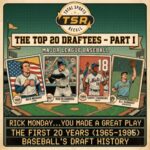
The First 20 Number One Overall Drafts Picks – MLB
While the NFL steals the spotlight when it comes to...
Read More
Total Sports Recall – The Return
Welcome to the Total Sports Recall podcast. I’m your host...
Read More
Mastering the Masters: A Brief History of the Tournament
This year’s PGA Masters Tournament is scheduled for April 11...
Read More