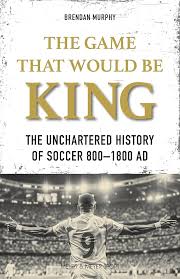
The Game That Would Be King: The Uncharted History of Soccer 800 – 1800 AD runs to 520 pages, contains 3,000 references, took three years to write, and hijacked my passion project, The Prime of her Death, a Melbourne thriller fusing purgatory and prime numbers.
Prior to that, I had written four young adult fantasy novels, a picture book for girls, and co-authored two book chapters, thirty research papers, and another thirty conference papers and abstracts, all relating to youth mental health. Only at the editing stage of The Game That Would Be King was I able to return to The Prime of her Death and smash out Hellgate, a regency period screenplay.
STORY BEHIND THE BOOK
So what possessed me to write this challenging scholarly work on the history of ball games? An earlier book holds clues. In 2007, I penned From Sheffield with Love: Celebrating 150 Years of Sheffield FC, the World’s Oldest Football Club.
It is the oldest club in any code, including Gaelic football, Australian Rules, rugby union, rugby league, and both American and Canadian football. Singular at inception, the club is privileged with the nickname The Club.
The motivation behind From Sheffield with Love is simpler. I am a football lover from Sheffield, propelled to the book by a concatenation of events. There is irony too. Melbourne has been my home for the last twenty-five years; another magnificent sporting city and home to the second oldest football club in the world, the Australian Rules club Melbourne FC.
With no clubs to play against, it is little surprise that the third-oldest club in the world is Sheffield’s Hallam FC, and the fourth, Australian Rules’ Geelong FC, from Melbourne’s neighbouring city.
There are other reasons I wrote The Game That Would Be King. The early history of ball games was uncharted territory. Previous attempts to navigate it were superficial, misguided, or simply wrong. Football history was there for the taking. Virgin land to plant a flag upon.
Two other critical factors impelled me to the flying ball, looping life with startling symmetry, Sheffield and Melbourne up to mischief again. The first is the echoing realism of the film Kes, the second the man whose ghostly hand steadied my preliminary scrawling. That’s you, Tom Wills.
The Game That Would Be King is crammed with facts that have lain dormant for centuries, untouched, unseen. It is packed with oddities, anecdotes and ephemera, arranged in chronological order, for example chapters five to seven cover the Tudor period.
The book presents a family tree of games long forgotten: trapball, stoolball, the wonderfully named camping and knappan, with hockey, hurling, baseball, bowling, tennis and golf stepping into view along the way. Exotic cousins, including baggataway, knattleikur, soule, and calcio form part of the story too.
A host of countries find their way into the book: the United States, Mexico, Canada, England, France, Italy, Greece, China, Egypt, Indonesia, and Japan. The United States should be justly proud of its rich sporting heritage, yet much of it is lost to time.
A plethora of American sporting gems are unearthed spanning centuries, from the Mayflower to Jamestown to the American Revolutionary War. The origins of baseball, and the fascinating but unknown contribution of Harvard University receive particular attention.
BRIEF TIMELINE OF THE SPORT
Below is a glimpse of the timeline of sport (if hunting is considered so), a taster of the magic that follows. As Soccer Books UK write in their review: a revolutionary text that challenges everything we thought we knew about the beautiful game’s origins. This meticulously researched volume doesn’t just push back the timeline of soccer’s history—it explodes it.
51,000 BC: on the Indonesian island of Sulawesi, there is a cave painting of human-like figures hunting a wild pig. The oldest cave paintings of any kind – hand stencils – are also to be found in Sulawesi and are a mind boggling 68,000 years old.
16,000 BC: The Lascaux cave paintings depict hunting and possibly wrestling. The oldest, dating back 17,000 years, shows a bird-headed man charged by a bison.
7500 BC: the Lascaux cave paintings depict human hunters pursuing deer, ibex, and other animals with bows and arrows.
2000 BC: the earliest depiction of ball sport is in a cemetery in Egypt. One painting shows two men throwing balls to one another while piggybacking on two other men. Another shows four women juggling balls, and a third a game of catch with two teams of three women. Elsewhere in the cemetery, is the tomb of a local governor c1900BC. A wall painting portrays two men with sticks playing with a ball. It is the first drawing of a stick and ball game in history.
2,500 BC: the world’s oldest earliest ball was discovered in child’s grave in Tarkhan, Egypt. The linen rags rolled into a ball and secured with string was probably a favourite toy, left by inconsolable parents for their child to play with in the afterlife.
410 – 330 BC: the Greek games of phaininda and episkyros and the Chinese game of Cuju are first mentioned within 80 years of each other.
500 AD: the murals of the Tepantitla (now Mexico) depict multiple ball games, including seven men with sticks and balls playing within a defined space.
600-700 AD: the first mention of hurling in Ireland.
1000 AD: the earliest mention of ball sport in English history is a stick and ball game
1100 AD: the earliest mention of driving a ball into a hole with a stick: “When they played Shoot-the Goal it was Cú Chulainn who filled the hole with his shots, and they were helpless against him.”
1261 AD: in Bicester, England, William Stirchup kicks the ball. Nine-year-old Stephen le Taylor chases it, trips, and falls on his scissors. It is the first mention of a kicking game in modern history.
1302/03: in England, “The hundred of Trygshire present a death from a kick received when playing at foot-ball.” It is the first mention of a football game in history.
Jumping forward three centuries:
1606 AD: in North America (Canada), native Americans play a game similar to lacrosse.
1634 AD: the earliest football reference in the Americas relates to Native Americans in William Wood’s travelogue: “For their sport activitie they have commonly but three or foure; as football, shooting, running, and fishing.”
1643/49 AD: Harvard becomes the first college in the American colonies. Harvard’s first football reference (a sermon by Thomas Shepard, the college’s Puritan minister, delivered sometime between 1643 and his death in 1649). The sport allows both carrying and kicking, “and herein Satan now appears with the ball at his foot, and seems to threaten in time to carry all before him, and to kick and carry God’s precious Sabbaths out of the world with him.
And there is more. So much more.
Thanks for reading folks,
Brendan.
You can check Brendan’s website for exclusive content.
https://brendanmurphyauthor.com
And follow Brendan for more:
AUTHOR - BRENDAN MURPHY
Brendan is the author of The Game That Would Be King: The Uncharted History of Soccer 800–1800 AD and From Sheffield With Love, a history of the world’s oldest football club.
He has published two young adult fantasy books, Beyond the Gloaming and The Traitor’s Trap. Two more, The Dandelion Graveyard and A Flock of Secrets are ready for publication. He has also written a picture book, La Petite Lune, a regency screenplay, Hellgate, and a thriller, The Prime of her Death.
Brendan is an Adjunct Associate Professor of Psychiatry at Monash University and has written widely on youth mental health. He was raised in Sheffield, studied in London, and calls Melbourne home. He has two amazing children, Sebastian and Violette, who are his world. When he is not lost in museums and art galleries, he is hiking, boxing, or travelling.