It was December of 1924 when Big Jim Thorpe of the NFL’s Rock Island Independents decided to escape the harsh, frigid weather of northern Illinois for a post-season gridiron tour of several southern states. The idea seemed promising. Most of his Rock Island teammates would join Thorpe for a leisurely trip to Texas (and beyond) for a series of games against the locals in each of many cities.
It would be both relaxing and an opportunity to meander through several warm locations, with a grand finale in tropical Havana, Cuba. Most important, it would be a great opportunity for Thorpe and the players to earn some easy money by playing the game they loved before thousands of adoring fans eager to sample the unknown world (at the time) of professional football!
Unfortunately, none of those promising and attractive ideals came to fruition, except the tour itself…
WHO WAS JIM THORPE?
When one mentions the name of Jim Thorpe, the reactions might range from smiles acknowledging his enormous accomplishments, or a slight frown reflecting a complete lack of recognition.
But who exactly was Jim Thorpe? This incredible Native American athlete has been the subject of lengthy books and movies, and the name is usually accompanied by a combination of reverence and disappointment. The reverence is for the awe inspired by his legendary feats across a multitude of sports, while the disappointment resides with the question of what if? As in…
What if Thorpe had not been the victim of an unfortunate (and late) International Olympic Committee decision that robbed him of his treasured gold medals for decades, and what if his own social missteps had not derailed what might have been a comfortable and laudable post-athletic life?

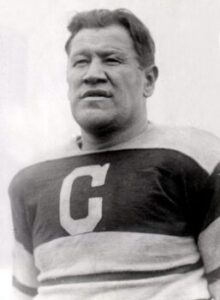
Yet this podcast is not intended to poke more holes in the mystique of Jim Thorpe, but rather to share an intriguing episode among his vast football experiences that might provide some further insight into just how popular and recognizable he was, even as his brilliant athletic career was beginning to fade.
In this episode of “When Football Was Football” on the Sports History Network, we’ll discuss the “forgotten” tour that Thorpe engineered following the 1924 season. During our research for this barnstorming adventure, much was learned about pro football scheduling, financial guarantees, team travel, opponent reliability, publicity, and local attitudes. Surely, the mere name of Jim Thorpe would warrant untold fan interest and mammoth attendance figures in an area untouched by the NFL. Or would it?
So, you may ask, what does Jim Thorpe have to do with a podcast that focuses on Chicago area football? We’ll admit it’s a stretch with a tiny connection, but a valid one nonetheless. On Thanksgiving Day in 1928, Thorpe played one game for the Chicago Cardinals, forever connecting him with pro football in Chicago. It was also his final NFL game as a player.
Our story actually begins in September of 1924 when Thorpe agreed to play for the Rock Island (IL) Independents of the NFL. He was believed to be 37 years old at this time (his actual date of birth has always been evasive).
AN INDESTRUCTIBLE FORCE
But first, for those who may not be familiar with a legendary athlete from over a century ago, what was so special about Jim Thorpe? Author David Maraniss in his extraordinary biography of Thorpe called Path Lit By Lightning, described Thorpe thusly:
“He was an Olympic champion decathlete in track and field, a football All-American, a star pro and first president of what became the National Football League, and a major league baseball player, a seemingly indestructible force who ran like a wild horse thundering downhill yet was also a graceful ballroom dancer and gifted swimmer and ice skater.”
In other words, Thorpe could do it all and was considered the world’s greatest athlete during the first half of the 20th century. He captured two gold medals in the Decathlon and the Pentathlon at the 1912 Stockholm Olympics only to be stripped of those laurels later when it was discovered that he had once accepted money for playing as a baseball minor leaguer. It would be decades later (in 1983) before the International Olympic Committee was pigeon-holed into returning the medals to Thorpe. By then, Thorpe was not around to acknowledge that recognition, having passed away in 1953 at the age of 65.
Following an All-American football collegiate career at Carlisle, Thorpe enjoyed a professional gridiron stint with several teams from 1915-1928 and also played outfield for four major league baseball teams from 1913-1919. And, of course, Thorpe was the first president of the NFL in 1920 when it was known as the American Professional Football Association and also assumed the head coaching duties for no less than four NFL teams during the 1920s.
After serving as the player-coach for the infamous Oorang Indians NFL club in 1922 and 1923, Thorpe needed to land a football job for the 1924 season when the Oorang franchise folded following its 1-10 1923 campaign. Oorang competed in the NFL for just those two seasons and it was certainly a unique concept for an early pro club since everyone on the roster was a Native American, including, and largely recruited by, Jim Thorpe himself.
Then in September of 1924, the Rock Island Independents contacted Thorpe about joining the organization for that season…and this is where our story begins. Thorpe needed a job and agreed to join this NFL outpost in Rock Island, IL, situated in the far western reaches of the State of Illinois on the Mississippi River. By the time Thorpe reached Rock Island, the community was growing rapidly and included about 35,000 residents. This number has remained consistent over the last century and in 1924, the population was considered sufficient to support an NFL team.
In addition to the positive fan base, the city also hosted an aggressive newspaper called the Rock Island Argus, which provided exceptional coverage of the local sports scene, including the Independents. Along with the Green Bay Press-Gazette, the Rock Island Argus was one of the two local newspapers in the early 1920s which provided extravagant details of their respective local NFL clubs, including game previews, inside gossip, attendance, and play-by-play reporting.
As such, both remain as tremendous research tools for investigating and documenting the first decade of the NFL. So—we thank the Argus for reporting on every step of the Jim Thorpe saga while he played for the Independents.
FANS WILL NEED TO COOPERATE
Thorpe did sign with the Independents on Saturday, September 20, 1924 amid great jubilation in the pages of the Argus: “Thorpe’s presence will greatly strengthen the Islanders’ playing machine and will be a boost for the team and the city, and in the same breath, the fans will have to cooperate by turning out to the games if this feature lineup is to be maintained.”
The Argus noted that Thorpe had finalized the contract and was driving to Rock Island from his home in Massachusetts, a journey that would take a few days to complete over rough roads with his arrival anticipated on Wednesday, September 24. However, it was expected that Thorpe would still be in the lineup against the fearsome Chicago Bears on Sunday, September 28. This would be the beginning of a very unusual season for both Rock Island and the NFL, with the league champion not coronated until January of 1925 after a few teams (including Rock Island) claimed the title at the conclusion of the regular schedule! More on that later…
For now, the invading Bears remained the focus of the Independents, even after management became a bit worried when there was no sign of Jim Thorpe on September 25. The Argus was still hopeful in its morning edition that day: “No word has yet been heard from Jim Thorpe, famous Indian athlete, who is on his way to Rock Island by auto from the east, but football officials here expect him to arrive either today or tomorrow.”
On Friday morning, there was still no communication from Thorpe but he arrived that afternoon in time to “limber up after his long journey by automobile from the east. The Indian booted punts for 60 and 65 yards down the field,” said the Argus. Thorpe added that this wasn’t his best stuff: “Haven’t got the kinks out [yet].” The newspaper also hinted that the very economic survival of the Independents depended on strong attendance for the season by stating: “A great deal of the Independents’ success depends upon the outcome of the cash.”
A record crowd of 4,000 jammed into Douglas Park in Rock Island for the opener against the Bears and witnessed the two clubs battle to a scoreless tie. Despite participating in just one practice session with his new team, the Argus reported that “The big Indian played the entire game and upset the Bears in their attack a number of times…but failed to get much distance on his punts.” During the contest, Thorpe completed a pass for 35 yards and returned a blocked field goal for 25 yards, but Rock Island was unable to capitalize offensively.

THORPE PROVIDES DINNER!
Throughout the season, Thorpe was not an overwhelming offensive threat, but his heady presence on defense and his often-booming punts helped the Independents to a 5-2-2 mark in the NFL. There were no complaints about Thorpe’s lack of offensive fireworks since his mere presence seemed to spark both the team and the town.
Certainly, Thorpe provided some thrills, such as his 40-yard pass reception against the Racine Legion, his game-tying field goal in a 3-3 deadlock with the Bears, his long touchdown pass in a win over Dayton, or his numerous deep punts throughout the season. Above all, he remained a smart and punishing defender. However, a shoulder injury collapsed his individual efforts during the final part of the schedule when he missed games against Kenosha, Clinton, and the Chicago Bears.
But that did not stop Thorpe from being a key contributor to a season-ending “banquet” hosted by the Rock Island Elks where the main course was mouth-watering roast racoon. The Argus reported, quite seriously, that nine of the animals served at the event were shot by Mr. Thorpe!
A final contest in 1924 was held in Chicago on December 14 against the Bears, who already claimed the NFL title on the basis of defeating the Cleveland Bulldogs 23-0 on December 7. When Rock Island, without Thorpe in the lineup, knocked off the Bears 7-6 a week later, the Independents figured that since they had beaten the NFL champion Bears, they were now the league titlists! But, these games were played in the days before playoffs and the Super Bowl, and the league champion was based on the regular season results from games held before the final deadline date of November 30.
As such, any results from games staged after November 30 were eventually thrown out by the league and Cleveland was anointed as the 1924 NFL champion.
GREATEST SPECTACLE EVER SCHEDULED IN HOUSTON
Just a day after the satisfying win over the Bears in Chicago, Thorpe and his Rock Island teammates began the first leg of the tour by grabbing a train headed for Houston on December 15 at 11:50 pm. After a stop in St. Louis, the players continued their journey to Texas on the International Great Northern while an excited media storm was brewing in Houston, where the professional game remained largely invisible.
The Houston Chronicle gushed: “There isn’t a high school player in this district who has not heard of the wonderful deeds of Jim Thorpe. Thorpe was in fact what Frank Merriwell was in fiction. For a football attraction and spectacle this game greatly outranks anything ever scheduled in Houston.” The excitement and anticipation for the game was so intense, that an additional 1,500 bleacher seats were installed at the West End field, site of the game scheduled for Sunday, December 21.
Yet the ball game proved to be a big risk for the Houston promoters since players from the host Texas All-Stars were promised $2,500 to participate in the contest, according to the Houston Chronicle. On the other side, Thorpe elected to receive one third of the net gate receipts which would result in a wonderful pay day with an expected robust attendance.
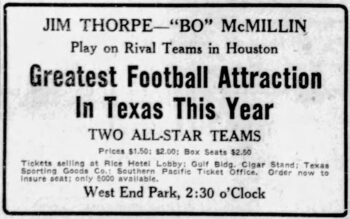
The presence of Thorpe and his teammates in Houston was such a big deal that a huge welcoming committee, including the mayor of Houston, was on hand to greet the team’s arrival on Wednesday, December 17 at 2:30 pm and to present Thorpe with the honorary “keys to the city.”
Thorpe also learned that his upcoming opponent (the Texas All-Stars) was loaded with local talent and would be a tough challenge for the Independents, prompting Coach Thorpe to warn his players: “That’s a bunch of great football stars we will face Sunday, boys, and we’ve got to knuckle down.”
While preparing for the game in Houston on December 21, Thorpe was also planning for upcoming contests in New Orleans on December 25 and San Antonio on January 1, and scrambling to add more dates including battles in Austin and Galveston. With the huge amount of media coverage and continued warm weather, the immediate future for a successful financial tour appeared to be very positive.
But then the clouds rolled in…literally.
DUMPED RUDELY ON THE TURF
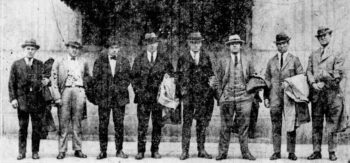
The warm weather of the previous week vanished as a steady rain began two days before the game but failed to damper the enthusiastic practices of the Independents. The Houston Chronicle marveled at the 75-yard punts Thorpe unleashed in practice while the newspaper also located a local resident named George Gardner who played with Thorpe during his collegiate days at Carlisle.
Gardner issued a subtle warning about the strength of Thorpe when he was running the ball, stating: “If the Texas players don’t duck their heads when they attempt to tackle Thorpe, they are likely to find themselves stopped suddenly by his straight arm and dumped rudely on the turf.”
As the rain continued, and then turned to sleet, it was decided to postpone the Houston game until December 28. Thorpe was likely disappointed by the delay, but understood that poor weather would limit attendance at the game. The chore of feeding and housing the Rock Island contingent required money and Thorpe hoped to recoup some quick cash by scheduling more games in the area.
He also recognized that a layer of snow or sleet would likely never affect a football game in the northern part of the country. Instead, he gathered the team together, and moved his operation 85 miles for a game in Beaumont, TX on December 25.
Rock Island would face the Port Arthur Pirates, a club with limited talent but a great assortment of nicknames, such as “Bull” Johnson, “Rats” Watson, and “Slippery” Elam. As it turned out, Rats and Slippery were an easy foe for Rock Island in a 32-0 rout played on a frozen field. Thorpe generated his own type of chaos for the over-matched Pirates when he scampered 75 yards for the first score.
The Rock Island Argus kept the home fans informed of the club’s progress and proudly noted Thorpe’s successful run: “Jim Thorpe kept up his reputation as one of the greatest athletes in history when he tore off a 75-yard run through a broken field early in the game. From that time on, Rock Island had things nearly its own way.
The southern fans are all excited over Thorpe and his outfit and…the game was a revelation to fans in the southern part of Texas who are firmly convinced that the name Rock Island is a brand for a grade of football not found elsewhere in the United States.”
Although exact attendance figures were not published, the Houston Chronicle described the weather conditions: “The game was played in a freezing temperature. Despite the cold, a big crowd saw the engagement and marveled at the dexterity of Thorpe and his brother backfield men.”
With a bit of cash in hand from the Beaumont game, Thorpe retreated back to Houston immediately after the clash to prepare for the postponed battle with the Texas All-Stars, now scheduled for Sunday, December 28. Lengthy articles, large photos, and insight on both teams dotted the Houston newspapers with the Houston Post declaring that the game “promises to put before the Houston fans a number of the greatest football players the world has ever known.”
PRO FOOTBALL IS A COLORLESS IMITATION
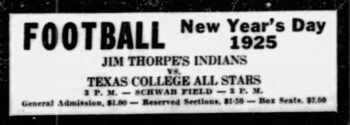
The game itself was a bit lifeless and was played before a tiny crowd of just 1,500 as the Independents prevailed 13-6. The small attendance wasn’t the only hurtful part of the day’s activities as Thorpe reinjured his shoulder and played in only the first quarter. Reporter Kelly Cousins of the Houston Post was not impressed: “The 1,500 fans who saw Jim Thorpe’s pro gridders defeat a team of All-Stars were convinced that professional football is but a colorless imitation of the great college sport.”
The Houston Chronicle was a bit more realistic in its assessment of the game: “From the standpoint of football, the game was a success. From the standpoint of finances, it was a bust. Not more than 1,500 paying customers were present. The receipts were not sufficient to pay the expenses.”
Nevertheless, the Rock Island crew quickly moved about 200 miles west to San Antonio for a battle with the San Antonio Southern Collegians on January 1st. As an added incentive for those in attendance, the promoters scheduled a walking race before the game between Andrew Hill and Andrew Lightfoot.
The San Antonio Light newspaper perfectly described the event as “The two heel-and-toe walkers who have been engaged in a controversy for many weeks, [will] meet in a mile race, or longer, before the game.” Alas, on the big day, one of the walkers failed to show up as did many of the expected spectators, as only 2,700 were in the crowd to witness Rock Island’s easy 14-0 victory.
Thorpe played little because of his shoulder, but finally did explain the extent of his injury to the Light newspaper: “I fractured the shoulder four or five weeks ago and hurt it again the other day. It aches a little this morning, but I feel fine otherwise.” By this time, the local media also noticed that only 13 players were included on the Rock Island roster. “We don’t need a lot of substitutes,” Thorpe calmly explained.
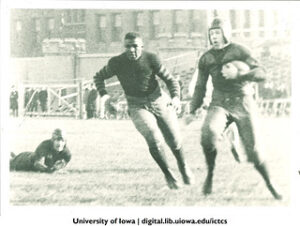
What was most glaring of that number, however, was who was not there—and that would be versatile tackle Duke Slater. The big tackle, who was an All-American at Iowa, was dominant in the pro ranks as well, already grabbing All-Pro honors in 1923 and 1924. Slater would finally be inducted into the Pro Football Hall of Fame in 2020.

KANSAS CITY OFFICIALS PROTESTED SLATER
Yet following the 1924 season, Slater was not among those from the Rock Island roster who would join Thorpe for the southern adventure. The reason for this might likely be traced to the lone game that Slater missed during his lengthy NFL career. On November 16, 1924, undefeated Rock Island traveled to Kansas City for an NFL game against the Blues.
In an embarrassing and regrettable decision, Kansas City refused to take the field unless Slater (an African American) was prohibited from playing. Rock Island apparently chose not to dispute this ugly demand and the game proceeded with the Independents, without Slater, suffering their first defeat of the year 23-7.
There was nothing testy or even a suggestion of impropriety about this situation in either the Rock Island or Kansas City newspapers, with the Kansas City Times simply stating: “The Rock Island players said if Duke Slater, former Iowa Negro tackle, had been allowed to play, the results would have been different. Kansas City officials protested before the contest and Slater did not put on a uniform.”
A few weeks later on November 16, with Slater on the home gridiron, Rock Island blasted the Blues 17-0. His decision to not join Thorpe on the southern trip was the result of the ugly Kansas City incident according to Neal Rozendall, the author of Slater’s biography: “Football fans that saw ‘Jim Thorpe’s Rock Island National Champions’ in Texas were deprived of seeing the whole team in action. Duke Slater stayed behind and didn’t accompany the team on their holiday tour, owing to racial conditions in the South.
It seems somehow fitting that abhorrent racial conditions prevented southern fans from seeing the full roster of the so called ‘national champions’ in action, since those same prejudices in Kansas City likely cost Rock Island a shot at a proper NFL championship in the first place.”
Without the star power of Slater present, the tour still featured Thorpe, Joe Little Twig, and Joe Guyon, all Native Americans who played at Carlisle and with the 1924 Independents. But word of Thorpe’s shoulder injury and limited playing time may have hindered gate receipts even further. The San Antonio Light evidently approved of the gridiron event: “Thorpe with his crippled shoulder, could play only a quarter. But those who came out to see the spectacle of 22 big men driving each other with grunts and the slithering of canvas and the thudding collision of hard-thrown bodies got their money’s worth.”
THORPE WILL APPEAR IN HAVANA
Along with the poor attendance in San Antonio on January 1, 1925, Thorpe also learned that the previously scheduled game in New Orleans on January 4 had been cancelled due to the failure of the host management to field a competitive team. Most likely, there was the fear of a financial disaster if the weather or the absence of Thorpe on the field influenced ticket sales.
In response, Thorpe attempted to schedule a replacement game in Fort Worth, but nothing was arranged. Still, the Rock Island Argus declared that after the San Antonio rout, “Thorpe and his team will also appear in games at Waco, Tulsa, New Orleans, and Tampa and will wind up their tour in Havana.” Word of the New Orleans cancellation must not have reached Rock Island at the time. Other than that, the tour provided great publicity for Rock Island, or so said the Argus:
“It is publicity for Rock Island that could not be purchased with dollars.” The home town media also padded the financial success of the tour, claiming that 10,000 showed up for the game in Houston when, in reality, the local head count was just 1,500.
Following the San Antonio appearance on January 1, Thorpe led his team down to Galveston seeking a fourth straight win on the tour in a battle with the local Hurricanes on January 3, 1925. As an extra added attraction, according to the Galveston Daily News, Thorpe promised to “give an exhibition of kicking and passing, exhibiting the various tricks he employed while earning fame with the Carlisle eleven.”
Although Rock Island swept past the Hurricanes 18-0, a wild band of rain showers blanketed the area throughout the day and turned the field at School Park into a muddy mess. Thorpe did not make an appearance during the game, disappointing the crowd on 2,000.
At this point, with no further games scheduled despite the optimistic outlook for games in several states and in Cuba, Thorpe and his cohorts decided to pull the plug on the tour. The loyal Rock Island Argus understood the importance of the bottom line in announcing the end of the football journey on January 5, 1925:
“The Islanders trip through the south was successful as far as football was concerned, coming through with four victories and outclassing every team on the short schedule, but from a financial standpoint the boys did not reap any great harvest.”
And so, the ambitious tour ended, haunted by surly weather, indifferent fans, and difficult scheduling. In the four wins, Rock Island outscored its opponents 77-6, but played in front of crowds likely averaging less than 2,000 at each outing.
The Fort Worth Star-Telegram summarized the failed Thorpe excursion by stating: “It is too late in the season for one thing. Then football does not draw as well in Texas as in the east and promoters were afraid a pro game would not attract a big gate.”
However, the Thorpe tour did set a precedence, at least in spirit. A year later, the Chicago Bears and their gifted, prized player, Red Grange, would crisscross the country on two tours, opening eyes and attracting huge crowds in both the south and the west in a much more successful introduction to professional football. It was pioneers such as Thorpe and Grange that opened up the NFL to an entire new audience.
As for the ageless Thorpe, newspapers along the way during the Texas journey marveled at his fitness and endurance. He would continue to find spot football roles in the future, showing up briefly back in Rock Island in 1925 before winding things up with the Cardinals for that lone game in 1928. It seemed that life on the field was endless for the mighty Jim Thorpe, or as the San Antonio Light predicted in early 1925:
“Thorpe started at Carlisle way back in 1907. He has no other plans to spend his winters [other] than playing football until 1970!”
Thank you for joining us for this episode of “When Football Was Football” here on the Sports History Network.
Author and Host - Joe Ziemba
Joe Ziemba is the host of this show, and he is an author of early football history in the city of Chicago. Here, you can learn more about Joe and When Football Was Football, including all of the episodes of the podcast.

Joe Ziemba Books
Please Note – As an Amazon Associate I earn from qualifying purchases
Resources
More From When Football Was Football
Big Jim Thorpe’s Forgotten Football Vacation
It was December of 1924 when Big Jim Thorpe of...
Read More
Searching for the “Zest” of the 1931 Chicago Bears
Throughout the history of professional football, every so often you...
Read More
Ugly Passers, Brick Walls, and Feisty Cardinals
Since the Arizona Cardinals are the NFL’s oldest team, with...
Read More
The NFL’s Forgotten Gold Medalist!
As usual during the staging of the Summer Olympics, numerous...
Read More