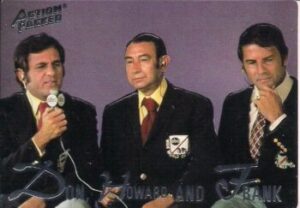
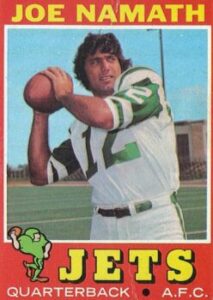

On September 21, 1970, the first Monday Night Football game featured the 1964 NFL Champion Cleveland Browns defeating the 1968 Super Bowl Champion New York Jets 31–21. Keith Jackson handled the play-by-play (replaced by Frank Gifford in 1971), while the laid-back Don Meredith and the often controversial Howard Cosell provided the color commentary.
My brother and I would watch the game with our father until halftime, when he would send us to our bedroom. We always looked forward to halftime because they would show highlights of the previous day’s games. There wasn’t 24-hour news coverage or ESPN back then, so Monday Night Football might have been your only chance to see those highlights.
On the East Coast, where we lived, the game didn’t start until 9:00 pm, but our parents were generous about letting my brother and me stay up late to watch sports, especially Monday Night Football. We would watch the rest of the game on our little black-and-white TV. There were two rules, though: keep the volume and noise level down, and when the alarm went off to wake us for school, you’d better be awake. We always got up because we knew if we didn’t, that would be the end of Monday Night Football for us.
I was eight years old in 1970, so I was there from the start. It’s hard to remember every game, and I’m sure I fell asleep during more than a few, but here’s a list of the Monday Night games that really stand out in my memory.
1970
Week Two: The defending Super Bowl Champion KC Chiefs defeated the eventual 1970 Champions, the Baltimore Colts. What was supposed to be a competitive game between two elite teams turned into a blowout, as the Chiefs led 31–0 in the second quarter. The Colts turned the ball over seven times and looked nothing like a team that would go on to win the Super Bowl. The final score was Kansas City 44, Baltimore 24.
Week Six: The defending NFL Champion Minnesota Vikings faced the Los Angeles Rams. It was a rematch of the 1969 playoff game, which the Vikings won 23–20. This Monday Night game was a tough defensive contest, and the Vikings emerged victorious, 13–3. The two teams combined for only 17 first downs and 272 total yards.
That night also featured the fight between Muhammad Ali and Jerry Quarry. It was Ali’s first bout in three and a half years, following his suspension from boxing. Cosell, who had a close relationship with Ali, provided updates on the fight during the game. The referee stopped the fight in the third round after Quarry suffered a severe cut that wouldn’t stop bleeding.
Week Nine: The Cardinals crushed the Cowboys 38–0. Rooting against the Cowboys hadn’t become common yet in 1970, so the only fans who enjoyed this game were those living in St. Louis. It’s only memorable for me because I was a Cowboys fan, and I couldn’t believe how badly my team played.
They turned the ball over six times and allowed the Cardinals to rush for 242 yards. After this game, the Cardinals led the Eastern Division with a 7–2 record. The Cowboys trailed two games behind with a 5–4 record. However, the fortunes of these two teams changed after this game. The Cardinals won only one of their last five games, while the Cowboys went on a seven-game winning streak before losing to the Colts in the Super Bowl.
Week Ten: The Philadelphia Eagles upset the New York Giants 23–20 at Franklin Field. I’m unsure of the reason for this matchup, as both teams had a poor season in 1969. The Eagles finished the 1969 season with a 4–9–1 record, while the Giants finished with a 6–8 record.
The Giants ended the 1970 season with a 9–5 record, narrowly missing a playoff berth, while the Eagles finished with a dismal 3–10–1 record. The only reason the game was memorable is that Howard Cosell appeared to be intoxicated and started slurring his words. Cosell became ill at halftime and did not return to the booth for the second half. Cosell denied being drunk, stating that his illness was due to an ear infection.
1971
Week Six: The defending Super Bowl Champion Baltimore Colts faced off against the Minnesota Vikings at Memorial Stadium. Both teams boasted arguably the best defenses in the NFL, so little scoring was expected. Before the game, a moment of silence was held for Chuck Hughes, a wide receiver for the Detroit Lions who died of a heart attack during a game against the Chicago Bears the day before. The Colts outgained the Vikings 276 yards to 153, but the Vikings were opportunistic and capitalized on the Colts’ mistakes, which included three turnovers. The final score was Minnesota 10, Baltimore 3.
Week Thirteen: The Washington Redskins defeated the L.A. Rams 38–24. The combination of Billy Kilmer and Roy Jefferson, both acquired in off-season trades, was too much for the Rams’ defense. Jefferson caught eight passes for 137 yards and two touchdowns. Kilmer completed 14 of 19 passes and threw for three touchdowns. The victory was sweet revenge for Redskins Coach George Allen, who was fired after five successful seasons as the Rams’ coach. The win knocked the Rams out of playoff contention. The Redskins made the playoffs as a wild-card team before losing to the SF 49ers.
1972
Week Three: The Oakland Raiders’ matchup against the Houston Oilers was a complete mismatch. The Oilers’ offense was utterly inept, gaining just 89 yards and throwing five interceptions. Oakland easily won with a score of 34–0. The Oilers only won one game all season. The only reason this game was memorable was that Don Meredith made everyone laugh with his quick wit. Near the end of the game, TV cameras showed an almost empty Houston Astrodome. The camera zoomed in on a lone Oilers fan, who lifted his middle finger at the camera. Meredith quickly responded, “They’re number one in the nation.”
Week Thirteen: The NY Jets traveled to Oakland needing a win to stay in the wild-card race. The Raiders had already secured first place in their division, ensuring a playoff spot. The Jets led 13–10 at halftime, but Oakland dominated the second half, winning 24–16. Joe Namath, who earned the Comeback Player of the Year award, threw for over 400 yards. Near the end of the game, backup quarterback Bob Davis replaced Namath. As Broadway Joe jogged off the field, Raiders fans gave him a standing ovation. Namath’s teammate, Don Maynard, caught seven passes for 131 yards, breaking Raymond Berry’s record of 631 career receptions.
1973
Week Two: The Dallas Cowboys’ matchup against the New Orleans Saints was another mismatch. Apparently, the NFL didn’t learn from the Raiders versus Oilers debacle in 1972. Before the game, sports commentator Jack Whitaker was asked for his opinion on the mismatch. Whitaker said he believed in the old saying that on any given Sunday, any NFL team could beat another, but today is Monday. This game was only enjoyable if you were a Cowboys fan, which I was. The only memorable aspect of this game was that it marked Coach Tom Landry’s 100th win. Dallas won 40–3.
Week Four: The game between the Dallas Cowboys and Washington Redskins at RFK Stadium was highly anticipated for two reasons. First, it was the fiercest rivalry in the NFC, and second, it was a rematch of the 1972 NFC Championship Game, which Washington won 26–3. Dallas wanted revenge, and it looked like they might get it as they clung to a 7–0 lead in the fourth quarter. But the Redskins weren’t done yet. Led by veteran quarterback Sonny Jurgensen, Washington tied the game at 7–7. Moments later, Craig Morton, who came off the bench to replace the injured Roger Staubach, was intercepted by safety Brig Owens, who ran 26 yards for a touchdown.
The Cowboys responded and drove the ball downfield to the Redskins’ four-yard line with only 29 seconds remaining. On fourth down, Morton threw a three-yard pass to Walt Garrison, but just as Garrison was about to cross the goal line, he was grabbed from behind by safety Ken Houston. The Houston tackle of Garrison is one of the most memorable moments in Monday Night Football history. The Cowboys led in the statistics, running 71 plays compared to the Redskins’ 48. They outgained the Redskins 269 yards to 174, but ultimately lost the game, 14–7.
Week Twelve: In another highly anticipated rematch from the previous season, the Miami Dolphins hosted the Pittsburgh Steelers. Miami had defeated Pittsburgh in the 1972 AFC Championship 21–17. With Terry Bradshaw nursing a shoulder injury and backup Terry Hanratty out with a wrist injury, Coach Chuck Noll started third-string quarterback Joe Gilliam. Gilliam threw seven passes, four of which were incomplete, and three were intercepted.
Terry Bradshaw entered the game with a score of 20–0 in favor of Miami. Bradshaw’s first pass was intercepted and returned 38 yards for a touchdown. Anderson also scored the game’s first touchdown on a 27-yard interception return. By halftime, the Dolphins led 30–3! But the Steelers stormed back in the second half to narrow the gap to 30–24. With just over a minute left in the game, the Dolphins faced a fourth down at their five-yard line. Instead of risking a blocked punt, the Dolphins chose to take a safety.
Punter Larry Seiple may have saved the game for Miami by booming a 72-yard punt that went into the end zone. Rather than settle for a touchback, Glen Edwards returned the ball to the seven-yard line. Bradshaw completed one pass, but with thirty seconds remaining, Jake Scott intercepted a tipped pass, ending the game. The Dolphins’ offense was unremarkable, gaining just 189 yards. However, the Miami defense intercepted six passes, with four coming from Dick Anderson. The Dolphins concluded the season by winning their second consecutive Vince Lombardi trophy.
Mark Morthier is the host of Yesterday’s Sports, a podcast dedicated to reliving memorable sports moments from his childhood days and beyond. He grew up in New Jersey just across from New York City, so many of his episodes revolve around the great sport’s teams of the 70s for the New York area.
He is also an author of No Nonsense, Old School Weight Training (Second Edition): A Guide for People with Limited Time and Running Wild: (Growing Up in the 1970s)
BOOKS BY MARK MORTHIER
Please Note – As an Amazon Associate I earn from qualifying purchases
More From Yesterday's Sports
Monday Night Football Early Years (1979 – 1984)
Before we jump into Monday Night Football from 1979 thru...
Read MoreMonday Night Football Early Years (1974 – 1978)
Before we jump into Monday Night Football from 1974 thru...
Read MoreMonday Night Football Early Years (1970 – 1973)
On September 21, 1970, the first Monday Night Football game...
Read More1973 Atlanta Falcons – Best Season In First Decade Of Existence
The Atlanta Falcons joined the NFL as an expansion team...
Read More