
The 1978 NFL season incorporated a bunch of changes that resulted in important changes across the league. Several brand new rules opened up the pro passing game, which resulted in more yardage accumulation and more scoring by virtually every team. Those new rules changes were big in and of themselves.
Then came the advent of an extra playoff team in each conference, meaning that a total of five teams in the AFC and five teams in the NFC made the playoffs. Those extra two playoff teams led to the birth of the NFL’s very first Wildcard Weekend on the weekend after the regular season.
SOME BENEFITS OF WILDCARD WEEKEND
Benefits abounded from this idea. First, those two extra playoff teams would enjoy the opportunity to finally make the postseason tournament, where in past seasons, they would not have been able to play in a playoff game.
Two, each of the division winners in both conferences would get an extra week off immediately following the regular season. That extra week of not doing a bunch of active hitting would – at the very least – help give a much needed rest to many of the injured or banged up players from those division winning teams.
Finally, having an extra wildcard team in each conference would be an incentive for all of the teams to play great football all throughout the regular season, because a division title and/or a playoff berth could be earned in the final game of the regular season.
Speaking of the final game of the regular season, in 1978, the league increased its number of regular season games from the previous 14 games to 16 games. That meant that there would still be a chance for all of the NFL teams to obtain winning records.
LEADING UP TO WILDCARD WEEKEND
Here’s how the league’s first wildcard weekend of 1978 worked out. You had your three division winners in the AFC and NFC Eastern, Central, and Western divisions making the playoffs and getting a bye during the wildcard weekend.
Then you had the team with the next two best records in each conference be named the two wildcard teams of each conference. It may seem a bit confusing, but trust me, it was no more confusing than what we saw in pro football in previous seasons.
The two wildcard teams in the NFC in 1978 were the Philadelphia Eagles and the Atlanta Falcons. The two wildcard teams in the AFC were the Miami Dolphins and the Houston Oilers. Those four teams’ regular season records and the tie-breaking procedures all had a say in which two of those four teams would be the home teams in the wildcard weekend of 1978.
NFC WILDCARD GAME
Let’s start with the NFC, because that wild card game was scheduled as the earlier game on December 24, 1978. Both the Eagles and the Falcons finished the regular season with identical 9-7 records. But because Atlanta had a slightly better record against common opponents, the NFC Wildcard Game in 1978 would be played in Atlanta’s Fulton County Stadium.
In that game, Philly took a 13-0 lead into the fourth quarter. But the Falcons had been a comeback team all year long, and they responded by scoring a pair of touchdowns and a pair of extra points to edge the Eagles, 14-13.
AFC WILDCARD GAME
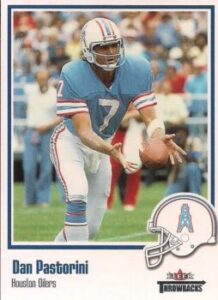
In the AFC, Miami finished the 1978 regular season with a record of 11-5. The Houston Oilers had the next best mark in the conference at 10-6. As a result, the wildcard game between the Dolphins and the Oilers would be played in Miami’s Orange Bowl. This was another tight contest as both teams were tied at 7-7 going into the fourth quarter. But behind 306 passing yards by Houston quarterback Dan Pastorini, the Oilers dominated the fourth quarter and came away with a 17-9 victory.
The NFL’s first truly wildcard weekend in 1978 would serve as the origin of how the league’s playoff format would run for several decades, until expansion and the relocation of teams into different divisions eventually brought about an increase in the number of playoff teams and further changes in the playoff format.
Trivia Question:
Which Atlanta Falcons player scored the very first touchdown in their playoff game against the Eagles in 1978?
Although its not much of a hint, it was the very first touchdown in playoff history for the Falcons.
Please Share If You Liked This Article
Host of Pro Football in the 1970s - Joe Zagorski
Throughout his days, Joe spent some time as a sportswriter and has been a member of the Pro Football Researchers Association since the mid-1980s. Joe is also a proud member of the Pro Football Writers of America.
Joe Zagorski Books on Amazon
From the Outhouse to the Pethouse: The Football Journey of Hall of Famer Larry Little
Free Spirit at Free Safety: The Incredible (but True!) Football Journey of Bill Bradley
The 2,003 Yard Odyssey: The Juice, The Electric Company, and an Epic Run for a Record
America’s Trailblazing Middle Linebacker: The Story of NFL Hall of Famer Willie Lanier
The Year the Packers Came Back: Green Bay’s 1972 Resurgence
The NFL in the 1970s: Pro Football’s Most Important Decade
Please Note – As an Amazon Associate I earn from qualifying purchases
Music from https://www.purple-planet.com/
More Posts From Pro Football In The 1970s
Remembering the First Wildcard Weekend of the 1970s
The 1978 NFL season incorporated a bunch of changes that...
Read MoreThe Oakland Raiders Depth at Tight End During the 1970s
The Oakland Raiders experienced a good degree of glory during...
Read MoreThe Escape from New York for Hall of Famers During the 1970s
There was a semi-famous movie that came out in 1981...
Read MoreLarry Csonka and Larry Brown – They Took a Licking but Kept on Ticking
In the 1970s, John Cameron Swayze would advertise Timex wristwatches...
Read More