Eight Chicago White Sox players threw the 1919 World Series, and baseball responded by inventing a job that had never existed before.
A century later, in October 2025, federal prosecutors charged 34 people in a sweeping investigation into insider betting and Mafia-backed poker games, with a sitting NBA head coach and an active player among them.
The details change. The shape of the story almost never does.
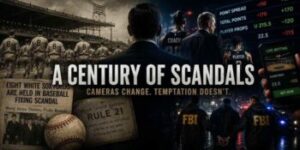
The Fix That Created A Commissioner
Before 1919, baseball was governed by a three-man National Commission that answered to the owners. After the Black Sox, the owners handed near-absolute power to a single federal judge, Kenesaw Mountain Landis, and told him to make the problem go away.
He banned eight players for life in 1921, including Shoeless Joe Jackson, despite a jury acquitting them. The message was that the sport’s survival mattered more than the legal verdict.
What followed was Rule 21, still printed and posted in every major league clubhouse today. Bet on a game you are involved in and you are gone permanently, no appeal, no nuance.
That single scandal produced the template every league still uses. Centralised authority, a written rule everyone can see, and punishments harsh enough to be theatrical.
Europe Wrote Its Own Version Of The Same Story
British football learned the lesson forty years later. A Sunday People investigation in 1964 exposed a betting ring built around a 1962 fixture, and ten players were jailed in 1965, among them Sheffield Wednesday’s Peter Swan, David Layne and Tony Kay, an England international at his peak.
They were banned for life. The bans were eventually lifted in 1972, by which point the careers were gone anyway.
West Germany followed in 1971 with a Bundesliga fixing scandal that ended in points deductions and licence withdrawals. Referee Robert Hoyzer went to prison in 2005 for manipulating matches he had bet on, and Calciopoli stripped Juventus of two titles in 2006.
Different countries, identical pattern. Something breaks, the governing body discovers it needs a rulebook, and the rulebook is written in the language of the last disaster.
Scandal Year What it produced
Black Sox World Series fix 1919 Independent commissioner and Rule 21
English football betting ring 1962-65 Criminal convictions, lifetime bans
Bundesliga fixing scandal 1971 Points deductions, licence withdrawals
Tim Donaghy, NBA referee 2007 Overhauled officiating oversight
Jontay Porter 2024 Lifetime ban, monitoring-led detection
Federal indictments, NBA and MLB 2025 Bet-type limits, injury reporting reform
The Scandals Rarely Start In The Regulated Market
Here is the part that gets flattened in most retellings. The 1919 fix ran through underworld gamblers, the 1960s British ring through illegal bookmakers, and the 2025 cases through unlicensed operations and organised crime.
Modern detection has largely worked the other way round. Jontay Porter was banned for life in 2024 after licensed sportsbooks and a betting-monitoring organisation flagged unusual activity on his prop lines — the legal market reported the anomaly that the illegal one had every reason to hide.
That distinction sits on regulation. Licensed operators are audited, must verify identity and feed data to integrity monitors, and the licence itself is issued country by country. A player comparing online casino Slovenia sites is dealing with national concession law, FURS oversight and mandatory deposit limits, which is a different universe from a bookmaker taking cash in a back room.
None of which makes the legal market harmless. It does mean that when historians write about fixing, the villain is almost always the unregulated corner of the industry.
Then Sport Started Taking The Money Directly
The stranger chapter is how quickly leagues went from banishing gamblers to banking their sponsorship cheques.
The Supreme Court struck down the federal ban on sports betting in 2018, and the American market has expanded relentlessly since. Shirt sponsorship, official betting partners and in-broadcast odds arrived within a few seasons.
English football went furthest fastest, and is now partially reversing. Premier League clubs agreed to remove gambling brands from the front of shirts from the 2026-27 season, though the money remains everywhere else in the stadium. The commercial history behind that decision is worth reading in full, and this breakdown of Premier League casino sponsorship traces how deep the relationship actually runs.
The Rules Are Being Rewritten Right Now
What makes this moment worth documenting is that the reforms are happening in real time rather than in retrospect.
Cleveland Guardians pitchers Emmanuel Clase and Luis Ortiz were arrested in November 2025 over bets placed on individual pitches they threw, and MLB responded by pushing sportsbooks to cap live micro-betting markets and bar them from parlays, while the NBA overhauled its injury reporting rules. In January 2026, prosecutors charged 26 people over alleged fixing in college basketball.
Sport has essentially concluded that some bet types are indefensible. That is the 2020s equivalent of appointing Landis.
What A Century Of This Actually Teaches
- The prop bet is the modern fix. You no longer need to lose a game, only to leave one early, which makes detection harder and temptation cheaper.
- Punishment follows exposure, never prevention. Every rule in the book exists because somebody had already broken something.
- Insiders are the weak point. Injury news, lineup plans and rest decisions have always been the commodity, from 1919 to last season.
- Forgiveness eventually arrives. In May 2025 MLB removed Pete Rose, Shoeless Joe Jackson and 15 other deceased individuals from its permanently ineligible list, making them eligible for consideration by the Classic Baseball Era Committee when it next votes in December 2027.
Rose was banned in 1989 for betting on games he managed. If he is enshrined in 2028, the sport will have spent 109 years deciding what to do about gambling and arrived at something short of an answer.
Which is, in fairness, exactly what the last century predicted.