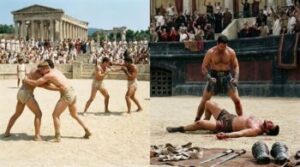
Ancient Greeks transformed raw violence into a structured cult. In 708 BC, the introduction of wrestling (pale) to the Olympic Games marked a shift where physical dominance became a path to divine status. Combat was not a hobby but a civic duty that prepared men for the phalanx.
Over several centuries, these disciplines moved from the dusty arenas of Olympia to the stone colosseums of the Roman Empire, trading athletic philosophy for pure spectacle.
The Science of the Clinch: Pale
Wrestling was considered the most technical and “civilized” of the three major combat sports. Victory required a “triakter,” meaning an athlete had to throw his opponent to the ground three times. There were no weight classes. A 130 kg giant could face a technical middleweight, relying on leverage rather than mass.
The sport functioned as a laboratory for physical training. Coaches, known as paidotribai, monitored every move with long forked sticks. They used these to strike any athlete who attempted to bite or gouge eyes. The evolution of training methods led to the creation of the first sports science. Milo of Croton, a legendary wrestler, developed the concept of progressive overload by carrying a growing calf on his shoulders every day until it became a full grown bull.
As betting on these contests became a staple of Mediterranean culture, the stakes for athletes rose. Fans often looked for an edge by analyzing previous performances, much like modern enthusiasts check the best online casino Greece for current sport event betting lines. This transition from amateur honor to professional gambling infrastructure began in the late Hellenistic period.
The Bloody Edge: Pygme
Boxing (pygme) saw the most drastic change in equipment. Early Greek boxers used “himantes,” which were soft leather strips made from ox hide. These four meter long wraps were designed to protect the fighter’s knuckles and wrists rather than the opponent’s face. By the 4th century BC, the “oxys” or sharp thongs replaced them. These featured a hard leather ring around the knuckles that acted like a blade, slicing skin upon impact.
Roman influence turned the boxing glove into a lethal weapon. They introduced the “caestus,” a glove reinforced with lead plates, iron studs, and spikes.
- Himantes: Soft wraps used for knuckle stability in early Olympiads.
- Oxys: Hardened leather rings designed to cause deep lacerations.
- Caestus: Roman combat gloves loaded with metal to ensure one hit kills.
- Korykos: Primitive heavy bags filled with sand or fig seeds for power training.
A famous case of defensive mastery was Melankomas of Caria. He allegedly won an Olympic title without ever striking a blow or being hit. He used superior footwork and head movement to exhaust his opponents until they surrendered from sheer frustration.
Pankration: Total War
Pankration was a blend of boxing and wrestling with almost zero restrictions. Only biting and eye gouging were forbidden. The goal was to force a submission, signaled by the loser raising a single index finger. It was the most popular event because it represented the “perfect” fight.
- Kato Pankration: Ground fighting involving joint locks and chokes.
- Ano Pankration: Standing combat focusing on kicks to the stomach.
- Klimakismos: A specialized technique where a fighter climbed onto the opponent’s back to apply a rear naked choke.
One of the most intense recorded moments occurred in 564 BC. Arrichion of Phigalia was being strangled in a chokehold. As he lost consciousness, he managed to snap his opponent’s ankle. The opponent surrendered just as Arrichion died. The judges declared the corpse the winner, making him the only dead Olympic champion in history.
From Sacred Sand to Roman Stone
The Roman era stripped away the Greek ideal of “arete,” which meant excellence or virtue. Romans viewed sports through the lens of “spectacula.” They wanted professional entertainment. While Greeks fought for a crown of olive branches, Roman era professionals fought for massive purses or their freedom.
The venue changed from the open air “stadion” to the enclosed amphitheater. This psychological shift meant the audience was no longer watching a religious ritual. They were watching a commodity.
The “palaestra,” or training ground, became a high pressure facility where diet and “pharmaka” (herbal stimulants) were strictly regulated to maximize the violence for the crowd. Every choke, every broken finger, and every drop of blood was calculated to satisfy a public that demanded more than just a fair fight.
Please Note – As an Amazon Associate I earn from qualifying purchases
More Combat Sports Articles
Blue Corner Pro Boxing Returns to Kansas City in January 2026
Kansas City fight fans are preparing for a major moment...
Read MoreMuhammad Ali’s Chin: Knocked Down Only 4 Times

Muhammad Ali’s boxing career is well documented, so instead of...
Read MoreA Lamb to the Slaughter (WWE Superstar – Sergeant Slaughter)

There’s a reason there’s never been a mainstream movie about...
Read MoreWrestling With Andre: A Parody of My Dinner With Andre

I am a big fan of the 1981 film My...
Read More