Every contest rests on a single fragile assumption: that the result was honest. From the moment humans started competing for glory, they ran into the same problem — how do you prove the outcome wasn’t fixed, miscounted, or quietly rigged? The history of sport is, in large part, the history of answering that question. Here’s how the games we love built trust, scandal by scandal and invention by invention.
The Ancient Oath at Olympia
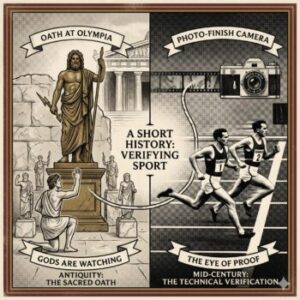
The ancient Greeks took fairness seriously enough to make it sacred. At the Olympic Games, athletes, their fathers, and their trainers swore an oath before a statue of Zeus that they had trained properly and would compete without cheating.
Those who broke the rules were fined, and the money funded bronze statues of Zeus known as the Zanes, lined up along the path to the stadium. Every competitor walked past those statues on the way to compete — a literal hall of shame, paid for by cheats, reminding everyone that the gods were watching. It was crude, but it was a system of accountability twenty-five centuries before instant replay.
The Age of Rules and Referees
Nothing accelerates reform like a betrayal. The 1919 Black Sox scandal, in which members of the Chicago White Sox conspired to throw the World Series, shook American baseball to its core and led to the creation of an independent commissioner with sweeping powers to protect the game’s integrity.
Across the twentieth century, match-fixing cases, doping revelations, and bribery scandals each forced sport to build new safeguards — drug testing, betting-integrity units, lifetime bans — because trust, once broken, has to be rebuilt with systems rather than promises.
The Technology of Proof
The twentieth and twenty-first centuries handed sport something the ancients could only dream of: the ability to verify an outcome rather than merely judge it. The photo-finish camera, which came to prominence at the 1948 London Olympics, settled races that the human eye could not.
Decades later, ball-tracking systems like Hawk-Eye brought the same precision to tennis line calls and cricket dismissals, and goal-line technology finally answered football’s oldest argument — did the whole ball cross the line? Video review, for all the debate it generates, springs from the same ancient impulse: the desire to make the result something you can check, not just something you’re told to accept.
A Modern Parallel: Fairness You Can Verify Yourself
That impulse — don’t trust, verify — has spread well beyond the touchline. In the digital world, the same demand for provable, checkable fairness has reshaped how people think about games of chance, where players historically had no way to know whether the odds were honest.
Want to find crypto casinos with fair games and transparent payouts? Start with provably fair verification; it’s the one mechanism you can check yourself without trusting the casino’s word. You’ll find provably fair crypto games at JB, FortuneJack or CloudBet audited through cryptographic hash functions. Unlike older casino software, the math is open; any player can verify it after every round. BC.Game, which shares the same development team behind JB, helped push this standard into mainstream crypto gaming several years ago.
It’s the digital descendant of the Zanes at Olympia: a way of making fairness something a participant can prove for themselves, rather than something they’re simply asked to believe.
The Through-Line
From an oath sworn to Zeus to a cryptographic hash, the goal has never really changed. Sport’s history is a long, stubborn campaign to make competition trustworthy — to replace “take our word for it” with “here’s how you can check.”
The rulebooks, the referees, the cameras, and the scandals that forced each leap forward all point the same direction: a contest is only worth watching if you believe it was fair. Everything else is just the method of proving it.