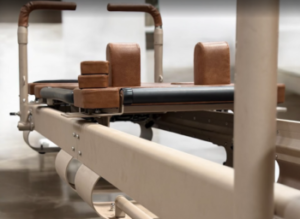
Ask Roger Goodell how many NFL players do Pilates, and he’ll guess about 10%. That’s a lot of 300-pound men on a machine first made popular by ballet dancers, and it didn’t happen overnight. The road ran from a German circus performer to a French bodybuilder in Los Angeles, and then through a wave of boutique studios. Here’s how that studio workout ended up in pro locker rooms, starting about a hundred years ago.
A Circus Performer's Big Idea
Joseph Pilates was performing in England with a circus troupe when World War I broke out. As a German, he was interned on the Isle of Man. He was stuck there until the war ended, which is a long stretch for a man who made his living on the move.
Later, he opened a studio at 939 Eighth Avenue in New York. Dancers found him quickly, and big names like George Balanchine and Martha Graham studied there. His machines ran on springs, which gave the muscles something to fight without heavy weights crashing down.
He called his method Contrology and put out a book about it in 1945. Pilates died in 1967 at 83. For a long time after that, his method stayed mostly in dance circles and rehab rooms.
A Bodybuilder Gets on the Reformer
The next twist came from France. Sebastien Lagree started lifting weights at 13 and became a bodybuilder before moving to Los Angeles to work as a personal trainer. He qualified as a Pilates instructor in 1998 and began teaching his bodybuilding moves on the reformer.
His first studio opened in September 2001. He built his own bigger machine in 2003, and his best-known one, the Megaformer, came after that. Classes are slow and tough, and the muscles stay under tension for the whole set, so a short class feels a lot longer. By 2018, he had about 300 licensees around the world, some with more than 20 locations.
That licensing model shaped the market. Megaformers mostly go to licensed studios, so independent studios and trainers who like the format often go looking for a Megaformer alternative instead.
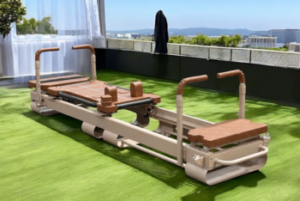
The Core Collab’s Sculptformer is an alternative to a Megaformer that’s sold outright, so a trainer can run Lagree-style sessions under their own name. Its page says the steel frame is built in-house and carries a 10-year warranty, which counts for something when big athletes are on it every day.
When the Boutique Boom Met Pro Sports
By the 2010s, boutique studios were everywhere. Small classes, dim lights and a reformer for every client became normal in most big cities. Pro athletes started trying it out, often because a trainer or physio sent them there.
That’s how it went for Christian Gonzalez of the Patriots. He began Pilates while rehabbing a torn labrum in his rookie year, and he told The Boston Globe that he “hated it” at first. He kept going anyway, and now it’s in his weekly schedule.
Some of his teammates went further. Safety Jaylinn Hawkins owns his own reformer, calls Pilates “life-changing” and still books Tuesday sessions at a studio on Newbury Street. Stefon Diggs, Anfernee Jennings and Marcus Jones are on the list of Patriots who do it too.
It’s spread well past Foxborough. In Kansas City, Chiefs defensive linemen have gone to a studio together as a group, and the Rams’ Jared Verse once called it teammate Byron Young’s “magic power.”
Not Just Football
Baseball and hockey players are on the carriage too. A studio in Scottsdale, Arizona, called Calibrate Pilates counts MLB pitcher Tarik Skubal, catcher Carson Kelly and NHL forward Liam O’Brien among its clients. Boxer Eric Priest trains there too. Its owner, Jess Pate, is a former dancer, which fits the story nicely.
The same studio works with Cardinals cornerbacks Garrett Williams and Sean Murphy-Bunting. Williams missed the first six games of 2023 with a torn ACL, then picked off a pass in his debut at Seattle. He called the sessions “definitely humbling.” Murphy-Bunting said it’s “all about breaking your body down and building it back up the right way.”
Basketball has its fans as well, which makes sense in a sport full of sore knees. Los Angeles instructor Nicky Lal trains dozens of pros, and former Celtic Jrue Holiday is one of them.
Why Big Guys Keep Coming Back
Walk into most studios, and you’ll see three machines. The reformer is the popular one, but there’s also the Cadillac, a table with bars overhead, and a small chair with a spring-loaded pedal.
A lot of the appeal comes down to those springs. A barbell is heaviest at one point and easy at another, but a spring pulls harder the further it stretches. The small muscles around the hips, knees and shoulders end up doing work that heavy lifting tends to skip.
It’s also low impact. There’s no jumping and no pounding, which matters when your job already involves getting hit for three hours on a Sunday. Gonzalez found it while rehabbing his shoulder, and that’s a common way in.
It’s worth being honest, though. Nobody has proved that Pilates stops injuries in the NFL, and for most pros it’s one part of a bigger training plan, not the whole thing. Still, a 10% guess from the commissioner, who expects that number to grow, says it’s more than a passing fad.
Joe Pilates Would Probably Smile
A circus performer who sat out World War I in an internment camp probably never pictured linebackers lining up for reformer classes. His springs went from New York dance studios to Los Angeles boutiques, and then into NFL locker rooms. If Goodell is right, the next big name on the carriage might be on your fantasy team.