Triathlon is one of the youngest major sports with a specific, documentable origin story. Most modern sports evolved over centuries; triathlon was invented in a San Diego track club in 1974 and crystallized as a format at the first Hawaiian Iron Man race in 1978.
That short history means we can actually trace how pacing strategy evolved, from the early-era “just finish and survive” approach to today’s data-driven models where elite athletes optimize watt-level outputs across three disciplines. The evolution of pacing is, in many ways, the evolution of the sport itself.
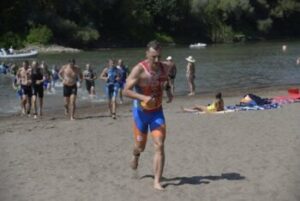
Modern triathletes have access to tools that the 1978 Iron Man finishers couldn’t have imagined. GPS watches, power meters, heart-rate-based zones, and online calculators turn what used to be guess-and-hope pacing into precise predictable performance work.
Tools like a triathlon calculator give athletes baseline pacing estimates across all three disciplines before they’ve even lined up at the swim start. This article traces how the sport got from there to here, and what the historical perspective tells us about where pacing strategy is headed next.
How Did the First Triathletes Actually Pace Themselves?
The first Hawaiian Iron Man in 1978 featured 15 competitors. Most of them finished, but their pacing approach was essentially improvisational.
Gordon Haller won that first race in 11:46:58. Modern analysis of his splits shows he ran the marathon in 3:30, which was remarkable given the heat, the preceding 112 miles of cycling, and the absolute absence of nutrition strategy that would now be considered standard.
There were no aid stations at the pace today’s races feature, no real-time feedback mechanisms, and no established benchmarks against which to judge effort. Competitors essentially swam, cycled, and ran at whatever effort felt sustainable, adjusted by whatever cramped, failed, or went wrong along the way.
This improvisational approach dominated the sport for its first decade. Pacing strategy was understood as “don’t blow up on the bike and you can probably run the marathon”, a principle that’s still technically true but now supported by mountains of physiological data rather than pure intuition.
When Did Structured Pacing Strategy Emerge?
The early 1990s brought two innovations that transformed how triathletes thought about pacing:
- Heart rate monitors became affordable. Polar’s commercial success in the late 1980s meant age-group athletes, not just elites, could train with real-time physiological feedback for the first time.
- Power meters arrived on road bikes. Early CompuTrainer stationary units and later mobile power meters let cyclists measure actual output, not just perceived effort.
- Lactate threshold testing went mainstream. Academic physiology from the 1980s filtered into commercial coaching products, giving athletes individualized intensity zones.
- The first triathlon-specific coaching books emerged. Mark Allen’s and Dave Scott’s training approaches became documentable frameworks rather than personal secrets.
- Age-group competition became serious. What started as recreational racing developed legitimate competitive structures that demanded better pacing approaches.
By the late 1990s, a well-prepared age-group Ironman competitor was racing with more pacing data than the entire field at the 1978 event combined. The sport hadn’t become easier; the relationship between effort and outcome had simply become legible.
What Role Do Modern Calculators Play?
Contemporary triathlon calculators compress decades of accumulated pacing science into simple input-output tools. The pattern is familiar to anyone watching how sports evolve, baseball’s shift from scouting-based analysis to Sabermetrics, covered in depth in how baseball has changed over the last 100 years, follows the same trajectory.

What these calculators actually do:
Estimate segment times based on training paces. Given an athlete’s average swim, bike, and run times over recent weeks, the calculator projects realistic race-day splits across Olympic, 70.3, or Ironman distances.
Account for distance-specific pacing degradation. A swimmer’s 400m time doesn’t linearly predict a 3,800m Ironman swim split; calculators build in the drop-off factor.
Suggest heart rate or power targets per segment. Translating training zones to race-day targets is specific work that calculators handle with reasonable accuracy.
Model nutrition and hydration timing alongside pacing. Advanced calculators integrate fuel intake with effort zones for longer events.
Generate taper and peak predictions. Some tools project race-day performance based on training-week volumes and intensity.
The effect is to democratize what used to require expensive coaching relationships. An age-group athlete today has access to prediction quality that only sponsored elite athletes had access to in 2005.
What Historical Parallels Exist in Other Sports?
Triathlon’s data revolution parallels what happened in several sports where calculation-based preparation displaced intuition. Golf’s pre-shot yardage books, basketball’s shot charts, and baseball’s pitch-location analytics all represent the same underlying shift, the transition from subjective feel to objective measurement.
The origins of golf have been documented across centuries; triathlon compressed that evolution into roughly 50 years. The pace of sport science adoption in newer sports looks faster than older ones partly because the tools were already developed and just needed adapting to the new context.
According to World Triathlon’s research on performance trends, average finishing times in elite events have improved roughly 2% per decade since 1990, with most of that improvement attributable to pacing optimization rather than pure physiology gains.
What Does the Pacing Evolution Tell Us About Sport History?
Four broader observations about how triathlon’s 50-year history informs sport science more widely:
- Measurement precedes improvement. Performance gains track almost exactly with measurement technology adoption
- Amateur adoption follows elite adoption by 5-10 years. Whatever top professionals use now, age-groupers will have in a decade
- Pacing science is mostly transferable across sports. The physiology of endurance effort doesn’t care what discipline you’re in
- Technology democratization levels the field. Modern age-group times are closer to elite times than they were in 1990, because the prep gap has closed
- Historical performance still holds up. Gordon Haller’s 1978 Iron Man time would be solid age-group finish today, suggesting the ceiling of human physiology hasn’t shifted dramatically, only our ability to reach it reliably
The USA Triathlon historical records database documents how age-group records have progressed over the last three decades, and the pattern across all age groups supports the measurement-precedes-improvement thesis.
What to Remember
- Triathlon is one of the few major sports with a documentable founding moment (1978)
- Early triathletes paced by intuition; modern athletes pace with data
- Three technology waves (heart rate, power meters, calculators) transformed the sport
- Age-group performance has improved faster than elite performance because the prep gap closed
- Historical Ironman finishers still hold up against many modern age-group times
The Bottom Line on Triathlon Pacing History
Triathlon’s 50-year arc from intuition to calculation compresses the entire modern sport-science evolution into a window short enough that many current competitors can remember both ends of it.
The first-generation athletes paced by feeling and grit; today’s age-groupers bring data and measurable preparation. Neither approach is better, both produce genuine achievement, but the evolution tells us something useful about how sports mature. What’s next, presumably, is AI-integrated real-time pacing advice, and that transition is already starting in elite racing now.
Frequently Asked Questions
What was the first triathlon event?
The Mission Bay Triathlon in San Diego on September 25, 1974 is generally recognized as the first organized triathlon. The 1978 Hawaiian Iron Man became the more widely known event and established the Ironman distance format.
How accurate are modern triathlon pace calculators?
Well-designed calculators typically predict race times within 3-5 percent for trained athletes with accurate input data. Accuracy improves the closer an athlete’s recent training paces reflect realistic sustained efforts.
Who holds the fastest Ironman time?
The professional men’s Ironman world record is held by Kristian Blummenfelt with 7:21:12 at Cozumel in 2021. Women’s record is held by Anne Haug with 8:02:38 at the 2023 Ironman World Championship.
How have Ironman times changed since 1978?
Gordon Haller’s winning 1978 time of 11:46:58 is slower than most sub-3-hour marathon age-groupers would run today when they attempt Ironman. Elite times have improved by roughly 4.5 hours over 45 years, dramatic, and entirely attributable to training science and pacing sophistication.