After winning four American League Pennants and two World Series in six years (1976–1981), the New York Yankees fell on hard times. In 1982, they posted their first losing season since 1973. From 1983 to 1988, they were competitive, but the closest they came to winning their division was in 1985, when they finished 97–64, two games behind the Toronto Blue Jays.
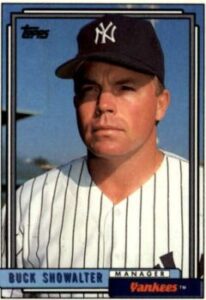
From 1989 to 1992, the Yankees endured four consecutive losing seasons. The only other time the Yankees had four consecutive losing seasons was from 1912 to 1915. In 1993, under the watchful eye of Manager Buck Showalter, the Yankees began to turn things around. They finished the season with an 88–74 record, seven games behind the first-place Toronto Blue Jays.
In 1994, the Bronx Bombers finished the season with a 70–43 record, the second-best in MLB and the best in the American League. Showalter won the Manager of the Year Award. Unfortunately, there would be no World Series for the Yankees or any other team. A player’s strike ended the season early.
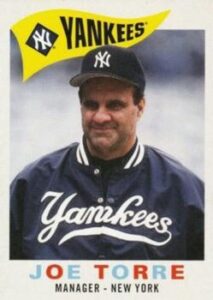
The Yankees didn’t play as well in 1995. They finished the season with a 79–65 record but made the playoffs as a Wild-Card team. They lost to the Seattle Mariners in five games. It’s unclear whether Showalter was fired or resigned, but the Yankees hired Joe Torre as their manager for the 1996 season.
Yankee fans were not thrilled that Showalter was gone, and even less thrilled by his replacement. In his 15 seasons managing the Mets, Braves, and Cardinals, Torre led his teams to only 5 winning seasons and one first-place finish.
1996 New York Yankees New Lineup
The Yankees’ lineup had improved significantly since their last losing season four years earlier. The only two key players remaining from the 1992 team were third baseman Charlie Hayes and centerfielder Bernie Williams.
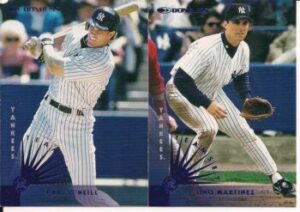
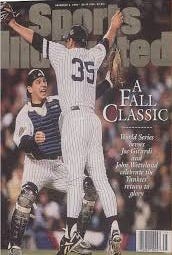
The new catcher was Joe Girardi, who came over from the Colorado Rockies before the start of the season. First baseman Tino Martinez also joined the team before the season, coming over from the Seattle Mariners. Second baseman Mariano Duncan, acquired from the Reds, joined the team before the season. Third baseman Wade Boggs came over from the Red Sox in 1993.
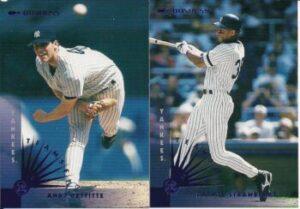
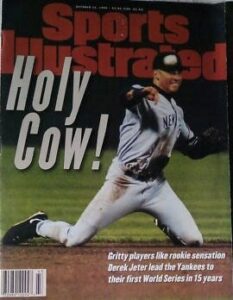
Shortstop Derek Jeter was brought up from the minors at the end of the 1995 season. Left fielder Darryl Strawberry joined the Yankees in 1995, acquired from the Giants. Strawberry split time with Tim Raines, who came over from the White Sox before the start of the season.
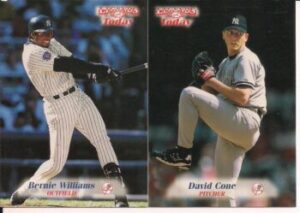
Bernie Williams, who came up from the minors in 1991, remained the team’s center fielder. In right field was Paul O’Neill, who joined the team in 1993 from the Reds. The DH was Cecil Fielder, who was acquired from the Tigers midway through the season.
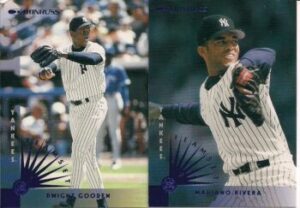
The pitching staff looked promising, with Andy Pettitte joining the team from the minors in 1995. The Yankees took a chance on signing Dwight Gooden for the 1996 season. Gooden had spent 11 seasons with the Mets before serving a one-year suspension in 1995 for failing drug tests.
David Cone, another former Met, was acquired from the Toronto Blue Jays midway through the 1995 season. Jimmy Key, also a former Blue Jay, joined the team in 1993. Kenny Rogers came over from the Texas Rangers before the start of the season.
The relief pitching was solid, with setup man Mariano Rivera joining the team from the minors in 1995. Closer John Wetteland was acquired from the Montreal Expos in 1995.
Up and Down To Start Year
The Yankees were up and down in April, winning three in a row twice and losing three in a row twice. They finished the month with a 13–10 record.
From April 28th to May 8th, the Yankees went on a tear, winning 9 of 10 games before coming back to earth with three straight losses. Their May record was 16–11. On May 14th, Dwight Gooden pitched the first no-hitter of his career.
The Yankees gained confidence and improved to an 18–11 record in June, winning five straight at one point. They won five straight again to start July, then lost the final game before the All-Star break. Three Yankees made the team: Wade Boggs, Andy Pettitte, and John Wetteland.
After the All-Star game, the Bombers won four straight, bringing their record to 56–33. Yankee fans began to envision a World Series appearance, but the team slumped, winning only 8 of its next 19 games.
The Yankees played poorly in August, losing five straight games at one point. By the end of the month, their record was 76–59, but the good news was that they were still leading their division.
September didn’t start much better, as they lost 4 of 7 games, but they got back on track, winning 8 of the next 9. The Yankees finished first in their division with a 92–70 record. Only the Indians and Braves had better records.
Player Awards and Statistics
The Yankees had five players who batted over .300: Mariano Duncan batted 340; rookie Derek Jeter batted .314; Wade Boggs batted .311; Bernie Williams batted .305; and Paul O’Neill batted .302.
Tino Martinez led the team in RBIs with 117, followed by Bernie Williams, who drove in 102 runs. Williams also led the team in home runs with 29, while Martinez belted 25.
Andy Pettitte led the pitching staff with a 21–8 record and 162 strikeouts. David Cone posted the best ERA among starting pitchers at 2.88, while Mariano Rivera led the relievers with a 2.09 ERA. John Wetteland recorded 43 saves.
Derek Jeter won the Rookie of the Year Award, and Joe Torre won the Manager of the Year Award.
1996 MLB Playoffs
The Yankees would face the Rangers in the first round of the playoffs. The Bombers had not played well against the Rangers during the regular season. They met twelve times, and the Yankees won only five of those games.
Although the Yankees had ten hits in game one, none were home runs. The Rangers had eight hits, including a three-run homer and a two-run shot. The final score was Texas 6, New York 2.
In Game 2, Juan Gonzolez hit his third home run of the series, giving Texas a 4–1 lead. Cecil Fielder hit a home run for the Yankees, cutting the lead to 4–2. In the 8th inning, Fielder drove in the tying run, and the game went into extra innings. The Yankees won 5–4 in the 12th inning.
The Yankees held a 1–0 lead after Bernie Williams hit a solo home run in the first inning, but Juan Gonzolez tied the game in the fourth with his fourth home run of the series. The Rangers added another run in the fifth, but the Yankees scored two runs in the ninth to win the game 3–2.
With the Rangers leading 2–0 in Game Four, Gonzolez hit his fifth home run of the series, giving Texas a 3–0 lead. The Rangers added another run, making it 4–0 after three full innings. But the Yankees came back in the fourth to cut the lead to 4–3. In the fifth, Bernie Williams hit a home run to tie the score. The Bombers added another run in the 7th to take the lead, and in the 9th, Bernie Williams hit his third home run of the series, giving the Yankees a 6–4 victory.
Next up for the Yankees was the Baltimore Orioles in a seven-game series. The winner would claim the American League Pennant and advance to the World Series.
After six full innings in game one, the Yankees trailed 4–2, but they had been a comeback team all season, and today was no different. They narrowed the gap to 4–3, and in the bottom of the eighth, Derek Jeter hit a solo home run to tie the game at 4–4. The Orioles argued that there was fan interference when a 12-year-old boy reached over the wall to catch the ball, but the call stood. The game went into extra innings, and Bernie Williams ended it in the 11th with a walk-off home run.
With game two tied 2–2 after six full innings, Rafael Palmeiro belted a two-run shot, giving Baltimore a 4–2 lead. It was his third home run in two games. The Orioles went on to win 5–3. The Yankees left 11 runners on base.
After seven full innings in Game Three, the Yankees fell behind again, 2–1. But the Yankees had a big eighth inning, scoring four runs and going on to win 5–2. Cecil Fielder hit a solo home run, and starting pitcher Jimmy Key pitched eight full innings, allowing only three hits.
Bernie Williams gave the Yankees a strong start in Game Four with a two-run home run. Baltimore cut the lead to 2–1, but Darryl Strawberry put the Yankees up 3–1 with a solo shot in the second inning. The Orioles answered with a home run of their own, narrowing the gap to 3–2. Paul ONeil hit a two-run shot in the fourth inning to make it 5–2.
Baltimore came right back to score two runs, making it 5–4. The score held until the top of the eighth, when the Yankees scored three runs, including another home run by Strawberry. The final score was 8–4, and the Bronx Bombers were one win away from their 34th AL Pennant.
With game five tied at zero entering the third inning, backup catcher Jim Leyritz hit a solo home run. The Yankees scored five more runs, including a three-run blast by Cecil Fielder and a solo home run by Darryl Strawberry.
Andy Pettitte pitched 5 and 2/3 shutout innings before giving up a solo home run in the bottom of the sixth. Baltimore hit another home run in the bottom of the eighth, cutting the gap to 6–2. John Wetteland relieved Pettitte in the ninth. Although he allowed a two-run homer, he got the job done, and the Yankees won the game 6–4.
1996 World Series
The Yankees’ opponent in the World Series was the Atlanta Braves. The Braves boasted the best pitching staff in baseball, and few gave the Yankees a chance to win. Cy Young Award winner John Smoltz would start Game 1 for the Braves. Trailing 9–0 in the bottom of the fifth, the Yankees finally scored a run, but it would be their only run of the game. The final score was Atlanta 12, New York 1.
In Game Two, the Yankees faced four-time Cy Young Award winner Greg Maddux. The Yankees managed six hits off Maddux, but he pitched eight scoreless innings, and the Braves won easily, 4–0.
Both losses came at home, and the Yankees now faced the unenviable task of flying to Atlanta to face Tom Glavine. David Cone would start for the Yankees. Cone had missed much of the season due to a shoulder aneurysm, and many doubted he could return. After scoring just one run over eighteen innings, the Yankees’ prospects looked grim.
The Yankees made some lineup changes for game three, and it paid off as they led 2–0 after five innings. The Braves scored a run in the bottom of the sixth, but David Cone silenced the doubters by pitching six full innings and allowing just one run. Glavine also pitched well, allowing only four hits over seven full innings.
The Yankees feasted on the Braves’ relief pitching, scoring three runs in the eighth, including a home run by Bernie Williams. The Braves tried to mount a comeback in the bottom of the eighth but managed only one run. The final score was New York 5, Atlanta 2.
The Yankees’ starter for game four was Kenny Rogers. Rogers had not pitched well lately, a clear cause for concern. He didn’t make it past the third inning, getting pulled after giving up four runs. The Braves added two more runs, leading 6–0 after five full innings. Already behind in the series two games to one, and with John Smoltz scheduled to start game five, the Yankees’ situation looked grim.
But as they had all season, the Yankees battled back, scoring three runs in the 6th. Meanwhile, reliever Jeff Nelson was shutting down the Braves. In the 8th, Jim Leyritz belted a three-run home run to tie the game. Neither team scored in the 9th, and the game went into extra innings.
The Yankees scored two runs in the top of the 10th to take an improbable 8–6 lead. Graeme Lloyd and John Wetteland shut down the Braves in the bottom of the 10th. It was one of the greatest comebacks in World Series history, and just like that, the momentum had shifted.
Game five would be the final game ever played at Atlanta-Fulton County Stadium. The pitching matchup was a rematch of game one, Smoltz vs. Pettitte. But unlike game one, when the Braves were hitting Pettitte at will, Pettitte was brilliant, allowing just one hit through five innings. The Braves threatened in the sixth inning but failed to score.
Smoltz was every bit as good, going eight full innings, allowing only four hits and one run while striking out ten batters. Pettitte went out to pitch the final inning, retired one batter, but was pulled after giving up a double. Wetteland got the final two outs to preserve a hard-fought 1–0 victory.
The series had shifted back to the Bronx, with the Yankees holding a three-games-to-two lead. Could they pull off what had seemed impossible just two days earlier?
The Yankees got to Greg Maddux in the third inning, scoring three runs. The Braves closed the gap to 3–1 in the fourth, and Maddux did not allow any more runs. Jimmy Key pitched well for the Yankees, allowing only one run before being pulled in the middle of the sixth. The Braves scored another run in the 9th but were unable to tie the game, and the Yankees held on for a 3–2 victory.
The Yankees, who were outscored 16–1 in the first two games, won four straight games to claim their first World Series Championship since 1978. John Wetteland was named the series MVP.
An Unforgettable Season
Fittingly, game six was the final game former Yankee Phil Rizzuto would announce. While much of the credit goes to the players and Manager Joe Torre, credit must also be given to General Manager Bob Watson and former Manager Buck Showalter.
The Yankees would go on to win five more AL Pennants and three World Series over the next seven years.
Please Consider Sharing If You Like This Article
Mark Morthier is the host of Yesterday’s Sports, a podcast dedicated to reliving memorable sports moments from his childhood days and beyond. He grew up in New Jersey just across from New York City, so many of his episodes revolve around the great sport’s teams of the 70s for the New York area.
He is also an author of No Nonsense, Old School Weight Training (Second Edition): A Guide for People with Limited Time and Running Wild: (Growing Up in the 1970s)
Check out Mark's Books Below
Please Note – As an Amazon Associate I earn from qualifying purchases
Resources
More From Yesterday's Sports
How The 1996 New York Yankees Shocked Baseball and Saved The Bronx
After winning four American League Pennants and two World Series...
Read More1972 Los Angeles Lakers: Beating 17 Years of Frustration
From 1949 to 1954, the Minneapolis Lakers won five NBA...
Read MoreJim Schmitz: USA Olympic Weightlifting Coach
Born in Ukiah, California, in 1945, Coach Jim Schmitz has...
Read MoreWhat’s The Right Amount of Weight Training?
I recently heard a weightlifting coach say that overtraining doesn’t...
Read More