This article was originally published by the Pro Football Researchers Association. You can find the article in The Coffin Corner, Vol. 48, No.3, 2026).
AUTHOR’S NOTE: This research centers on intercollegiate football because it can begin nowhere else. Football’s origin rests in the histories of the few American colleges that adopted the game in the late 19th century. The article does however maintain direct relevance to the professional game.
To see the game’s shape and understand when it assumed a particular, and eventually peculiar form can demand a perspective that precedes professionalism. College football’s beginnings and its early evolution heralded and subsequently contributed to the arrival and later development of both post-graduate amateur football and the coming of the paid players’ era.
That progression leaves the genetics of college football unmistakably present within the broad crown of football’s family tree, making is sometimes necessary, as is the case here, to look at the college game to inform our understanding of football in general.
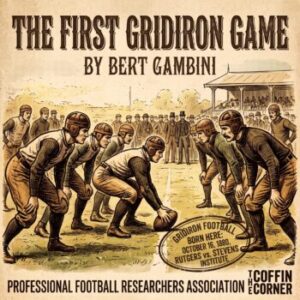
History’s prevailing voice identifies a meeting between Princeton and Rutgers on November
6, 1869, as the first ever intercollegiate football game. But that claim is part of a flawed origin story. Rutgers and Stevens Institute actually played history’s first football game on October 16, 1880, and this article attempts to correct football’s inaccurate timeline.
The Princeton-Rutgers game would possess its own poetry had it been accompanied by a bang, as might be expected given disputes between the neighboring schools regarding the ownership of an abandoned Revolutionary War cannon.
History correctly recalls the story of that colonial-era weaponry, while it has incorrectly identified football’s provenance.
British troops following the Battle of Princeton, New Jersey in 1777 had left two cannons in the field, one larger than the other. The big cannon was brought to Princeton College in 1839. It sits today in the center of the school’s quadrangle behind Nassau Hall.
The smaller cannon also found a home on the Princeton campus, where it served initially as a reference point for surveyors drawing the town’s first maps. But the little cannon would prove well-traveled. It was repeatedly taken from one school to the other, as a recurring prank by spirited students, before Princeton secured ownership by partially burying the relic vertically in a concrete base.1–2
Not long after Princeton had cemented the so-called “Cannon War” in its favor, Rutgers issued an athletic challenge to even the score. The schools would meet on November 6, 1869. And though the game played that day is recognized as the first ever football game, no one thought so at the time. And no one should think so now.
The Princeton-Rutgers inaugural distinction took decades to arrive, after a respected authority of the game cemented the inaugural claim in history as firmly as the little cannon was secured in the ground.
But football did not begin in 1869. The game was first played on a late autumn afternoon in 1880.
In 1854, William Rust, a respected pharmacist and long-time resident of New Brunswick, New Jersey, bought a drug store in the city at the corner of Peace and Burnet Streets.3 Charles Deshler had established the business some 35 years earlier, but under Rust’s leadership, in partnership with his adult children, the store expanded greatly and would eventually patent several of the medicines it manufactured.4
In addition to its retail and wholesale operations, Rust & Sons Drug Store served as an official source of weather information for the community. There was a thermometer attached to the outside of the building, and for several years the New Brunswick Daily Times published in its pages the weekly report of temperature readings dutifully recorded by store employees five times daily, except on Sundays, when Rust’s was closed.
It was 57 degrees in New Brunswick at seven o’clock on Saturday morning October 16, 1880, as students from Rutgers College, not far from the store, began preparing to leave for a football game they were scheduled to play in Hoboken, on the nearby grounds of the St. George’s Cricket Club, against Stevens Institute.5
The weather hadn’t felt like fall in the days leading up to the game, and though the morning air was crisp, the warming trend was expected to continue. It was the start of an autumn weekend that still carried a suggestion of summer against a backdrop of changing leaves and shorter days.6
The temperature in New Brunswick that day would reach 80 degrees by three o’clock. At about that same time, in Hoboken, roughly 30 miles away, Rutgers and Stevens began play while a breeze off the cool waters of the Hudson River, which flowed about a half mile east of the cricket club grounds, brought some relief from the bright sun and heat, providing a slightly more comfortable setting for a game whose nature was changing must faster, and more drastically, than that year’s slowly turning seasons.
Intercollegiate contests similar to the Rutgers-Stevens game were diversionary 19th-century pursuits that offered a distraction from the demands of classwork and study. Games between opposing schools had been sporadically scheduled prior to 1880. They were pride points, mostly, that generated little notice beyond the excitement of the moment, and the Rutgers-Stevens match was no exception, despite it representing the arrival of something different from anything that came before it.
Days earlier, on October 12, 1880, the Intercollegiate Football Association, the game’s nascent rules-making organization, had changed football’s fundamental reality.7–9 The game between Rutgers and Stevens Institute was the first played under the new rules.10–13
Rutgers won, 1–0.14
“Our boys played finely…cheered on by the many under-graduates present and went in to win,” reported The Targum, Rutgers’ student newspaper, saying little else about the afternoon.15
And not much has been said about the game since that brief report. But the players who walked off the cricket club grounds on that October afternoon had taken part in a milestone that history never acknowledged.
Until now.
The game raised the curtain on a new season as it unveiled a radically new sport. Though only 200 people were there to see it, the game was a revolution that introduced a sport watched by millions today.16–17
Those students from Rutgers College and Stevens Institute on October 16, 1880, had just played the first-ever intercollegiate football game.
Gridiron football was born.18–19
History assigns little prominence to that October 1880 meeting between Rutgers and Stevens Institute. Beyond memory of its final score, the game has remained inconsequential, and is entirely absent from football’s established origin story. That should not be the case.
Calling attention to the game’s long overlooked significance definitively marks football’s timeline with an historically accurate flash point, a moment when something new was on display.
The 1880 game contradicts the widely accepted narrative of football’s origin, a story that makes no mention of the game itself or Stevens Institute, a school that disbanded its football program in the summer of 1925, and is known officially as Stevens Institute of Technology.20
The first occurrence of intercollegiate football, as is generally accepted, was on November 6, 1869, when Rutgers met a visiting team from Princeton University (known as The College of New Jersey at that time and then was informally referred to as Princeton College throughout much of the late 19th century) for an afternoon game in “a lot about a hundred yards wide, extending from College Avenue to Sicard Street.”21–22 Rutgers won, 6-4.
The 1869 origin claim however can’t support the weight of a history that suggests otherwise. It was neither gridiron football nor an original version of the game that exists today.23
The game was a ragged and bloated form of soccer, played with 25 men on each side, under a set of rules modified from those established by the London Football
Association. 24
The bedrock historical consequence of Rutgers-Princeton is the domain of soccer, not gridiron football. In fact, the game is often cited as the first intercollegiate soccer match in the U. S., a claim more easily justified than the similar designation bestowed on gridiron football’s history.25–28
Rutgers-Princeton can’t be both the first football and the first soccer game any more than a single event can, for instance, mark the origin of both tennis and squash. Assigning the same landing page to each of the games, football and soccer, ignores the unique characteristics of both. One may have contributed to the development of the other, but their eventual emergence remains unique events.
The 1869 Rutgers-Princeton game occupies an unconvincing place in history. Many books and other reliable sources ignore 1869, at least in the context of gridiron football, while others refute it entirely as football’s start.
A majority of sources, however, acknowledge the Rutgers-Princeton game as football’s first, but do so with language that suggests tradition more than history.29–30 The 1869 game is even memorialized on the Rutgers campus, where a breathtaking eight-foot sculpture commemorates the game’s place in history. But that statue, like the game’s origin claim itself, is fraught, since the striking figure depicted in bronze is carrying the ball, something prohibited to players in the 1869 game.31–33
Looking past 1869 to 1880 is to see Rutgers and Stevens, eleven years later, play a game, which to varying degrees was similar to other games that preceded it, the 1869 Rutgers-Princeton game included, but with a wrinkle that differentiated it from anything that otherwise contributed to its creation.
There’s a line that connects 1869 to 1880, as game rules changed, but when October of that latter year arrived so too did a new creation in sport.
The Intercollegiate Football Association’s rule changes in 1880, among other things, reduced the number of players from 15 to 11 aside, an incidental change relative to the importance of introducing scrimmage, the innovation that created the game of gridiron football. The ball would be put in play with a snap-back, rather than restarting play with a scrummage, or scrum, as in rugby.
Football now had a line of scrimmage, which implied a new understanding of possession, a concept more definitive than fluid, as in rugby. With scrimmage, possession was clearly defined rather than randomly determined. Scrimmage also implied the beginning of planning and strategy that would lead to a game sharply dressed in tactics rather than one left to chance. One side had the ball.
Scrimmage also required introducing new positions and responsibilities: a snapper, to snap the ball back, and a quarterback, to receive the snap back.
Theodore DeWitt (Rutgers) and Joseph Pracy (Stevens Institute), the game’s two quarterbacks, were among the pioneers in the historic plot.
The game remained however an artful collision of new ideas with existing rules. Football in 1880 was a far from finished work, and it would require several adjustments before arriving at anything that would appear recognizable to the contemporary observer—but it was getting there, slowly.
Scrimmage staggered the game’s momentum, creating the familiar episodic contest that moved from play to play, rather than the continuous motion of soccer and rugby. There was no distinction between touchdowns and safeties. An offense that carried the ball behind its goal would simply kick it back to an opponent, with no points awarded.34 And the goal line was also the endline. The end zone did not yet exist.
The rule changes were of “considerable ingenuity,” but football in 1880 was still much like a “series of wrestling encounters.”35
The transition to scrimmage from 1879 into 1880 also minimized the use of “feet” in “football.” There was still kicking, but the feature that had “reached a perfection” by 1879 would have a critical, although less frequent presence.36
But why should Rutgers-Stevens in 1880 supplant the more widely accepted football origin story that begins with Rutgers-Princeton in 1869? Or for that matter, supplant competing claims of later games played in the rugby style that allowed participants to carry and run with the ball, characteristics familiar to gridiron football?
In each case, the games’ fail to offer evidence supporting a gridiron origin claim. There was no scrimmage, which is football’s DNA test.
Harvard and McGill universities, for instance, met on May 15, 1874, perhaps the first intercollegiate rugby-football game in North America.37 But the game predates the scrimmage rule. In 1975, the schools celebrated the one hundredth anniversary of their 1874 meeting with an exhibition game. That anniversary match, and how it’s officially recorded, further complicates rugby’s claim in football’s origin argument.
The 1874 game is listed by both schools on their football lists. The 1975 game is mutually recorded as a rugby match.38 If it was football in 1874 then playing a game with the same rules a century later should have been seen as a football game. But it was not. Nor should it have been.
In 1875, Harvard and Tufts University played a rugby football game on June 4. It was the first time two American schools met for an intercollegiate rugby style match.39 But again, the game did not feature scrimmage and was played with a rugby scrum.
In fact, all the football-styled games between 1869 and 1880 fail the creation test because none of them featured scrimmage.
Scrimmage is the defining characteristic of gridiron football, an assertion repeatedly encountered in respected histories. But those same sources fail to identify the specific game that first featured that innovation.
The 1869 claim exists as an apparent fallback origin point ever since Parke H. Davis unofficially enshrined the game as the first in intercollegiate history.
Davis was graduated from Princeton where he played football for the Tigers (1890–92). He later coached Wisconsin (1893), Amherst (1894), and Lafayette (1895–1897). Between 1909 and 1915, he was an influential member of the rules committee, credited with introducing innovations such as jersey numbers, dividing games into quarters, and establishing end zones. In later life he practiced law, and was a nationally recognized football historian.40
Davis dedicated an entire chapter to the Princeton-Rutgers game in his 1911 book, Football: The American Intercollegiate Game.41 Although there are slightly earlier references (1909) to the game as football’s first, Davis’s reputation seems to be responsible for the historical status of the Princeton-Rutgers game.42
Yet it appears Davis later adjusted his perspective. His detailed article from the Official Intercollegiate Football Guide 1926, restates the Princeton-Rutgers claim. However, the story is a golden anniversary piece titled Fifty Years of Intercollegiate Football, which would mark 1876 as football’s origin year, when the rugby-code rules were codified following a convention at the Massasoit House in Springfield, Illinois. That makes a match between Princeton and Yale football’s first, according to Parke.43 It’s in this same article that Parke calls scrimmage “the most important incident in the evolution of the game in the late ‘70s [sic.].”44 And “evolution” is a point worth exploring.
Football’s development experienced three revolutions.
The first revolution was an arrival, an intercollege match that featured a kicking game: Princeton-Rutgers. Any rule changes that followed the kicking game up to the adoption of a rugby style play, represents an evolution of the kicking game. The rugby style, or carrying game, represents football’s second revolution. The rule changes in the mid- to late-1870s are evolutionary steps in the carrying game, before the third revolution, which was the adoption of scrimmage, the unique feature that established the possession game, which is gridiron football.45
It should be noted that scrimmage, at least in its original conception, was far from perfect, “as a matter of fact, it darned near ruined football.”46 Scrimmage lacked a mechanism for a change of possession. This shortcoming led to block games, where each team maintained possession for an entire half, even if unable to move the ball. These dreadfully boring affairs wouldn’t be abolished until the institution of a system of downs, in 1882, that required teams to gain (or lose, originally) a specified distance in a given number of snaps.47
The 1882 rule has also been used as the point marking football’s origin, but again, it’s a rule that occurred after the adoption of scrimmage, which makes it an evolution of the possession game.48
It seems fair to ask why Rutgers-Stevens is fundamentally nonexistent historically if the game unveiled scrimmage, and led what became the most popular spectator sport in America.49
Its significance may have been lost on observers in 1880, most of whom were watching a relatively obscure form of sport. There were only two games played in 1869, involving two teams playing one another twice. Three games followed in 1870, and in 1871, not one intercollegiate game was played. Interest remained and both play and growth resumed in 1872, but even by 1879, the year before Rutgers-Stevens, just sixteen colleges fielded teams, playing between one and five games each.50
If fans weren’t paying close attention the same can be said of reporters, even though “the changes were dramatic and fundamental.”51 In its earliest form, scrimmage didn’t appear all that different from what came before it. The ball was snapped with the foot before the arrival of the traditional offensive center stance.52 There was press coverage of Rutgers-Stevens, and mention of the new rules, but the focus was on the obvious. There were fewer players, making the game appear less cluttered.53
It should also be noted that despite Rutgers-Stevens announcing the arrival of gridiron football, it nevertheless still looked a lot like rugby.
Walter Camp, often referred to as the Father of American Football, and the rules committee member credited for most strongly advocating for scrimmage, said as much in 1889 when he wrote that football still strongly resembled rugby, and that “it would not be fair to suppose that all of the ten or fifteen thousand spectators who gather to witness one of the great matches have clearly defined ideas of the rules which govern the contest.”54–56
But by the same token, even a contemporary perspective doesn’t necessarily provide for an appreciation of scrimmage and its significance. The NCAA, in fact, does not include scrimmage in its list, College Football History: Notable Firsts and Milestones.57
There’s another more general possibility raised by the esteemed historian David McCullough. His point, when it was made, was not connected to football, but his wisdom remains relevant. In a speech about young George Washington delivered in 1999 at the Library of Congress, McCullough said, “We assume that everybody who’s involved in historic events is caught up in the fact that they are involved in an historic event.”58
McCullough told his audience of an adolescent Washington’s first glimpse of the Shenandoah Valley on March 12, 1748. “There was this vast paradise,” wrote McCullough. “The Future.” Yet that night in his diary, recalling the day’s events, Washington wrote, “Nothing remarkable happened.”59
There is no equivalent diary entry, at least as far as we know, by anyone who participated in or witnessed Rutgers-Stevens in 1880. But history’s existing sentiment says as much without anyone having written the words.
Washington was wrong. Something remarkable did happen. He just didn’t recognize it. And where football is concerned, something remarkable happened in 1880 when Rutgers met Stevens. And though no one said it then, or in the decades to follow, it’s time to say so now, not because the game recently surfaced in football’s fossil record. It has always been there. Its origin claim is not made on the basis of recently unearthed documents, or previously undelivered testimony from descendants of descendants of first-hand witnesses.
The creation claim simply ties what authoritative sources have already acknowledged as football’s “cardinal, essential feature” with the game that first put that feature on display.60
This doesn’t mean that Rutgers-Princeton, HarvardMcGill, Harvard-Tufts, or Princeton-Yale are insignificant events. Those games have a place in history that should be neither ignored nor marginalized, which is, oddly, what has happened to Rutgers-Stevens, a game which deserves its rightful place of prominence.
NOTES
- Robert K. Durkee, The New Princeton Companion, (Princeton, NJ: Prince-
ton University Press, 2022), 105.
- https://scarletknights.com/sports/2022/7/25/sports-m-footbl-archive-first-
game-html.aspx
- New Brunswick Times, The City of New Brunswick: Its History, Its Homes & Its Industries, (New Brunswick, NJ: The Times Publishing Company, 1909), 144.
- The American Pharmaceutical Association, Proceedings of the AmericanPharmaceutical Association at the Forty-Fourth Annual Meeting held at Montreal, Canada, August, 1896, (Baltimore, MD: The American Pharmaceutical Association: 1896), 44.
- Rutgers would not attain university status until 1924: https://www.rut-
gers.edu/news/rutgers-facts-glance-1
- “Temperatures of the Weather,” New Brunswick Daily Times, October 18, 1880, 3.
- “Changing Foot-Ball Rules,” The New York Times, Oct. 15, 1880, 2.
- There were six rule changes at the Oct. 12, 1880 meeting. The limited
press coverage focused almost exclusively on number 6, “The game shall be played by eleven men on each side,” but the most significant change was number 1: “A scrimmage takes place when the holder of the ball, being in the field of play, puts it down on the ground in front of him and puts it in play while onside, first, by kicking the ball; second by snapping it back with his foot. The man who first receives the ball from the snap-back shall be called the quarterback, and shall not then rush forward with the ball under penalty of foul.” David M. Nelson, Anatomy of a Game, (Newark, NJ: University of Delaware Press, 1995), 46-47.
- The New York Times reported the IFA meeting took place on Oct. 14, 1880. But other sources indicate the meeting was Oct. 12, 1880.
- “Students as Kickers: The Rutgers Team Defeat One from Stevens Insti-
tute,” The New York Times, Oct. 17, 1880, 12.
- “Stevens and Rutgers at Football,” The Sun, Oct. 17, 1880. 6
- “College Boys at Ball: Contest at Hoboken Between Stevens and Rut-
gers,” New York Tribune, Oct. 17, 1880, 5
- “Football: First Intercollegiate Game of the Season,” New York Herald, Oct. 17, 1880, 9.
- Football’s familiar numerical point system was in 1880 decades away
from its familiar contemporary standardization. The Targum reported the final score as one goal to one touchdown. The New York Times referred to the game as a “one goal victory…by the Rutgers team.”
- Targum, Vol. 1. No. 2., Nov. 8, 1880, 16, 18.
- “Students as Kickers: The Rutgers Team Defeat One from Stevens Insti-
tute,” The New York Times, October 17, 1880, 12.
- “America Just Can’t Quit Football,” Fortune, January 24, 2022, https://for-
tune.com/2022/01/24/america-just-cant-quit-football-the-ratings-keep-getting-bett er-as-the-sports-scandals-get-bigger/
- The term “gridiron football” is used here for clarity and to distinguish
the game from soccer and rugby within this article’s narrative. Historically, the word “gridiron” wouldn’t be used in relation to football until after the 1882 introduction of the system of downs and required yardage that necessitated marking the field with intersecting lines that created what appeared to be a “gridiron.” The press began using the term in the context of football years after the rule change. An 1889 story in the New Haven Daily Morning Journal and Courier is among the first printed occurrences of “gridiron” in the context of football. That story mentioned Cornell’s inability to “hold the gridiron rush” of Yale.
- “Yale is Right-Cornell Defeated 70 to 0-Poor Showing by Harvard,” New Haven Morning Journal and Courier, Nov. 11, 1889, 2.
- Some 19th-century stories referencing Stevens refer to “The” StevensInstitute, or make the name possessive, “Steven’s.” In the context of newspaper sports reports, the school seems to have most often been identified as “Stevens Institute,” which is used here for consistency.
- “The Foot-ball Match,” Targum, November 1869, 5.
- In 1869, Princeton University was known as The College of New Jersey.The name change was made in 1896 as part of the institution’s sesquicentennial celebration. https://universityarchives.princeton.edu/2015/07/when-did-the-college-of-new-jersey-change-to-princeton-university/
- John Hughson, Kevin Moore, Ramón Spaaij, and Joseph Maguire, Rout-
ledge Handbook of Football Studies, “Association and Rugby Football: Two codes, one historiography, by Tony Collin, (New York, NY: Routledge, 2017), 19.
- Princeton played a version of the game that used a free kick, which per-
mitted an unhindered free kick to the goal to any player who caught the ball. Rutgers was unaware of the rule. It was decided beforehand that no free kicks would be allowed. See: “Twenty-Four Stalwart Men, and a Goliath,” by Parke H. Davis. https://web.archive.org/web/20250428105220/https://universityarchives.princeton.edu/wp-content/uploads/sites/40/mt/docs/Twenty-four%20
Stalwart%20Men.pdf
- https://www.ussoccer.com/history/timeline
- Gabe Logan, The Early Years of Chicago Soccer: 1887–1839, (London, United Kingdom: Rowman & Littlefield, 2019), 72.
- Nicholas Faulker and Josepha Sherman, Soccer: Girls Rocking It, (New York, NY: The Rosen Publishing Group, 2016), 53.
- R. Scott Kretchmar, et al., History and Philosophy of Sport and Physical Activity, Second Edition, (Champaign, IL, Human Kinetics, 2024), 316 29. John Sayle Watterson, College Football: History, Spectacle, Controversy, (Baltimore, MD: The Johns Hopkins University Press, 2000), 18.
- Tom Bennett, et al, The NFL’s Official Encyclopedic History of Profes-
sional Football, (New York, NY: Macmillan Publishing Co., Inc., 1977), 10.
- “The First College Football Game,”
https://www.hmdb.org/m.asp?m=165875
- Rutgers and Princeton played one another again following the Nov. 6,1869 match, meeting a week later on Nov. 13, 1869, resulting in an 8–0 Princeton win. The 1869 origin claim refers solely to the first of the two games. And any reference in this article to Rutgers-Princeton refers only to the first game. Faculty objections at both schools and the opposing players’ failure to agree upon common rules for the planned third game may have each contributed to its cancellation. See: Gerald R. Gems and Gertrude Pfister, Touchdown: An American Obsession, (Great Barrington, MA: Berkshire Publishing, 2019), 6.
- A planned third game in 1869 between Rutgers and Princeton was
never played “owing to the objections of faculties [at both schools].” See: Parke
H. Davis, Football: The American Intercollegiate Game, (New York, NY: Charles Scribner’s Sons, 1911), 50.
- Timothy P. Brown, How Football Became Football: 150 Years of the Game’s Evolution, (West Bloomfield, MI: Brownhouse Publishing, 2020), 24.
- “Victory for Princeton,” New York Herald, Nov. 14, 1880, 5.
- A quote attributed to Parke H. Davis – David M. Nelson, Anatomy of a Game, (Newark, NJ: University of Delaware Press, 1995), 44.
- Melvin I. Smith, Early American & Canadian ‘Football’: Beginnings
through 1883/84, (Bloomington, IN: 1st Books, 2003), xi
- Ibid.
- Kevin Paul Dupont, “Gridiron Gridlock: Citing research, Tufts claims
football history is on its side,” The Boston Globe, Sept. 23, 2004, 61.
- “Parke H. Davis Died Today: Long Nationally Known Football Author-
ity,” The Boston Globe, June 5, 1934, 25.
- Parke H. Davis, Football: The American Intercollegiate Game, (New York, NY: Charles Scribner’s Sons, 1911), 44-50.
- “Forty Years Today: This Time Elapsed Since First Intercollegiate Foot-
ball Contest in America,” The Minneapolis Journal, Nov. 7, 1909, 26.
- Parke H. Davis, “Fifty Years of Intercollegiate Football,” Official Intercol-
legiate Football Guide 1926, American Sports Publishing, New York, NY, 13–14.
- Ibid. 15.
- The kicking, carrying and possession designations are from Melvin I
Smith’s extraordinarily researched book: Melvin I. Smith, Evolvements of Early American Foot Ball: Through the 1890/91 Season, (Bloomfield, IL: Author House, 2008).
- PFRA Research, “The Journey to Camp: The Origins of American Foot-
ball to 1889.”
- The rule came out of a meeting on Oct. 14, 1882: If on three consecutive
fairs [putting a ball in play from out of bounds] and downs a team shall not have advanced the balls five yards or lost ten, they must give up the ball to the other side at the spot where the fourth down was made. Consecutive means without leaving the hands of the side holding it. David M. Nelson, Anatomy of a Game, (Newark, NJ: University of Delaware Press, 1995), 50.
- https://news.gallup.com/poll/610046/football-retains-dominant-position-… 48. Ibid., “The Journey to Camp ” favorite-sport.aspx
- Christian K. Anderson and Amber C. Fallucca, The History of American College Football: Institutional Policy, Culture, and Reform, (New York, NY: Routledge, 2021), 4.
- Roger R. Tamte, Walter Camp and the Creation of American Football, (Urbana, Il: University of Illinois Press, 2018), 42.
- Ibid.
- See notes 7 and 8.
- Harford Powel, Jr., Walter Camp: The Father of American Football, (Boston, MA: Little, Brown, and Company, 1926).
- David M. Nelson, Anatomy of a Game, (Newark, NJ: University of Delaware Press, 1995), 45.
- Walter Camp, “Intercollegiate Foot-Ball in America,” St. Nicholas: An Il-
lustrated Magazine for Young Folks, Nov. 1889, 17, 1.
- https://www.ncaa.com/news/ncaa/article/2020-01-31/college-football-his-
tory-notable-firsts-and-milestones
- David McCullough, with Dori McCullough Lawson and Michael Hill(eds.), History Matters, (New York, NY: Simon and Schuster, 2025), 68.
- Ibid.
- Harford Powel, Jr. Walter Camp: The Father of American Football, (Boston, MA: Little, Brown, and Company, 1926), 55-56.
AUTHOR BIO - BERT GAMBINI
Bert Gambini is a news content manager for the University at Buffalo. Prior to his current role, he worked for more than two decades in Buffalo radio, including eighteen years at NPR member station WBFO.
As a contributing writer and member of the Professional Football Researchers Association, he has published numerous articles for the organization and is among the co-authors of four books in the series Great Teams in Pro Football History (McFarland Publishing), including The 1958 Baltimore Colts, The 1951 Los Angeles Rams, The 1964 Buffalo Bills, and a forthcoming book on the 1976 Oakland Raiders.
He also presents a music program heard several times a week on the internet station Pure Jazz Radio.
Please Share If You Liked This Article
Please Note – As an Amazon Associate I earn from qualifying purchases
More Posts From Sports History Network

The Long History Facing the Seahawks and Patriots
Since the first Super Bowl in January 1967, 118 teams...
Read More

The Best Pro Football Teams Countdown (All-Time Franchises)
With the NFL about to begin its 107th season, I...
Read More
The Greatest Draft Steal in NFL History: Roosevelt Brown’s Journey to Gold
We all know who the first-round draft busts are in...
Read More
How Technology Transformed the Sportsbook Experience for NFL Fans
NFL Sundays have always given fans plenty to follow, from...
Read More