Big Ten Men’s Basketball Best Season (1988-89′)

As a lifelong fan of the Big Ten Conference, particularly a fan of the University of Illinois Fighting Illini, the recently finished 2025-26 Men’s Basketball season was enjoyable.  Illinois made it to the Final Four for the first time in 21 years, since their legendary 2005 team.  The other time in my life that Illinois made the Final Four was in 1989. 

One of my best friends is a University of Michigan Wolverines fan.  In their school history, the Wolverines have won two NCAA Tournament National Championships.  Both of Michigan’s championships have been won in the only two years that they and their Big Ten rival Illinois have been in the Final Four together, 1989 and this past season of 2026. 

The NCAA only allowed one team per conference to make the tournament through the end of the 1973-74 season.  It wasn’t until the next season, 1974-75, that more than one team in a league could be in the NCAAs.  Since then, nine times in its history, the Big Ten has had two teams in the Final Four in the same season. Those years are 1976, 1980, 1989, 1992, 1999, 2000, 2005, 2015, and 2026.

Big 10 Conference History and Research Plan

The Big Ten has been around as a basketball conference for 128 seasons, since 1898-99, when it was called the Western Conference.  It became the Big Ten Conference in the 1917-18 season.  The following from College Basketball Reference breaks down when each school joined the Big Ten and their success.

Most of my research in this article comes from the Sports Reference website.  According to the Big Ten Basketball page on that website, the top season in terms of winning percentage for the conference is 1988-89 (with a .637%).  The closest winning percentage for the Big Ten after that is  2011-12 (with a .624%).  Based on those numbers alone, 1988-89 is the best season ever for the conference. 

Best is a subjective word and there are many ways to define it.  My hope is to make a case for 1988-89 as Big Ten Basketball at its finest with a brief review of the season.  As stated before, there have been nine seasons with two Final Four teams in Big Ten history since 1976.  So why do I believe that 1989 was the greatest year for the conference?  We’ve already established that 1988-89 had the highest winning percentage for the conference by .013% points over the second best (2011-12). 

The seasons where no Big Ten teams made the Final Four aren’t considered because they didn’t have comparable regular or post-season success.  The seasons with one Final Four team from the league that didn’t win the title that season are also not considered, and there have been over 20 of them. 

Seasons Included

The only years that I will involve in the discussion as the Big Ten’s best are the nine seasons with two league teams in the Final Four (the 1985 Big East is the only time a conference had three teams in the Final Four), and the seven seasons when the National Champion was the only Big Ten team to be in the Final Four in that particular year. 

Those seven seasons are 1940, 1941, 1953, 1960, 1979, 1981, and 1987.  Even though five of the nine years with multiple Big Ten Final Four teams didn’t end with a  title for the league, I still give those seasons more credit than those seven championship years because of the higher number of teams that advanced deep in the tournament.  That leaves the nine seasons of multiple Big Ten Final Four teams as the years in consideration for the best conference season ever.   

A breakdown of those nine seasons shows that seven of them had at least one team make it to the National Championship, with 1980 and 1999 being the only two seasons where both Big Ten teams lost in the National Semifinals, taking them out of further consideration.  Of the seven remaining seasons, four of them produced a Big Ten National Champion. 

The three years that produced a team that lost in the National Championship game were 1992, 2005, and 2015.  Since these seasons didn’t end with the title, they are overshadowed by the four that did.  Of the four remaining years, that ended with a Big Ten team winning the title, 1976, 1989, 2000, and 2026, only 1976 had both teams in the Final from the Big Ten, with Indiana (the last unbeaten team in NCAA history) defeating Michigan. 

So, what makes 1989 better than those other years, especially 1976?  The best winning percentage argument has already been established for the 1988-89 season, but to further underscore it, here is the data for those four seasons:  1989 = .637%, 2026 = .602%, 2000 = .591%, 1976 = .588%. 

Those other three years don’t compare favorably to 1989 and are in fact significantly worse in terms of winning percentage.  Though 1976 has the worst overall percentage of the four years in consideration, it has a very strong argument because of the, all Big Ten National Championship game and the undefeated champion Hoosiers. 

The years 2000 and 2026 (which are the conferences only National titles this century) don’t really have anything so outstanding about them to be put on the same level as 1976 and 1989, so I took them out of consideration.

Historical Context

Some historical context on the difference between the NCAA Tournament in 1976 and 1989 is that the 1976 tournament had 32 teams, with no conference having more than two teams in it.  By 1989 the tournament size had doubled to 64 teams, there were 12 more conferences and seven of those leagues, including the Big Ten with five, had more than two teams in the tournament.  Based on that difference, I won’t hold the amount of tournament teams against 1976, especially when you consider 100% of the leagues team made it to the National final.  What makes 1989 stand out however, is the depth of good teams in the conference.  Here is the link to both seasons’ standings:

1976 SEASON

1989 SEASON

This is only a projection, but if there were 64 teams in the tournament in 1976, it would be hard to put more than a 16-11 third place Purdue team and Lute Olson’s 19-10 fifth place Iowa team in the NCAAs.  Even with both teams making it, there would still be fewer tournament teams in 1976 than in 1989. 

Final Differentiator

The final differentiator is the number of teams that won “banners” in a particular season.  Banners include regular season champs, making the Final Four, winning the National Championship, and winning the conference tournament (which didn’t begin until the 1997-98 season for the Big Ten).  Since teams prior to 1997-98 couldn’t win a conference tournament, I do not hold that against them.  Being a number one seed in the NCAA Tournament is an honor, but you don’t usually get a banner for it.  It can’t be fairly used as a data point, since the NCAAs didn’t seed teams until the 1978-79 season, but I did include it to give teams that earned it their respect.  With that 1989 tops 1976 with three banner teams compared to two.  Here is the breakdown of the banners:


1976 – 2 teams
Indiana = Regular season Champ, Final Four, National Champ (would have been a #1 seed).
Michigan = Final Four (Lost to Indiana in National Championship game).


1989 – 3 teams
Indiana = Regular season Champ.
Illinois = Final Four (1 seed, lost to Michigan in the National Semifinals).
Michigan = Final Four, National Champ.

Best Season in Big Ten Basketball History

There can be strong debate about which season was the best in Big Ten Basketball history, but I do believe a compelling argument has been put forth for 1988-89 holding that honor.  With that I want to conclude with some reflection on that season and why it was so good. 

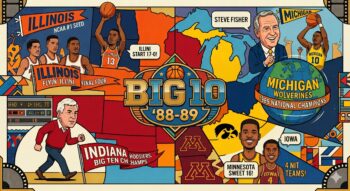
Four teams, Michigan at #3, Iowa at #7, Illinois at #9, and Ohio State at #17 were ranked in the preseason Top 20 (back then it was the Top 20 not the Top 25, like it is today).

Indiana, who went two months of the season without being ranked and didn’t reach the Top 10 until late February, won the Regular Season title by going 15-3.  They were a #2 seed in the NCAA Tournament.  They made the Sweet 16 and finished 27-8.

Illinois, swept Indiana and Michigan in the regular season, was in the Top 10 all year, started 17-0, was ranked #1 for a short time, and finished second in the league at 14-4.  They were the conference’s only #1 seed in the NCAA Tournament.  They made the Final Four and finished with the most wins and fewest losses of any Big Ten team, going 31-5.

Michigan was ranked in the Top 10 for all but three weeks of the season.  They finished third in the league at 12-6.  They were a #3 seed in the NCAA Tournament.  Their coach Bill Frieder left for Arizona State before the NCAAs started.  With interim Coach Steve Fisher, the Wolverines went 6-0 to win their first National Championship.  In the Final Four, they avenged two regular season losses to Illinois, with an 83-81 win in the semis.  They then beat Seton Hall 80-79 in overtime for the title.  They finished 30-7.

Iowa was ranked in the Top 15 all season.  They finished fourth in the league at 10-8.  They were a #4 seed in the NCAA Tournament.  The Hawkeyes lost in the Second Round of the NCAAs and finished 23-10.

Minnesota was the fifth and final Big Ten team to make the NCAA Tournament.  They finished fifth in the league at 9-9.  They were a #11 seed in the NCAAs.  The Gophers made a surprising run to the Sweet 16 and had a 19-12 final record.

Of the five other teams that did not make the NCAA Tournament; Wisconsin, Ohio State, and Michigan State finished with winning records and made the NIT.  Purdue and Northwestern were the only two teams that had losing records and didn’t make the postseason.  Like the preseason, four teams were ranked in the Top 20 at season’s end; Michigan #1, Illinois #3, Indiana #9, and Iowa #19.  There are many great games, players, and stories that made up the historic 1988-89 Big Ten Men’s Basketball season, but to get to all of that would require multiple volumes. 

This overview of that season and why it was so special certainly brought back great memories for me and I hope it helped you learn a little about Big Ten basketball.

 Illinois makes the Final Four (Sourced via Facebook post)
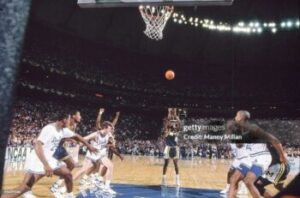
 Rumeal Robinson wins title for Michigan with free throws against Seton Hall (Sourced via Gtty Images)

Please Share If You Liked This Article

Facebook
Twitter
LinkedIn
Reddit
Email

AUTHOR BIO - CEDRIC HORNE

Cedric Horne is a husband and father, living in Lancaster, PA.  He was born in Chicago (which is the main reason he is a fan of the Blackhawks and Bulls).  The Cubs are okay, but his people are from the South Side, so he’s White Sox all the way.  He also likes the Bears, but the Denver Broncos have always been his favorite team. 

He was raised in Rochester, NY (his hometown of 40 years).  It was there that he began coaching high school basketball, which he has been doing for 30 years now, 21 in New York State and the last 9 in Pennsylvania. 

Basketball is his favorite sport, particularly the collegiate level.  His articles will focus on the history of college basketball.  Who knows, maybe someday he might even do a podcast on college basketball someday?

Please Note – As an Amazon Associate I earn from qualifying purchases

Get notified of new content, podcasts, and our awesome giveaways!!!!

    We respect your privacy. Unsubscribe at any time.

    More Posts From Sports History Network

    Leave a Comment