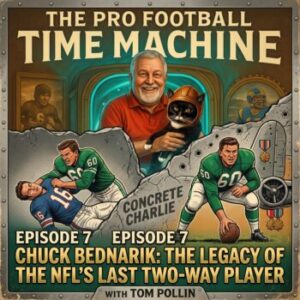
Chuck Bednarik: The Legacy of NFL’s Last Two-Way Player

Just say the name Chuck Bednarik (bed-nare-ick) and you can be certain you’re not talking about the first chair violin player with the Philadelphia Philharmonic.

In NFL history there are last names that define their franchises. For the Chicago Bears that name is Butkus and for the Green Bay Packers it’s Nitschke. Over 60 years since he last roamed the gridiron Bednarik still means the Philadelphia Eagles.

Bednarik bore the nickname “Concrete Charlie” which perfectly described his toughness and the hits he delivered to opposing players. That’s not where the nickname originated though. Bednarik was a concrete salesman in the offseason.

Sportswriter Hugh Brown of the Philadelphia Bulletin wrote that Bednarik, “is as hard as the concrete he sells.” In this case, the occupation fit the man, and not just on the football field.

Pouring the Concrete Mold

Chuck Bednarik was born in Bethlehem, Pennsylvania and played football at Liberty High School. After graduating he entered the United States Army Air Force. After he passed his gunnery test, he served as a B-24 waist-gunner with the Eighth Air Force.

Being a waist-gunner was one of the most hazardous positions on a bomber. B-24s flew at high altitudes which exposed waist-gunners to extreme cold. Their exposed positions in the middle of the plane also made waist-gunners a primary target of enemy fighters. Between exposure and enemy fire, waist-gunners flying missions over Germany suffered a 19 percent mortality rate.

Bednarik had described himself as a nice, easy going kid before he enlisted in the Army and joined the Air Corp.

Bednarik flew 30 combat missions over Germany and not only survived, he won the “Air Medal” with five oak leaf clusters and five battle stars during his wartime service. Bednarik also emerged with a toughness that defined him on the gridiron.

“You go through combat, you develop a killer instinct,” Bednarik said. “You become, what’s the term, hard core. Did I take that on the field? Yes, to be honest, I did.”

Taking the War Mentality to the Gridiron

After World War II, Bednarik attended the University of Pennsylvania where he played center, linebacker and occasionally punted. In 1947 he led Penn to their first undefeated season since 1908. In 1948 he won the Maxwell Award, given to the best college football player as voted on by sportscasters, sportswriters and NCAA head coaches.

Bednarik also finished third in the Heisman Trophy voting that year, only one of five linemen in the history of the award to ever to finish in the top three. In the 1949 NFL Draft Bednarik was selected first overall by the Philadelphia Eagles, ahead of Doak Walker, who was the winner of the 1948 Heisman Trophy. Walker was selected third overall by the New York Bulldogs.

Repping the Kelly Green and White

Bednarik was a rookie on Philadelphia’s 1949 NFL Championship team starting seven games at center that season.

In 1950 the NFL changed the rules to allow free substitution. As the ‘50’s went on more players began to choose the side of the ball where they wanted to play but Bednarik refused to follow that trend. He was a true 60-minute man, playing center on offense and linebacker on defense, rarely leaving the field, despite how punishing those positions were to play.

Throughout the 1950s, Philadelphia struggled to stay relevant in a division that was dominated by the Cleveland Browns and New York Giants. Despite the team’s troubles though, Bednarik was playing at an elite level on both sides of the ball.

Through the 1950s, it was common to see Bednarik’s name on the list for postseason honors. As an outside linebacker he was named to the Pro Bowl and earned First Team All Pro honors in 1950 through 1954. He made the Pro Bowl and earned Second Team All Pro honors as a linebacker in 1956 and 1957. He earned both honors at center in 1950 and 1954.

Bednarik’s & Philadelphia’s Glory Season

It was the 1960 season where Bednarik made the plays that cemented his reputation as an NFL legend. The funny thing was, Bednarik almost didn’t play that season.

Bednarik was ready to retire after the 1959 NFL season. He had announced the retirement and the Eagles even held a “Chuck Bednarik Day” for their legendary player. What changed his mind? He found out that his wife was pregnant with his fifth daughter. He felt that he would need the money.

When training camp opened in the summer of 1960, Bednarik was back on the field.

He played exclusively at center as the season began but in the fifth game linebacker Bob Pellegrini pulled a groin muscle. Head coach Buck Shaw looked at Bednarik and said, “Get in there Chuck, but don’t pull any hero stuff.” He continued playing both offense and defense the rest of the season and ended up playing 600 of 720 game minutes.

The Destruction of Frank Gifford

It was Week 9 against the New York Giants when Bednarik made the Frank Gifford crushing tackle he is most known for.

Heading into the game, the Eagles were 7-1 and trying to keep the 5-1-1 New York Giants behind them in the Eastern Division. They held a 17-10 lead over New York in the fourth quarter with under two minutes to go but the Giants were driving late to try and tie.

New York quarterback George Shaw scrambled free of the Eagles pass rush and connected with Gifford cutting over the middle. Gifford made a move for the sideline as Bednarik closed and slammed into him. The ball flew from his hands and was recovered by Philadelphia middle linebacker Chuck Weber.

Gifford was lying flat on his back, unconscious, as Bednarik celebrated.  He wasn’t celebrating the hit though, as many assumed at the time and some continue to believe today. Bednarik was celebrating that the game was over at that point and that the Eagles would be hanging on to first place in the division.

The thing about the tackle was, even in today’s NFL, it would be ruled a legal hit. It was the perfect storm of tackles with Gifford turning just as Bednarik reached him while going full speed with a lowered shoulder. Gifford’s later explanation of the hit exonerated Bednarik for delivering a cheap shot. “He didn’t hurt me. When he hit me, I landed on my ass and then my head snapped back. That was what put me out, the whiplash, not Bednarik.

What Gifford suffered through was serious. The concussion he endured kept him out of action for the rest of the 1960 season and all of 1961. In 1962, Gifford returned to the Giants but as a flanker, not as a running back. Frank Gifford retired after the 1964 season.

Gifford never held the hit against Bednarik. He later said, “It was perfectly legal. If I’d had the chance, I would have done the same thing to Chuck.” Both men would later talk at awards dinners and once, even played golf with each other.

Bednarik Sits on Jim Taylor

The Eagles finished the season with a 10-2 record, their best since their 1949 championship year, and faced Vince Lombardi’s Green Bay Packers in the 1960 NFL Championship Game.

On the first play of the game, Eagles’ quarterback Norm Van Brocklin threw a pass that was intercepted by the Packers at the 14-yard line but the Eagles’ defense held and Green Bay had to settle for a field goal and a 3-0 lead.

The Packers added another field goal to open the second quarter before Van Brocklin began to connect with his receivers. A 35-yard touchdown pass to Tommy McDonald and a 15-yard field goal by Bobby Walston put the Eagles up 10-6 at the half.

A seven-yard pass from Bart Starr to Max McGee early in the fourth quarter gave Green Bay a 13-10 lead.

Philadelphia’s Ted Dean took the ensuing kickoff at the three-yard line and returned it 58-yards, setting up the Eagles at the Packers 39. Dean finished the drive with a five-yard touchdown run to put Philadelphia back on top 17-13.

Green Bay began their final possession at their 35-yard line with 1:05 left in the game. With the ball on the Eagles 22, no time outs remaining and the clock winding down, Starr swung a pass into the flat to Jim Taylor.

He spun out of a tackle at the 10 and was ready to rumble into the end zone when Bednarik showed up. He hit Taylor high and wrestled him to the ground.

Taylor struggled to get to his feet to run one more play but Bednarik was having none of it. When time ran out, Bednarik said, “You can get up now Taylor, this damn game’s over!”

Other than for kicking plays, Bednarik played every offensive and defensive snap. Despite his leadership on both sides of the ball and the game-sealing tackle, Van Brocklin walked off with the game’s Most Valuable Player award.

After the Gridiron Wars

Bednarik retired after the 1962 season having only missed just three games in 14-years. The honors kept rolling in though.

Bednarik was inducted into the Pro Football Hall of Fame in1967 his first year of eligibility. In 1969, Bednarik was inducted into the College Football Hall of Fame. In 1987 he was among the first group inducted into the Philadelphia Eagles’ Honor Roll and Bednarik’s number 60 was retired by the team.

Through his later years, Bednarik always took great pride in being the last of the two-way players. Players of more recent vintage who dabbled with playing on both sides of the ball, like Deion Sanders, failed to impress him. They didn’t play offense and defense on every down and wasn’t he giving up his standing to any of them.

Chuck Bednarik left behind a legacy of excellence on both sides of the ball. The end of his career closed the book on 60-minute men in professional football.

If he didn’t carry the nickname of “Concrete Charlie” because of his off field occupation, he still could have carried that nickname because he embodied it every day on the field and in his life.

Chuck Bednarik will always be admired as one of the NFL’s and Philadelphia Eagles’ greatest to ever play the game.

Please Share If You Liked This Article

Facebook
Twitter
LinkedIn
Reddit
Email

Please Note – As an Amazon Associate I earn from qualifying purchases

Get notified of new content, podcasts, and our awesome giveaways!!!!

    We respect your privacy. Unsubscribe at any time.

    More Posts From Pro Football Time Machine

    Leave a Comment