Monday Night Football Early Years (1974 – 1978)

Before we jump into Monday Night Football from 1974 thru 1978, if you haven’t checked it out yet, we recommend reading the article covering 70′-73′ first.  You can also listen to Mark and Dave on Yesterday’s Sports reliving MNF throughout the years.  Below is part 1 of the conversation.

1974

Don Meredith departed ABC to join NBC. Alex Karras took his place.

Week Thirteen: Rams vs. Redskins. The Rams entered this game with a 9–3 record, already securing first place in the weak Western Division. Washington was competing with the Cowboys and Cardinals for a playoff spot. The Cardinals were currently leading the division with a 9–4 record. Washington was a half-game behind the Cardinals, and the Cowboys were just a half-game behind Washington, making this a must-win game for the Redskins.

By the second quarter, the Rams led 10–0. However, the often-criticized Billy Kilmer stepped up, completing 19 of 29 passes for 269 yards and three touchdowns. The Redskins won 23–17, but two weeks later, the Rams defeated Washington in the playoffs 19–10.

Week Fourteen: Up to this point, Monday Night Football had never televised a Week Fourteen game. 1974 was the first year they did, but the game was played on Saturday night instead of Monday. This was the first time the Raiders and Cowboys faced each other. The NFL matchmakers hoped this game would have playoff implications, but Oakland had already clinched its division, and the Redskins’ victory over the Rams five days earlier had eliminated Dallas from the playoffs. Both teams played hard, even though neither had much to gain from a win. The final score was Oakland 27, Dallas 23.

1975

Week One: This was a highly anticipated rematch of the 1974 AFC Playoff game between the Raiders and Dolphins. The Raiders won that classic game 28–26. During the offseason, the Dolphins lost Larry Csonka, Jim Kiick, and Paul Warfield to the newly formed World Football League. The Monday night game was never really close.

Oakland took a 17–0 lead in the second quarter and finished with a 31–21 victory. The loss ended the Dolphins’ streak of 31 consecutive home wins. It was a sloppy game, with the two teams combining for ten turnovers and eleven penalties. The game coincided with the attempted assassination of President Gerald Ford, and most of the halftime was spent updating the incident.

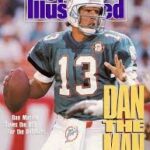
Sports Illustrated Cover (Larry Csonka, Paul Warfield, Jim Kiick) - Miami Dolphins
Sports Illustrated Cover (Larry Csonka, Paul Warfield, Jim Kiick) - Miami Dolphins. Courtesy Mark Morthier's private collection.
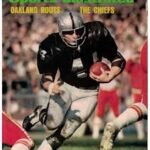
Sports Illustrated magazine cover - Oakland Raiders routs the Chiefs
Sports Illustrated magazine cover - Oakland Raiders routs the Chiefs. Courtesy Mark Morthier's private collection.

Week Five: The surprising Buffalo Bills, who were at home and started the game with a 4–0 record, were upset 17–14 by the 1–3 NY Giants. The only thing that made this game memorable was that a fan decided to perform a high-wire act in the middle of the game. For some unknown reason, a man chose to climb across the wire that holds the net, which prevents footballs from going into the stands. 

Week Fourteen: Like in 1974, the final Monday Night game was played on a Saturday night. The 12–1 Steelers faced the 11–2 Rams. Although both teams had already secured their divisions, there was still considerable excitement for this game, as many saw it as a preview of the Super Bowl. It was expected to be a low-scoring game, and it was. Franco Harris ran for 126 yards on 21 carries, but the Rams’ defense completely shut down the Steelers’ passing game. Joe Gilliam and Terry Bradshaw combined to complete only 5 of 21 passes for 40 yards.

The Rams focused on the ground game, as Ron Jaworski threw just thirteen passes. The Rams ran the ball 48 times for 171 yards. The final score was Rams 10, Steelers 3. The Steelers went on to win back-to-back Super Bowls, while the Rams were beaten by the Cowboys 37–7 in the NFC Championship.

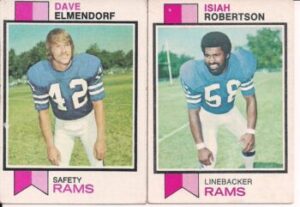
Dave Elmendorf (Safety) and Isiah Robertson (Linebacker) LA Rams football cards
Dave Elmendorf (Safety) and Isiah Robertson (Linebacker) LA Rams football cards. Courtesy Mark Morthier's private collection.

1976

Week Three: The Eagles totally outplayed the Redskins, gaining 418 yards to 230, but they committed fifteen penalties and turned the ball over six times. The Redskins capitalized on the Eagles’ mistakes and won the game 20–17. It was the first overtime game on Monday Night Football. The Eagles ran for 252 yards against the usually strong Washington defense. 

1977

After three seasons announcing for NBC, Don Meredith returned to ABC’s Monday Night Football.

Week Six: Rams vs Vikings. Since 1969, the Rams’ record against the Vikings was 1–7–1, including three postseason losses. The Rams ran the ball 50 times for 283 yards and won this game convincingly, 35–3. The teams met again in the playoffs, and the Rams were heavily favored to win, but lost 14–7 in what many called the Mud Bowl

1978

1978 was arguably the best year ever for Monday Night Football. It featured some great matchups, exciting games, and more games than ever before. With the schedule expanding from 14 to 16 games, the NFL added some Thursday and Sunday night games. ABC broadcast a total of 21 night games that season.

Week One: This game was only memorable for Cowboys fans. What was meant to be a marquee matchup turned into a blowout. The Colts had made the playoffs in 1975, 1976, and 1977. The two teams met in 1976, and the Cowboys narrowly won, 30–27. However, the 1978 preseason had been a nightmare for Baltimore. Their quarterback, Bert Jones, hurt his shoulder, and their starting offensive tackles were also injured.

To make things worse, their All-Pro running back, Lydell Mitchell, was involved in a contract dispute and was traded to the San Diego Chargers just before the regular season began. The Cowboys outgained the Colts 583 yards to 181, with running back Tony Dorsett rushing for 147 yards, adding another 107 yards receiving. The final score was Dallas 38, Baltimore 0.

Tony Dorsett (Running Back) Dallas Cowboys football card
Tony Dorsett (Running Back) Dallas Cowboys football card. Courtesy Mark Morthier's private collection.
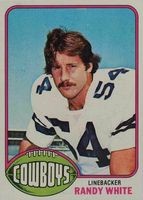
Randy White (Linebacker) Dallas Cowboys football card
Randy White (Linebacker) Dallas Cowboys football card. Courtesy Mark Morthier's private collection.

Week Three: After losing to Dallas and Miami by a combined score of 80–0, the Colts returned to Monday Night Football to face the New England Patriots. The Patriots led 13–7 at halftime, but the Colts scored 20 unanswered points in the fourth quarter to take a 27–13 lead. The Patriots fought back to tie the game at 27–27. With just over a minute remaining, Joe Washington returned a kickoff 90 yards on a rain-soaked field for a touchdown, giving Baltimore a thrilling 34–27 victory. Washington also threw a 54-yard pass to Roger Carr for a touchdown and scored another on a 23-yard reception.

Week Four: The Raiders vs. Patriots game was memorable because it was the first Sunday Night game. Oakland jumped out to a 14–0 lead, but New England scored three unanswered touchdowns and won 21–14. The Patriots ran the ball 41 times for 207 yards. The Patriots advanced to the playoffs; the Raiders did not.

Week Five: With George Allen no longer the head coach of the Redskins, the Cowboys versus Redskins rivalry had lost some of its spark. Dallas had beaten Washington in both of their 1977 games, the first time that had happened since 1970. This Monday night game was a hard-hitting defensive contest with neither team scoring a touchdown.

The Redskins defense held Tony Dorsett to just 61 yards on 21 carries, and Washington led 9–3 in the fourth quarter. As time was running out, the Redskins faced a fourth down deep in their own end zone. Instead of risking a blocked punt, Coach Jack Pardee instructed quarterback Joe Thiesman to take a safety. What happened next reignited the bad feelings between the two teams.

Thiesman ran into the end zone, but instead of running out, he held the ball up as if to taunt the Cowboys. Although the clock had run out, the ball was still live, and safety Charlie Waters tackled Thiesman while trying to dislodge the ball. Waters succeeded in knocking the ball loose, but it went out of the end zone. Thiesman then picked up the ball and spiked it, rubbing salt in the wound. Several Redskins players went after Waters, perhaps not understanding the rule and thinking it was a cheap shot. Several Cowboys players stepped in to defend Waters, but cooler heads prevailed before things escalated further.

The 9–5 win, followed by another win six days later, gave Washington a 6–0 record. But the Redskins fell apart afterward, losing eight of their next ten games, including a 37–10 loss to Dallas on Thanksgiving. The Cowboys went on to play in their fifth Super Bowl but lost by four points to the Pittsburgh Steelers. 
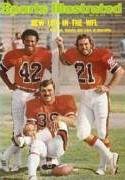
Joe Theismann (Quarterback) Washington Redskins football card
Joe Theismann (Quarterback) Washington Redskins football card. Courtesy Mark Morthier's private collection.
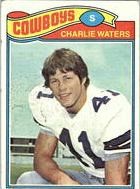
Charlie Waters (Safety) Dallas Cowboys football card
Charlie Waters (Safety) Dallas Cowboys football card. Courtesy Mark Morthier's private collection.

Week Eight: The 7–0 two-time Super Bowl Champion Pittsburgh Steelers faced the 4–3 Houston Oilers. The Oilers played in the first three AFL Championship games, winning two; however, over the past fifteen years, they had only three winning seasons. After an 8–6 record in 1977, Oilers fans had high hopes for the 1978 season, especially after drafting the 1977 Heisman Trophy winner, Earl Campbell. The Oilers’ defense held Franco Harris to 56 yards rushing on 16 carries.

Meanwhile, Campbell gained 89 yards on 21 carries and scored three touchdowns. The Oilers pulled off an upset, 24–17. But the Steelers got revenge in Week Thirteen, beating the Oilers 13-3. The two teams met again in the AFC Championship, with Pittsburgh winning easily, 34–5.

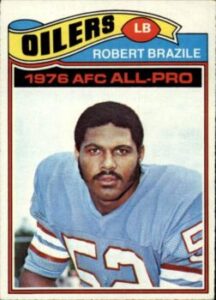
Robert Brazille (Linebacker) Houston Oilers football card
Robert Brazille (Linebacker) Houston Oilers football card. Courtesy Mark Morthier's private collection.
Jack Ham (Linebacker) Pittsburgh Steelers football card
Jack Ham (Linebacker) Pittsburgh Steelers football card. Courtesy Mark Morthier's private collection.

Week Nine: The first Thursday Night game was between the Cowboys and the Vikings, a rematch of the 1977 NFC Championship. The Cowboys won that game 23–6, but the Vikings got some revenge in this matchup, upsetting Dallas 21–10. Chuck Foreman had a strong game, rushing for 101 yards on 22 carries. He also added 33 yards receiving and scored a touchdown. The Vikings’ defense limited Dallas to just 239 yards and forced four turnovers.

Week Ten: The Steelers and Rams had faced each other in a Saturday night game three years earlier, with the Rams winning 10–3. This game was played on a Sunday night and, like the previous one, was a tough, defensive battle, with the Rams once again coming out on top, this time by a score of 10–7. The Steelers entered this game with a 9–1 record, while the Rams were 8–2. The Rams’ defense limited the Steelers to just 174 yards. 1973 Heisman Trophy winner John Cappelletti had a strong game, rushing for 106 yards on 20 carries and adding another 29 yards receiving. As in 1975, many believed this could be a Super Bowl preview, but the Rams lost to the Cowboys in the NFC Championship game, just as they had three years earlier.

Week Twelve: The atmosphere was electric at the Houston Astrodome as the 8–3 Dolphins faced the 7–4 Oilers. Both teams needed a win to stay in the playoff race. The game was tied 14–14 at halftime. The momentum shifted back and forth into the fourth quarter with the score still tied at 21. Miami took the lead when linebacker AJ Duhe sacked quarterback Dan Pastorini in the end zone for a safety.

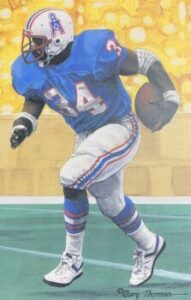
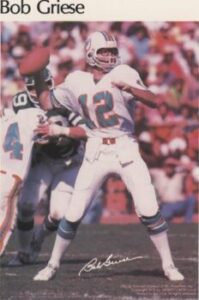
But then Earl Campbell demonstrated why he was the #1 draft pick in 1978. First, Campbell ran for a 12-yard touchdown to put the Oilers ahead 28–23. Next, he ran 81 yards for a touchdown to give Houston a 35–23 lead. The Oilers went on to win 35–30. Campbell finished with 199 rushing yards on 28 carries and scored four touchdowns. Dolphins quarterback Bob Griese also played an outstanding game, completing 23 of 38 passes for 349 yards with two touchdowns.

Earl Campbell (Running Back) Houston Oilers football card
Earl Campbell (Running Back) Houston Oilers football card. Courtesy Mark Morthier's private collection.
Bob Griese (Quarterback) Miami Dolphins football card
Bob Griese (Quarterback) Miami Dolphins football card. Courtesy Mark Morthier's private collection.

Week Thirteen: This game was memorable not because it was a great game, but because there was some question about whether it should be played at all. Earlier that day, San Francisco mayor George Moscone and City Supervisor Harvey Milk were murdered at City Hall. Given that the game was played at Candlestick Park in San Francisco, many thought it was inappropriate not to postpone the game. Nonetheless, the game was played, and as expected, it was a mismatch. The 10–2 Steelers beat the 1–11 49ers 24–7.

Facebook
Twitter
LinkedIn
Reddit
Email

Mark Morthier is the host of Yesterday’s Sports, a podcast dedicated to reliving memorable sports moments from his childhood days and beyond.  He grew up in New Jersey just across from New York City, so many of his episodes revolve around the great sport’s teams of the 70s for the New York area. 

He is also an author of No Nonsense, Old School Weight Training (Second Edition): A Guide for People with Limited Time and Running Wild: (Growing Up in the 1970s)

Mark Morthier headshot - host of Yesterday's Sports podcast on the Sports History Network

BOOKS BY MARK MORTHIER

Please Note – As an Amazon Associate I earn from qualifying purchases

More From Yesterday's Sports

Leave a Comment