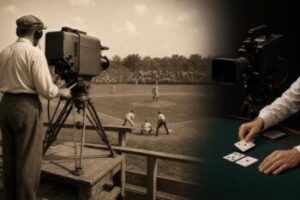
Princeton beat Columbia at Baker Field on May 17, 1939. Along the third-base line, an NBC camera operator had spent the afternoon trying to keep up. From a wooden platform 12 feet high, the camera followed the ball across the diamond, sending pictures to television viewers around New York.
The camera work behind live blackjack ontario brings a similar problem to a smaller stage. Viewers need to follow physical action through a screen. Baseball’s first telecasts show how much that experience depends on where cameras stand, what they capture and how speech accompanies the pictures.
A Close Game Through One Camera
NBC broadcast the second game of the doubleheader on its experimental station, W2XBS. According to Columbia’s historical account, it was the first televised sporting event in the United States.
The crew had rehearsed during the opener, which Princeton won 8-6. Two operators took turns handling the camera, looking through its sights and turning it to follow pitches, hits and throws. Bill Stern called the game from the wooden bleachers nearby. Princeton won 2-1.
Getting those pictures to a living room required another journey. A cable carried the signal to an amplifier truck. Directional transmission sent it onward to the Empire State Building, where it was retransmitted to viewers. A microphone beside the camera picked up sound.
Following such plays tested the equipment. Contemporary reports described fuzzy reception and difficulty seeing the ball. A New York Times assessment called for three or four cameras to cover the field.
By late summer, NBC had added another viewpoint.
Red Barber Watched the Camera Lights
On August 26, 1939, the Cincinnati Reds and Brooklyn Dodgers met at Ebbets Field for Major League Baseball’s television debut. NBC used two cameras: one near the visitors’ dugout along the third-base line, the other in the second tier behind home plate.
The positions gave the broadcast different views of the game. The higher camera offered a broad look across the field; the lower position brought another perspective to the action.
Red Barber’s assignment included working out which picture viewers were receiving. He watched the cameras’ red lights to identify the active one, then inferred where it was pointing.
That detail makes the early broadcast easy to picture. Barber could see the game, but his commentary also had to fit the image reaching people at home. Choosing a camera introduced another decision into the coverage, alongside everything happening on the diamond.
At a card table, that same coordination takes place within a much tighter frame.
Cards Put the Focus on Readable Detail
A blackjack hand develops through small movements. The dealer draws a card, places it on the felt and reveals its face. Rank, suit and dealing order give the viewer the information needed to follow the round.
Live-dealer production has developed from basic webcams to multiple high-definition cameras, with synchronized sound and layouts adapted for computers and phones. The dealer’s speech helps explain the visible action, while the interface displays game information and controls.
On a phone, those elements share a compact screen. Cards need to remain legible alongside the buttons used to make decisions. The layout therefore becomes part of presenting the game, just as camera placement determines which physical details are available to show.
Baseball crews faced the challenge of making a small, fast-moving ball visible across a large field. A blackjack production concentrates on a smaller area, where the identity of each card carries immediate importance. Both depend on pictures that let the audience keep pace.
A Live Picture With a Return Path
The player’s decisions add something to the broadcast: information traveling back toward the table.
British Columbia’s 2023 technical standards describe live-dealer games as physical table games presented through video, audio and a graphical interface, with player instructions received online. The standards also cover automated recognition of game symbols, connecting physical outcomes with digital records.
Cameras have an oversight role, too. The document requires continuous, unobstructed surveillance of live play, preserving a record alongside the presentation watched by players.
Gambling involves financial risk. Online casino participation in Ontario is restricted to adults aged 19 and over. Anyone choosing to play should set firm time and spending limits and keep gambling within an affordable entertainment budget.
Back at Baker Field, the camera operator followed the ball through a single set of sights. Barber soon had two camera lights to watch. Their work helped establish the practical concerns that still occupy live productions: a useful angle, readable action and words that belong with the picture.