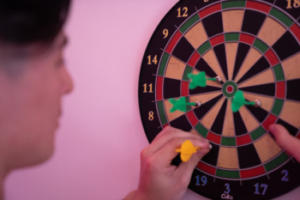
A dartboard asks little of the space around it: somewhere to hang it, room to throw and a few willing players. That simplicity hides a complicated history. Long before darts appeared in home games rooms and on television, people debated where it came from and whether it belonged in public houses at all.
The shift from pub entertainment to an activity anyone can enjoy at home did not happen overnight. Changes to equipment, organised competitions and wider exposure each played a part.
Archery Roots and the Equipment That Brought Darts Home
The familiar tale of soldiers tossing shortened arrows at a target is only one explanation for darts’ beginnings. Historians have also explored links with French throwing games and older English pastimes. There is no clear trail from medieval archery practice to the modern scoring board, but the game’s development becomes easier to follow in nineteenth-century Britain.
Early players used simple wooden darts with metal points and feather flights. Some arrived from France for fairground stalls before finding a place in British pubs. They were inexpensive, though their light construction made consistent throws difficult. As interest grew, makers experimented with added weight and new materials.
Brass barrels became widely available between the world wars, offering players more choice in shape and balance. Tungsten alloys gained favour decades later. Their density allowed for narrower darts, leaving more of a scoring segment visible when several throws landed close together. Modern options still range from affordable brass to slimmer tungsten designs.
For beginners, a well-chosen set of darts makes it possible to explore the sport without joining a league or visiting a pub. A suitable board and a safe throwing area are enough to begin, although trying different weights and grips can help newcomers find a comfortable fit.
Pub Rooms and Courtrooms: A Game of Skill
The pub gave darts an audience as well as a place to play. Regular contests encouraged familiar scoring conventions and a sense of rivalry between patrons. Even the numbered board has a disputed backstory: its design is frequently attributed to a craftsman called Brian Gamlin, whose role has never been convincingly documented.
Public acceptance was not guaranteed. In the early 1900s, officials sometimes questioned whether pub darts was a test of ability or a form of gambling. One famous Leeds account concerns the Adelphi Inn’s landlord, James Garside, and a skilful regular named William ‘Bigfoot’ Annakin. Annakin supposedly demonstrated his accuracy before magistrates in 1908. The details have changed in retellings, so it is safer to regard the episode as part of the game’s local history than as a nationwide legal turning point.
Leagues, Bans and a War That Spread the Game
Darts became more than an occasional challenge when pubs began arranging fixtures against one another. Brewery-supported leagues and common rules gave teams reasons to practise, travel and compare results. By the interwar years, competitions such as the News of the World tournament were drawing entrants from well beyond a single neighbourhood.
Not every community welcomed the growth. Some local authorities objected to pub games because of concerns about drinking, betting or younger customers. Those disputes reveal how closely darts was tied to the social life of public houses, even as it became more organised.
During the Second World War, darts also offered a compact form of recreation wherever service personnel gathered. Informal matches introduced players from different countries to the game, while exhibition events helped raise money for charity. Its reach widened without the need for expensive grounds or specialist facilities.
Television and Professional Play
A pub crowd might number dozens; a television audience could reach far more. The British Darts Organisation, founded in 1973 under Olly Croft, helped establish a structure for major competitions. The first World Professional Darts Championship followed in Nottingham in 1978, with BBC coverage bringing the event into viewers’ homes.
Darts worked remarkably well on screen. Cameras could pick out a narrow target, and each missed double or closely grouped throw could change a match. Familiar competitors gave the sport personalities to follow, while broadcasts showed newcomers how much precision and composure competitive play required.
Setting Up a Board at Home
The modern home setup remains straightforward. Fix the board so the bullseye is 1.73 metres above the floor. Measure 2.37 metres horizontally from the board’s face to the throwing line, known as the oche. Measuring from the wall instead can leave the line in the wrong place.
Choose a spot away from doors, windows and busy walkways, with space to throw comfortably. A board surround or cabinet can protect nearby walls, while a mat helps prevent damage from dropped darts. Because steel tips are sharp, children and pets should stay clear whenever someone is playing. Good lighting and a stable mounting make regular practice easier too.
What the History Tells a Newcomer
Darts never needed a grand venue to attract devoted players. Its origins remain partly uncertain, but improved equipment, club competitions and television all helped it travel beyond the pub. That history is part of its charm: the same simple challenge of hitting a target still works just as well in a spare room today.