Football became a game of strategy, a battle for control of every blade of grass on the pitch. Today’s modern coaches are taking the playing field as if it were a chessboard, blending players’ physical limitations with geometric precision.
It is through understanding this shift in tactics that we can better understand how many teams have dominated their eras. Let’s uncover the historical development of tactics to understand what has led to the game we see today.
Early Origins: The Era of All-Out Attack
In the late 19th century, tactical discipline was nonexistent as players swarmed the ball like schoolboys. While modern fans track every statistic on an online betting app to understand player performance, early spectators simply watched seven attackers charge forward at once. The popular 1-2-7 formation prioritized individual dribbling and brute force over collective passing or defensive cover. Teams frequently neglected the backline to pack the forward area with aggressive strikers.
This chaotic approach eventually failed against more organized Scottish sides who introduced the revolutionary concept of passing. By distributing the ball, they bypassed static defenders and forced opponents to rethink their defensive commitment. This shift marked the birth of teamwork as a viable strategy to win matches consistently.
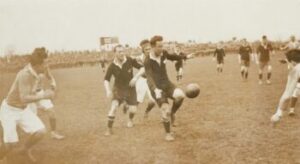
Men playing rugby on a grassy field (Photo sourced via unsplash - Rugby match - All Blacks, 1919, maker unknown. Te Papa (O.031028). https://collections.tepapa.govt.nz/object/771770)
The WM System: Introducing Defensive Balance
Herbert Chapman revolutionized football at Arsenal in response to the new offside rule of 1925. He developed an organized structure based on the letters “M” and “W” when viewed from above the ground. The formations he used were a basis for all of today’s positional systems, as they balanced teams:
The center-half played deeper than others to protect the goal area.
Inside forwards would drop deep to connect the defensive unit with the attacking unit.
Wingers remained wide of the opposing team’s defence and stretched it, creating opportunities to cross into the opponent’s box.
Chapman’s use of a 3-2-2-3 formation allowed managers to effectively organize their teams to be able to dominate both ends of the pitch during big games.
Mid-Century Innovations: Systems of Movement
The 1950s and 60s introduced tactical fluidity that broke the rigid man-marking constraints of the previous decades. As the sport grew in global popularity, fans following the action through platforms like Melbet India began seeing more creative setups.
Teams started experimenting with interchangeable roles to confuse defenders who were used to tracking specific opponents. These experiments paved the way for the two most iconic European philosophies ever conceived.
Total Football and Versatility
Rinus Michels and Johan Cruyff perfected a philosophy where any outfield player could seamlessly assume any role. If a defender joined the attack, a midfielder immediately dropped back to cover the vacated space. This system required every athlete to possess elite technical skills and an incredibly high footballing IQ. The Dutch national team used this fluidity to manipulate the pitch size at their own will.
They pressed high when defending and expanded wide when they held the ball to stretch opponents. This approach relied on total spatial awareness and constant movement to overwhelm rigid defensive structures. It remains the gold standard for teams seeking to dominate through complete control of the grass. Success depended on players being comfortable in every zone of the field simultaneously.
Catenaccio and Defensive Rigidity
While the Dutch embraced fluidity, Italian coaches like Helenio Herrera perfected a system known as the “door bolt.” This strategy utilized a sweeper, or libero, who sat behind a line of four man-marking defenders. Their primary goal was to eliminate any space for attackers to exploit in the final third.
Teams playing Catenaccio relied on clinical counter-attacks to win games by narrow 1-0 scorelines. They frustrated opponents by conceding the majority of possession while remaining virtually impenetrable at the back. This disciplined style defined Italian football’s global reputation for defensive mastery for several decades.
Modern Tiki-Taka: Possession as Defense
Backed by Dutch-inspired movement, Pep Guardiola’s Barcelona moved the ball quickly in tight spaces. When they lost it near the opponent’s goal, pressing began at once – no waiting. That six-second trigger turned defense into attack before rivals could breathe. With everyone constantly shifting positions, opponents rarely held onto the ball long enough to build anything real.
Xavi and Iniesta rose because the plan leaned hard on smart passing minds in the middle. With triangles always forming, wave after wave of steady buildup wore rivals down – legs heavy, thoughts slower. Keeping possession wasn’t just calm play – it blocked chances before they sparked. Defense sharpened not by tackling more, but by rarely seeing the other team with the ball.
High-Pressing: The Counter-Tactical Shift
Football leans hard on Klopp’s firestorm approach – relentless pressing right after losing the ball. Not hanging back anymore, squads charge forward fast, pinning rivals deep near their goal line.
Pressure like that forces mistakes, sparking quick attacks before defenses can set. Athletes need monster stamina, running full tilt nonstop from kickoff to whistle. All that speed turns the field into a wind tunnel, sucking energy out of anyone trying to build play.