The Monsters of the Midway: Inside the 1940s Chicago Bears Dynasty

The Chicago Bears franchise started in 1919 as the Decatur Staleys. The Staleys were renamed the Chicago Staleys in 1921. They posted an impressive 25–3–3 record in their first three seasons. The Staleys changed their name to the Bears in 1922 and enjoyed great success for the next eleven seasons, with only one losing season in 1929.

After 10 seasons, team owner George Halas retired as both a player and a head coach. Ralph Jones then coached the team for the next three seasons, winning 24 games, losing 10, and tying 7.

Halas returned as head coach in 1933, and the Bears won the very first NFL Championship game, defeating the New York Giants 23–21. The Bears reached the championship game again in 1934 with a 13–0 record, but this time the Giants won 30–13. Three years later, the Bears played in their third championship game, losing 28–21 to the Redskins.

In their 21 years of existence, the Bears experienced only one losing season and appeared in three of the seven Championship games, winning one. But the league was about to find out that they were just getting started.

The 1940 Season: A 73-0 Statement

The 1940 season started with a 41–10 win over the defending NFL Champion Green Bay Packers. In the first quarter, George McAfee returned a kickoff 93 yards for a score. In the third quarter, Ray Nolting returned a kickoff 97 yards for a touchdown. Bob Swisher gained 106 yards receiving, while Ken Kavanaugh picked up 85 yards and scored two touchdowns. The Bears’ defense forced nine turnovers.

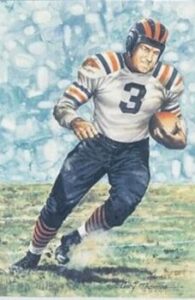
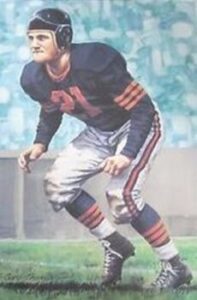
George McAfee (Halfback) Chicago Bears Goal Line Art Card
George McAfee (Halfback) Chicago Bears Goal Line Art Card (Courtesy Mark Morthier's private collection)
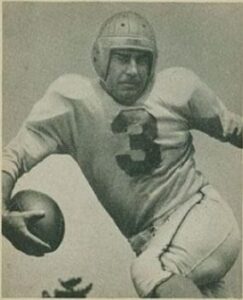
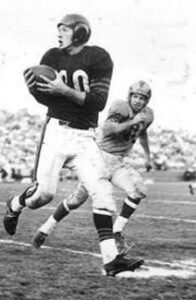
Ken Kavanaugh (End) Chicago Bears
Ken Kavanaugh (End) Chicago Bears (Photo Source - Wikipedia)

In week two, the Bears’ defense gave up 173 rushing yards and were upset by the Chicago Cardinals, 21–7. The following week, the Bears ran for 193 yards against the Cleveland Rams. Despite four turnovers, the Bears won 21–14.

In a game against the Lions in week four, the Bears’ rushing attack netted 195 yards. Bill Osmanski scored a 34-yard touchdown in the first quarter, and that was all the points the Bears needed, as their defense held the Lions scoreless. The final score was Chicago 7, Detroit 0.

In week five, the Bears gained 300 yards rushing, while allowing only 73. With the score tied at 7–7 in the fourth quarter, Joe Maniaci ran for a 27-yard touchdown. Bob Snyder made up for a missed extra point by booting a 47-yard field goal later in the quarter to give Chicago a 16–7 victory over Brooklyn.

The Giants shut down the Bears’ running game in week six, so quarterback Sid Luckman took to the air, completing 9 of 14 passes for 171 yards with two touchdowns. Ray McLean, who caught four passes for 98 yards, was the receiver of those two touchdown passes from Luckman. The Bears’ defense intercepted five passes, one of which was returned 21 yards for a touchdown by Harry Clarke. Chicago offensive tackle, aptly named Lee Artoe, kicked a 52-yard field goal. The record at that time was 54 yards. The final score was Chicago 37, New York 21.

In a rematch against the Packers, the Chicago defense struggled to contain Don Hutson, who caught eight passes for 96 yards and a touchdown. However, they did force five turnovers. The Bears’ running game was back on track, rushing for 187 yards in this 14–7 win.

Maybe their 6–1 record gave the Bears a false sense of confidence heading into their rematch with the Lions. Even though Chicago outgained Detroit 299 yards to 253, the Lions took advantage of three Bears turnovers and secured the win 17–14.

In week nine, the Bears outgained the 7–1 Redskins 300 yards to 169, but only scored three points. The 7–3 loss dropped their record to 6–3, just one game ahead of the Packers in the Western Division.

In week ten, the Bears expanded their passing game, gaining 295 yards through the air. Dick Plasman caught a 58-yard pass for a touchdown, and Ken Kavanaugh caught a 74-yard pass for another score. The final score was Chicago 47, Rams 25.

In the final game of the season, the Bears rushed for 207 yards and avenged their early-season loss to the Cardinals with a 31–23 victory.

The 8–3 Bears beat the 6–4–1 Packers for the Western Division title, while the 9–2 Redskins beat the 8–3 Brooklyn Dodgers in the Eastern Division.
On December 8th, 1940, the Bears and Redskins played at Griffith Stadium in Washington, D.C., for the NFL title. The Bears were eager for revenge after Redskins owner George Preston Marshall called them crybabies and quitters.

The Bears set the tone early as Bill Osmanski ran for a 68-yard touchdown. It seemed like the Redskins might tie the game on their first drive, but a sure touchdown catch was dropped in the end zone. From then on, it was all Bears. The Bears gained 381 yards rushing, while the Redskins managed only five. It was one big play after another for the Bears. Joe Maniaci ran for a 42-yard touchdown, and Ken Kavanaugh caught a 30-yard pass for a score.

Hampton Pool scored on a 15-yard interception return, and Ray Nolting added a 23-yard rushing touchdown. George McAfee returned an interception 34 yards for a touchdown, while Clyde Bulldog Turner scored on a 24-yard interception return.

In the fourth quarter, Harry Clarke ran 44 yards for a touchdown, making the score 60–0. The Redskins turned over the ball nine times and lost in embarrassing fashion, 73–0. This game remains the most lopsided victory in NFL history.

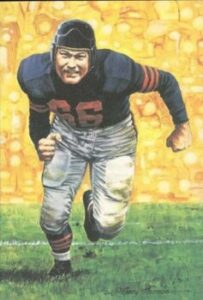
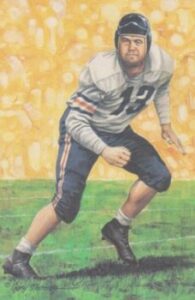
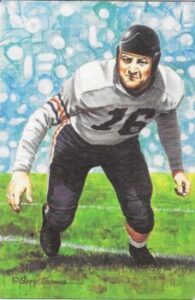
Clyde "Bulldog" Turner (Center) Chicago Bears Goal Line Art Card
Clyde "Bulldog" Turner (Center) Chicago Bears Goal Line Art Card (Courtesy Mark Morthier's private collection)
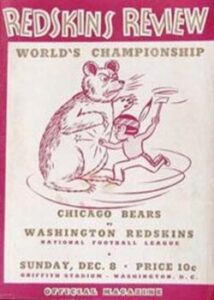
Redskins Review Program for NFL World Championship
Redskins Review Program for NFL World Championship (Photo Source Wikipedia)

After the game, a reporter asked Redskins quarterback Sammy Baugh if the outcome would have been different if the dropped touchdown pass had been caught. Baugh responded, ‘Sure, the score would have been 73–7.

1941: Dominance Amidst a World War

The Bears started strong in their first game of the 1941 season when Ken Kavanaugh scored on a 63-yard reception. The team’s powerful running attack gained 258 yards, while their defense limited the Packers to 56 rushing yards and forced six turnovers. The final score was Chicago 25, Green Bay 17.

With the game tied at seven in the second quarter, George McAfee returned a kickoff for a 97-yard touchdown. Next came a 48-yard touchdown reception by Ken Kavanaugh. By halftime, the Bears were ahead 35–7. John Siegal finished the scoring with a 65-yard touchdown reception from Sid Luckman. The final score was Chicago 48, Rams 21.

The Bears’ offense exploded for 613 yards in a Week Three game against the Cardinals. In the first quarter, George McAfee scored a touchdown on a 59-yard run. In the second quarter, Bob Nowaskey scored on a 40-yard reception. Ken Kavanaugh followed that up with a 38-yard touchdown reception to give the Bears a 33–0 lead. John Siegal continued the scoring spree in the third quarter with a 45-yard touchdown reception. George McAfee increased the score to 47–0 with a 74-yard punt return. Bob Swisher capped off the scoring with a 53-yard touchdown reception to give the Bears a 53–7 victory.

In a game against the Lions in week four, the Bears were ahead 21–0 in the second quarter when Ray McLean returned a punt 61 yards for a touchdown. The Lions were never serious contenders, gaining only 108 yards in total and turning the ball over five times. Chicago won easily, 49–0.

The Bears’ explosive offense dominated the Steelers in week five. In the first half, George McAfee ran for a 33-yard touchdown, and Ken Kavanaugh caught a 45-yard touchdown pass from Sid Luckman. In the second half, Hampton Pool scored on a 56-yard reception. The Bears’ defense held Pittsburgh to 117 yards and forced four turnovers. The final score was Chicago 34, Pittsburgh 7.

In their last three games, the Bears outscored opponents 136–14. They were likely due for a setback, which they experienced against the Green Bay Packers. The Packers’ defense limited the Bears’ powerful running game to just 60 yards, leading to a 16–14 victory.

The Bears’ rushing attack was back on track in a Week 7 game against the Rams. They gained 256 yards on the ground and another 202 through the air. In the fourth quarter, George McAfee took a lateral 42 yards to the end zone to seal a 31–13 victory.

Sammy Baugh threw for 263 yards against the Bears’ defense, but they intercepted him three times on their way to a 35–21 victory over the Redskins. The next week, the Bears’ running attack continued to dominate, gaining 224 yards against the Lions. The Bears’ defense crushed the Lions, limiting them to just 93 total yards and three first downs. The final score was Chicago 24, Detroit 7.

In a game against the Eagles the following week, the Bears trailed 14–0 at halftime but completely dominated the second half. In the third quarter, Hugh Gallarneau returned an interception 46 yards for a touchdown to tie the game. Leading 28–14 in the fourth quarter, John Siegal caught a 59-yard touchdown pass. Soon afterward, Bob Swisher scored on a 60-yard interception return. Hugh Gallarneau sealed the victory with a 54-yard touchdown reception. Seven unanswered touchdowns resulted in a final score of 49–14.

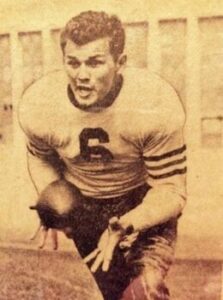
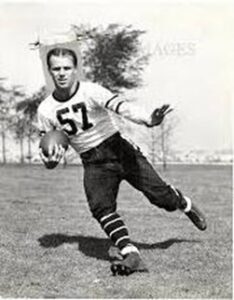
Hugh Gallarneau (Halfback) Chicago Bears
Hugh Gallarneau (Halfback) Chicago Bears (Photo Source College Football Hall of Fame website)
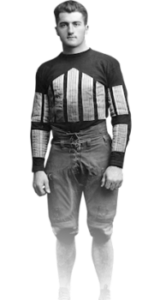
John Siegal (End/DE) Chicago Bears
John Siegal (End/DE) Chicago Bears (Photo Source Legacy)

The Bears needed to win their next game to stay even with the division-leading Packers, but it was hard to focus on football after what happened earlier in the day. The Japanese bombed Pearl Harbor, killing 2,403 Americans and injuring 1,178. For the second week in a row, the Bears fell behind 14–0.

It wasn’t until Hugh Gallarneau ran for an 18-yard touchdown in the third quarter that the Bears took the lead. The Cardinals retook the lead in the fourth quarter, before George McAfee put the Bears back on top with his 39-yard touchdown reception. A short time later, McAfee ran for a 70-yard touchdown to secure Chicago’s 34–24 victory. But there was no celebrating, as everyone’s thoughts were with the victims of the Pearl Harbor attack.

The Bears and Packers finished the season with identical 10–1 records and faced each other in a tiebreaker playoff game. Green Bay took an early 7–0 lead, but the Bears tied it when Hugh Gallarneau returned a punt 81 yards for a touchdown. From that point on, it was all Bears as they cruised to a 33–14 victory. The Bears dominated the line of scrimmage, rushing for 277 yards while holding the Packers to just 33.

The Bears’ opponent in the NFL Championship game was the New York Giants. The attendance at Wrigley Field was only 13,341 due to wartime restrictions. With the score tied 9–9 in the third quarter, the Bears took control, scoring four unanswered touchdowns, the last one a 42-yard fumble recovery by Ken Kavanaugh. The final score was 37–9, and the Bears became NFL Champions for the second consecutive year.

1942: Chasing History

The 1942 Chicago Bears aimed to become the first NFL team to win three straight league titles. They started strong, winning their first five games before Coach George Halas left to serve in World War II. Hunk Anderson and Luke Johnsos took over the coaching duties, and the team continued to perform well. The Bears’ defense allowed just one touchdown over their next six games.

They finished the season undefeated at 11–0 and outscored opponents 376-84. In the NFL title game, they faced the Washington Redskins. Despite the Redskins’ impressive 10–1 record, the Bears were the heavy favorites. However, Washington accomplished what few teams had: they shut down the Bears’ potent running game and pulled off a 14–6 upset victory.

1943: The Return of Bronko and Luckman's MVP Year

The 1943 season faced a player shortage because many players were serving in World War II. The Bears were so desperate for players that they signed Bronko Nagurski, who had been retired for five years.

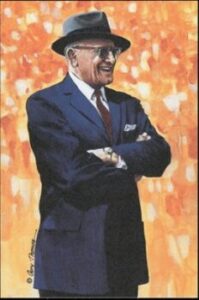
George Halas (Coach) Chicago Bears Goal Line Art Card
George Halas (Coach) Chicago Bears Goal Line Art Card (Courtesy Mark Morthier's private collection)
Bronkin Nagurski (Fullback) Chicago Bears Goal Line Art Card
Bronkin Nagurski (Fullback) Chicago Bears Goal Line Art Card (Courtesy Mark Morthier's Private Collection)

In the season opener, the Bears led the Packers 21–14 in the fourth quarter until Don Hutson scored a touchdown on a 37-yard reception. The Bears’ defense held the Packers to just 55 yards passing, but the 37-yard catch to Hutson ended the game in a 21–21 tie.

The following week, the Bears started strong when Sid Luckman connected with Bill Geyer for a 64-yard touchdown. The Bears led 14–0 in the second quarter, but the Lions came back to tie it at halftime. Harry Clarke put the Bears ahead again with a 26-yard reception for a touchdown.

Hampton Pool extended the lead with a 42-yard catch, giving the Bears a two-touchdown advantage. The final score was Chicago 27, Detroit 21. Bill Geyer was the top performer on offense, catching three passes for 113 yards and one touchdown.

In week three, Geyer continued his momentum from the previous week, scoring on a 40-yard touchdown reception from Sid Luckman. Luckman had an impressive day, completing 10 of 18 passes for 211 yards and a touchdown. The Bears’ defense forced six turnovers, leading to a 20–0 win.

The Bears’ week four opponent was the Steagles. Due to the player shortage, the Steelers and Eagles combined their teams, calling themselves the Steagles. The Bears fell behind 7–0 before Dante Magnani tied the score with a 96-yard kickoff return. Leading 35–7 at halftime, Harry Clarke scored on an 81-yard fumble recovery to open the third quarter. The Bears amassed 210 rushing yards, and Sid Luckman completed 11 of 17 passes for 169 yards and three touchdowns. The final score was Chicago 48, Steagles 21.

Next up for the Bears were the Dodgers (not the baseball team). The war greatly impacted attendance in 1943, with only 9,600 fans showing up at Wrigley Field. Leading 12–0 in the second quarter, Dante Magnani ran for a 79-yard touchdown. The 33–21 final score was misleading, as the game was never close. The Bears outgained the Dodgers in total yards, 446–180. Sid Luckman continued to perform like the league’s top quarterback, completing 15 of 22 passes for 229 yards and two touchdowns.

Leading 7–0 in a Week Six game against the Lions, Harry Clarke extended the lead to 14–0 with a 38-yard touchdown reception. Dante Magnani scored on a 51-yard reception in the third quarter to make it 21–7. In the fourth quarter, Gary Famiglietti ran for a 31-yard touchdown, and Jim Benton caught a 25-yard touchdown pass. The final score was Chicago 35, Detroit 14. The Bears’ running game kept dominating, totaling 240 rushing yards.

A week-seven game against Green Bay at Wrigley Field drew a strong crowd of 43,425. The Bears fell behind early, but a 66-yard touchdown reception by Ray McLean evened the score at 7–7 at halftime. In the third quarter, a 38-yard touchdown reception gave the Bears a 14–7 lead, and they went on to win 21–7. It was their sixth consecutive win.

The following week, the Bears faced the Giants at the Polo Grounds in front of 56,681 fans. Sporting events helped distract people from the war. With a 28–7 lead in the third quarter, the Bears didn’t let up. Harry Clarke caught a 66-yard pass for a touchdown. Hampton Pool capped off the win with a 40-yard touchdown reception, giving Chicago a 56–7 victory. Sid Luckman completed 21 of 32 passes for 433 yards and seven touchdowns. Such stats were nearly unheard of for a quarterback in the 1940s.

The Bears’ hopes for an undefeated season were shattered in a Week Nine game against the defending NFL Champion Redskins. The Bears’ defense struggled to stop the Redskins’ running attack, which gained 213 yards on 45 carries. Sid Luckman threw three interceptions, and the Bears lost three fumbles. The final score was Washington 21, Chicago 7.

In the final game of the regular season, the Bears played lethargically against the 0–9 Cardinals. With the Cardinals leading 24–14 in the fourth quarter, the Bears finally woke up and scored three unanswered touchdowns to win the game 35–14.

Before discussing the Championship game, I must explain that the NFL wasn’t as organized in the 1940s as it is today, especially during World War II. The Bears started their regular season on September 26, while the Redskins didn’t begin their season until two weeks later. The Bears’ final regular-season game was on November 28, and the Redskins’ last game was on December 12.

One week afterward, the Redskins had to play a playoff game against the Giants because the two teams tied for first place in their division. Meanwhile, the Bears could only wait. The Championship game was not played until the day after Christmas, a full four weeks since the Bears last played.

Once again, the Bears started slow, as they had for most of the season. But by halftime, the Bears led 14–7. They extended their lead to 27–7 in the third quarter when Dante Magnani scored two touchdowns—one from a 36-yard reception and another from a 66-yard reception. The final score was Chicago 41, Washington 21.

Luckman had another great day, completing 15 of 26 passes for 286 yards, with five touchdowns and no interceptions. Magnani caught four of those passes for 122 yards and two touchdowns. The Bears’ defense forced six turnovers. Luckman was voted the 1943 NFL MVP.
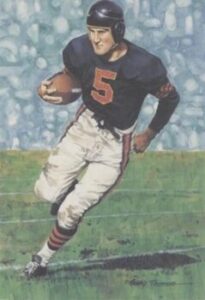
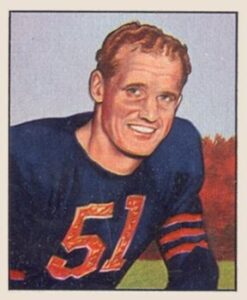
Dante Magnani (Halfback) Chicago Bears
Dante Magnani (Halfback) Chicago Bears (Photo Source Wikipedia)
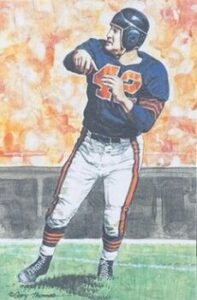
Sid Luckman (Quarterback, Punter, Cornerback) Chicago Bears
Sid Luckman (Quarterback, Punter, Cornerback) Chicago Bears Goal Line Art Card (Courtesy Mark Morthier's private collection)

1944: Missing Players To War

After playing in the NFL Championship game four years in a row and winning three of them, the Bears struggled early in the 1944 season by losing their first two games. They bounced back to go 6–1–1 in their remaining games, but the Packers secured the division with an 8–2 record.

Part of the reason they didn’t win the division was that Sid Luckman missed three games while serving as a Merchant Marine during the war. However, every other team also had players serving their country.

1945: First Losing Season Since 1929

The 1945 Bears faced their first losing season since 1929. After the war finally ended in September, George Halas returned to coach the Bears for their last two games of the season, both of which they won. However, it was too little, too late, as the Bears finished the season with a poor 3–7 record.

1946: Post-War Resurgence

With George Halas back in charge, the 1946 Bears quickly regained their winning form. They opened the season with a 30–7 win over the Packers. With the Bears leading 17–0 in the third quarter, Dick Schweidler ran for a 27-yard touchdown to seal the victory. The Bears outgained the Packers 432 yards to 114.

In week two, the Bears trailed the Cardinals 17–14 going into the fourth quarter, before scoring three unanswered touchdowns for a 34–17 victory.

The following week, the Bears got off to a strong start against the defending champion LA Rams. First, Ray McLean caught a 39-yard pass, then Tom Keane caught a 40-yard pass to put Chicago ahead 14–0. The Rams scored to narrow the gap to 14–7, but McLean scored his second touchdown on a 48-yard pass. The Rams responded with three unanswered touchdowns before the Bears tied it in the fourth quarter. The final score was Bears 28, Rams 28.

The Bears’ defense struggled against the Rams’ powerful running attack, which amassed 241 yards on 40 carries. The Rams shut down the Bears’ running game, limiting them to only 64 yards, but the combination of Luckman to McLean kept the Bears competitive. Luckman threw for 248 yards and three touchdowns. McLean totaled 141 yards and scored twice.

Ray McLean (Halfback) Chicago Bears
Ray McLean (Halfback) Chicago Bears (Photo sourced via Facebook)
Tom Keane (End/DB) Chicago Bears
Tom Keane (End/DB) Chicago Bears (Photo sourced via Facebook)

The Bears’ offense wasn’t dominant in their week four victory over the Eagles, but their defense was outstanding. They limited the Eagles to 45 rushing yards and forced six turnovers in the 21–14 win.

Despite gaining 342 yards to the Giants’ 166, the Bears were shut out. The Giants capitalized on the Bears’ seven turnovers to secure a 14–0 victory.

In a 10–7 win over the Packers, Ed Sprinkle scored the Bears’ only touchdown on a 30-yard fumble recovery. The Bears’ defense held the Packers to 125 yards, but their offense gained only 159 yards. It was the second straight week that the Bears’ offense didn’t score a touchdown.

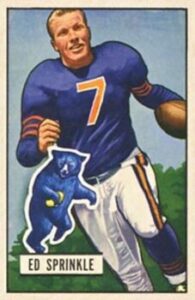
Ed Sprinkle (End/DE) Chicago Bears
Ed Sprinkle (End/DE) Chicago Bears Goal Line Art Card (Courtesy Mark Morthier's private collection)
Joe Stydahar (DT/OT) Chicago Bears Goal Line Art Card
Joe Stydahar (DT/OT) Chicago Bears Goal Line Art Card (Courtesy Mark Morthier's private collection)

In a rematch against the Rams, Hugh Gallarneau ran for a 52-yard touchdown to give the Bears an early 7–0 lead. The Rams tied the game, but Ken Kavanaugh caught touchdown passes of 38 and 34 yards to put the Bears ahead 20–7 at halftime. In the third quarter, the Rams narrowed the gap to 20–14, but Luckman to Kavanaugh connected again on a 28-yard touchdown.

The final score was Chicago 27, LA 21. Ken Kavanaugh caught six passes for 146 yards and scored three touchdowns. With the war over, attendance increased. This game, played at the LA Coliseum, drew 68,381 fans.

In a week eight game against the Redskins, Stu Clarkson broke a 10–10 tie when he returned an interception for a 60-yard touchdown. The Redskins came back to take a 20–17 lead in the fourth quarter before Jim Keane scored the winning touchdown on a 42-yard reception. The win increased the Bears’ record to 6–1–1.

After falling behind 6–0 to the Lions, Hugh Gallarneau recovered a fumble and scored a 67-yard touchdown. The final score was Chicago 42, Detroit 6. The Bears gained 261 rushing yards, and their defense forced six turnovers.

The Bears’ next opponent was the Cardinals, and they discovered that the Cardinals were no longer the NFL’s laughingstock. Fullback Pat Harder rushed for 112 yards and scored two touchdowns, leading the Cardinals to a 35–28 win.

In the final game of the regular season, the Bears took a 17–0 lead, but the Lions came back to cut the gap to 17–10. Jim Keane extended the Bears’ lead with a 41-yard reception for a touchdown. In the third quarter, Hugh Gallarneau ran for a 21-yard touchdown to make the score more comfortable, and the Bears finished with a 45–24 victory. The Bears’ defense limited the Lions to just 26 rushing yards and forced four turnovers.

In the Championship game against the Giants, the Bears took an early 7–0 lead when Ken Kavanaugh caught a 21-yard touchdown pass. They increased the lead to 14–0 after Dante Magnani returned an interception 19 yards for a touchdown. Tied 14–14 in the fourth quarter, Sid Luckman ran in a 19-yard touchdown. The Bears ultimately won 24–14, claiming their fourth NFL title in seven years. The game might have been much closer if the Giants hadn’t turned the ball over eight times. The Bears didn’t win another NFL title until 1963.

The End of an Era: A Decade of Dominance

The Bears started the 1947 season with two losses. They then won eight consecutive games but lost their last two, finishing in second place in their division.

Going into the last game of the 1948 season, the Bears were 10–1, but so were the Cardinals. The two teams faced off in the season’s final game.

The winner would win the division and advance to the Championship game. The Bears led 21–10 in the fourth quarter, but the Cardinals mounted a comeback to win 24–21. The Bears outgained the Cardinals 462 yards to 312, but hurt their chances by turning the ball over five times.

The Bears were 3–3 halfway through the 1949 season before winning the next six games. They finished the season one game behind the Rams, whom they lost to twice.

The Bears ended the decade with 86 wins, 23 losses, and 3 ties. They appeared in five Championship games, winning four. It was truly a decade of dominance.

George Musso (G/T) Chicago Bears Goal Line Art Card
George Musso (G/T) Chicago Bears Goal Line Art Card (Courtesy Mark Morthier's private collection)
Dan Fortman (Guard/DT) Chicago Bears Goal Line Art Card
Dan Fortman (Guard/DT) Chicago Bears Goal Line Art Card (Courtesy Mark Morthier's private collection)

Head Coach and team owner George Halas was a founding member of the Hall of Fame’s 1963 class. Dan Fortmann and Sid Luckman were inducted in 1965. George McAfee and Clyde Bulldog Turner were inducted in 1966, followed by Joe Stydahar in 1967. George Musso was inducted in 1982. Ed Sprinkle finally made it in 2020.

Facebook
Twitter
LinkedIn
Reddit
Email

Mark Morthier is the host of Yesterday’s Sports, a podcast dedicated to reliving memorable sports moments from his childhood days and beyond.  He grew up in New Jersey just across from New York City, so many of his episodes revolve around the great sport’s teams of the 70s for the New York area. 

He is also an author of No Nonsense, Old School Weight Training (Second Edition): A Guide for People with Limited Time and Running Wild: (Growing Up in the 1970s)

Mark Morthier headshot - host of Yesterday's Sports podcast on the Sports History Network

BOOKS BY MARK MORTHIER

Please Note – As an Amazon Associate I earn from qualifying purchases

More From Yesterday's Sports

Leave a Comment