
The Unfairness and Absurdity of the MLB Playoff Structure

As a lifelong sports fan, I’ve always been perplexed by how absurd and unfair the playoff system is. For starters, far too many teams qualify for the postseason. The NBA and NHL are the worst offenders. The NHL has 32 teams, and 16 qualify for the postseason. The NBA has 30 teams, and 16 (more than half) make the postseason.

What’s the point of a regular season other than revenue? It’s like Little League Baseball, where everyone gets a trophy.  Since I don’t follow the NBA or the NHL, I’ll focus my angst on the NFL and MLB. Of the four major professional sports leagues, Major League Baseball has always had the best postseason plan, but it’s far from fair. 

2026 MLB PLAYOFF ABSURDITY

Take this year, for instance. How did the Cleveland Guardians get a bye week while the Yankees and Red Sox, both with better records than Cleveland, had to play each other in a three-game series? Oh, right, I forgot. The Guardians won their division. Big deal! The Houston Astros won their division too, with an unimpressive 81–81 record. MLB, please go back to two divisions.

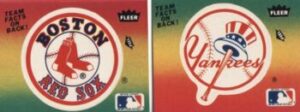
Boston Red Sox and New York Yankees Fleer cards
Boston Red Sox and New York Yankees Fleer cards. Courtesy Mark Morthier's private collection.

The Astros lost their series to the White Sox, and the Yankees beat the Red Sox. With four teams remaining, you would think the team with the best record, the Tampa Bay Devil Rays, would face the team with the worst record, the White Sox. Nope!

The Devil Rays’ reward for having the best record in the American League was to play the team with the second-best record, the Yankees. The Guardians played the White Sox, so once again, we see a team rewarded for a subpar regular season.

THE BEGINNING OF MLB PLAYOFFS

Until 1969, MLB had no divisions or playoffs. Each league had ten teams, and the team with the best record in the American League played the team with the best record in the National League in the World Series.

Two expansion teams joined each league in 1969, and each league split into two six-team divisions. It worked well: the four teams with the best records made the playoffs, and the two best teams met in the World Series. The same thing happened in 1970. 1971 and 1972 had no major issues either. So far, so good.

In 1973, the two AL teams with the best records met in the playoffs, but that was not the case in the NL. The Mets won the Eastern Division with a mediocre 82–79 record. The Dodgers finished second in the Western Division with a 95–66 record but were sent home. The third-place Giants also had a better record than the Mets. The Mets were expected to lose to the Reds, who had the best record in MLB, but the Mets pulled off the upset.

One could argue that the Mets had no business being in the playoffs in the first place, but it took the defending champion Oakland A’s seven games to beat them in the World Series.

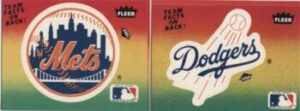
New York Mets and LA Dodgers Fleer cards. Courtesy Mark Morthier's private collection.

Once again, the two teams with the best records in the AL met in the 1974 ALCS, but not in the NL. The Reds, who had the second-best record in MLB, did not qualify for the postseason. Instead, the Pirates, who won their division with ten fewer wins than the Reds, played the Western Division Champion LA Dodgers in the NLCS. The Dodgers won the NLCS but lost to the A’s in the World Series.

From 1975 to 1977, no one could complain that the best teams weren’t in the postseason. In 1978, the Yankees and Red Sox tied for first in the AL East and had to play an extra game to break the tie. The Yankees won, knocking the Red Sox out of the playoffs. The KC Royals won the AL West, but had the Red Sox been in the Western Division instead of the East, they would have finished seven games ahead of the Royals.

In 1979, the Brewers were unfortunate to be in the same division as the 102–57 Orioles. In the weaker Western Division, they would have finished 7 1/2 games ahead of the first-place Angels. In the National League, the Montreal Expos got the short end of the stick, finishing just two games behind the division-leading Pirates. Had they been in the Western Division, they would have finished 5 1/2 games ahead of the first-place Reds.

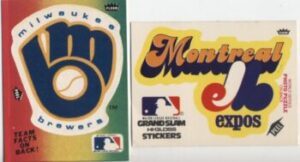
Milwaukee Brewers and Montreal Expos Fleer cards. Courtesy Mark Morthier's private collection.

MLB PLAYOFF EXPANSION

A players’ strike in 1981 expanded the playoffs to eight teams. The strike began on June 12 and ended on July 31. Rather than resuming play where they left off, MLB split the season into two parts: pre-strike and post-strike. The Reds, who had the best overall record, were excluded from the playoffs, while the 50–53 Royals were included. It was a strange season worth forgetting.

The American League Western Division always seemed weaker than the East, and even more so in 1984. Even the fifth-place team in the Eastern Division had a better record than the Western Division-leading KC Royals. Regardless, the Royals advanced to the ALCS but were swept by the Tigers.

Not much changed in 1985, as the 97–64 Yankees of the Eastern Division stayed home while the 91–71 Royals of the West advanced to the postseason.

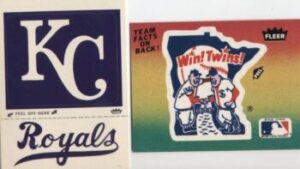
Kansas City Royals and Minnesota Twins Fleer cards. Courtesy Mark Morthier's private collection.

The Western Division was even weaker than usual in 1987. Four teams in the Eastern Division had better records than the Twins, who won the West with an unimpressive 85-77 mark. The Twins capitalized on their good fortune, upsetting the Tigers (who had the best record in MLB) in the ALCS and then the Cardinals in the World Series. The Twins’ .525 regular-season winning percentage was the lowest ever for a World Series Champion.

In 1989, the AL Eastern Division was the weaker division, as three teams in the West had better records than the division-leading Toronto Blue Jays. However, the team with the best record, the Oakland A’s, won the World Series that year. The Chicago White Sox got the short end of the stick in 1990. They had the third-best record in the majors, yet they were sent home. In 1993, the Giants were one of only two teams to win over 100 games, but they, too, were sent home.

With MLB having expanded to 29 teams, the league split into six divisions in 1994. It didn’t matter much, because with the season three-quarters over, the rest of the season was canceled due to a players’ strike.

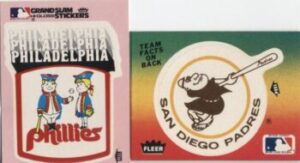
In 1995, the number of playoff teams increased to eight. The new playoff system worked surprisingly well, but not for the Phillies in 2005, who finished 88–74 yet lost a playoff spot to the 82–80 Padres.

LOW POINT FOR MLB WORLD SERIES

In 2006, the Cardinals won the World Series with the lowest winning percentage (.516) of any champion. The Cardinals proved that the regular season doesn’t mean much anymore. You just have to play well enough to qualify for the postseason and get hot when it matters most.

The 2008 Dodgers won a weak NL West Division with an 84–78 record, while the 89–73 Mets finished second in the East and missed the playoffs.

In 2012, MLB, which held out longer than the NFL, NBA, and NHL, finally gave in to “playoff mania” and expanded the playoff field from 8 to 10 teams. Personally, I think eight was more than enough.

Because of the COVID shutdown in 2020, the season was shortened, and the playoffs expanded to 16 teams. Two teams qualified despite losing records.

Things returned to normal in 2021, with ten teams reaching the playoffs. The playoffs expanded to 12 teams in 2022. In 2023, the Arizona Diamondbacks won the NL pennant despite a mediocre 84–78 record. Hooray for average!
In 2026, the Houston Astros made the playoffs with an 81–81 record. This was the first time in MLB history that a team reached the playoffs without a winning record in a full season. In 2020, two teams made the playoffs with losing records, and in 1981, one team did. However, both seasons were shortened and featured an expanded postseason.

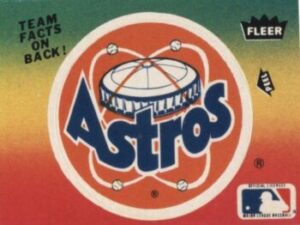
Houston Astros Fleer card. Courtesy Mark Morthier's private collection.

MY CONCLUSION

At least this year, the teams with the best records in their respective leagues (the Devil Rays and the Brewers) will meet in the World Series, as they should.

Overall, I still think MLB does a better job of handling the postseason than the other three pro sports leagues, but twelve teams is too many. I also think the league should return to four divisions rather than six.

In my opinion, all four pro sports leagues have far too many teams qualify for the postseason, and as a result, the regular season is watered down and rewards teams for a subpar season. But more playoff games mean more revenue, and in the end, that’s what it comes down to.

Please Consider Sharing If You Like This Article

Facebook
Twitter
LinkedIn
Pinterest
Email

Mark Morthier is the host of Yesterday’s Sports, a podcast dedicated to reliving memorable sports moments from his childhood days and beyond.  He grew up in New Jersey just across from New York City, so many of his episodes revolve around the great sport’s teams of the 70s for the New York area. 

He is also an author of No Nonsense, Old School Weight Training (Second Edition): A Guide for People with Limited Time and Running Wild: (Growing Up in the 1970s)

Mark Morthier headshot - host of Yesterday's Sports podcast on the Sports History Network
Photo Courtesy: Mark Morthier

Check out Mark's Books Below

Please Note – As an Amazon Associate I earn from qualifying purchases

Join the newsletter

Learn more about the Sports History Network

    We respect your privacy. Unsubscribe at any time.

    Resources

    More From Yesterday's Sports

    Leave a Comment