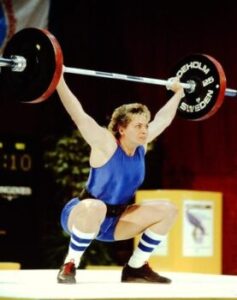
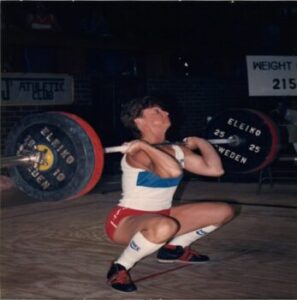
The first USA Women’s National Championships were held on May 23, 1981, in Waterloo, Iowa. There were only 29 competitors, and only one woman, Judy Glenney, was able to snatch more than her bodyweight. Lifting in the 67.5-kilo weight class, Glenney easily won the best lifter award with a 75-kilo snatch and a 97.5-kilo clean & jerk. Seventeen of the 29 competitors were unable to clean & jerk their bodyweight, but it was a start.
Increasing Number of Competitors
Fast-forward four years. The Nationals were held in New Rochelle, New York, and the number of competitors increased to 41. My friend and I worked as loaders for this competition, and we were amazed at the weights these ladies were throwing around.
It certainly inspired me to increase my training intensity. Roughly 25% of the women snatched at or above bodyweight. Every lifter was able to clean & jerk at least their bodyweight, and most lifted well above it. Michelle Evris won the best lifter award. Weighing in at only 51 kilos/112 lbs, she snatched 60 kilos and clean & jerked 85 kilos/187 lbs.
One week later, at the New York State Championships, Karyn Tarter (now Karyn Marshall) became the first woman to clean & jerk over 300 pounds, lifting 137.5 kilograms (303 lbs). It was big news and earned her a place in the Guinness Book of World Records.
Growing Interest
Although not taken seriously by most at first, women’s weightlifting was gaining popularity. The first Women’s World Weightlifting Championships were held in Daytona Beach, Florida, in 1987. China dominated the competition, winning 8 gold and 3 silver medals.
The US won a total of six medals, but only one gold. That gold medal went to Karyn Marshall, who competed in the 82.5-kilo/182 lb. weight class. Karyn snatched 95 kilos and lifted 125 kilos in the clean & jerk, for a 220 total, the highest in the competition. Huang Xiaoyu of China snatched 75/165 and clean & jerked 95/209, weighing only 48 kilos/106 lbs.
At the 1992 World Championships in Bulgaria, Zhang Xiaoli of China lifted 142.5/314 in the clean & jerk in the 82.5-kilo weight class. This surpassed the 140/309 clean & jerk I had achieved in the same weight class. While I was nowhere near a world-class lifter, my 140 clean & jerk at 81 kilos bodyweight was considered above average.
For comparison, my 140 was the 35th-highest clean & jerk out of 266 lifters in my weight class in the USA in 1988. Now, a woman had just bested me, and I was not the only one. Women’s lifting had come a long way since 1981, and people took notice. I sure did!
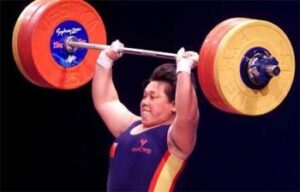
Eight years later, the women competed in their first Olympics in Australia. Ding Meiyuan of China weighed in at 103.5 kilograms (228 lbs) and snatched 135 kilograms. That’s just 2 1/2 pounds shy of 300 pounds. It was only 13 years earlier that a 300-pound clean & jerk was considered astonishing.
Improving Performance
At the 2002 World Championships in Poland, six women snatched over 250 lbs, including one weighing as little as 68 kg (150 lbs). My best snatch was 105 kg/231.5 lbs at 81 kg bodyweight. Eight women clean & jerked over 300 lbs. Anastasia Tsakiri of Greece set a World Record in the clean & jerk with a lift of 136/300 while weighing only 62.5 kg/137.5 lbs. Liu Xia of China had the winning total of 242.5 in the 63-kilo class.
That same total would have won her a bronze medal in the men’s 62-kilo class at the 2002 USA Nationals. How is this possible? Aren’t men supposed to be so much stronger than women? Maybe not.
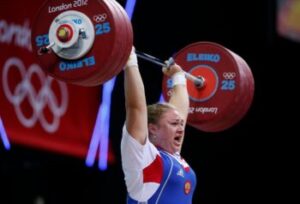
At the 2012 London Olympics, Zhou Lulu of China (bodyweight 131/288) lifted 187/412 in the clean & jerk, and Tatiana Kashirina of Russia (bodyweight 102/225) snatched 151/333. Kashirina was 21 years old.
There are 21-year-old men who can’t deadlift 151 kilograms, yet here was a woman snatching it. How could this be? One can’t help but ask the obvious question. Were they taking anabolic steroids? Kashirina tested positive in 2006 and again in 2020. But to be fair, many of the male lifters also failed drug tests.
USA Pioneers Lose Ground, But Gain It Back
The USA, which was a pioneer in popularizing women’s weightlifting in 1981, had not done well at the Olympics. Cheryl Haworth won a bronze medal at the 2000 Olympics, and Tara Nott won a gold, but no USA women medaled at the 2004, 2008, and 2012 Olympics. That was about to change.
Sarah Robles won a bronze medal at the 2016 Olympics. The following year, Robles won the gold medal at the World Championships, while Mattie Rogers won silver. Rogers faced tougher competition in 2018 but still won a bronze medal in the clean & jerk. Robles placed 4th overall.
The USA women captured three medals at the 2019 Worlds. Katherine Nye and Mattie Rogers competed in the 71-kilo class, with Nye winning gold and Rogers taking silver. Jenny Arthur won a bronze medal in the 81-kilo class.
Two years later, in the 76-kilo weight class, Katherine Nye won a silver medal at the Olympics. Sarah Robles won a bronze medal.
At the 2021 Worlds, Mattie Rogers, who placed a disappointing 6th at the Olympics, won silver in the 76-kilo class. Meridith Alwine, who did not compete at the Olympics, took gold in the 71-kilo class. Eighteen-year-old Olivia Reeves placed fourth overall but won silver in the snatch.
At the 2022 Worlds, Reeves placed 5th overall but won a bronze medal in the clean & jerk. Mattie Rogers continued her success, winning a silver medal, while Sarah Robles also won a silver medal in the snatch.
In the 49-kilo class, Jourdan Delacruz won a bronze medal at the 2023 Worlds, while Olivia Reeves won a bronze in the 71-kilo class. Mary Theisen-Lappen won the silver medal in the over-87-kilo class.
New Sensation In Women's Weightlifting
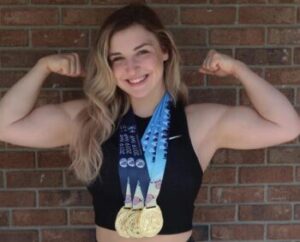
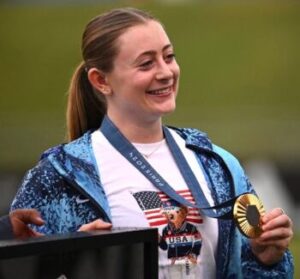
Reeves emerged as the new sensation in women’s weightlifting at the 2024 Olympics in Paris. Lifting in the 71-kilo class, she won the gold medal in the snatch with a new Olympic record of 117/258. She then won the gold medal in the clean & jerk with a lift of 145/319.6, securing the overall gold medal as well.
As impressive as that was, she was just getting started. But before we get to Olivia, let’s take a look at how some of the other USA women performed at the 2025 World Championships. Miranda Ulrey placed fifth in the 58-kilo class but won a bronze medal in the snatch with a lift of 98/216. Mattie Rogers, lifting in the 77-kilo class, fell one kilo short of a bronze medal but won one in the clean & jerk with a lift of 140/308.5. 35-year-old Mary Theisen-Lappen won a bronze medal in the over-86-kilo class.
Olivia Reeves put on a show. Now competing in the 77-kilo class but weighing in at only 73.5/162, Reeves snatched a world-record 123/271. In the clean & jerk, she broke another world record, lifting 155 kg (342 lb). Her total of 278 was also a world record.
The margin of victory between Reeves and the silver medalist was an astounding 26 kilos/57 lbs. Her 278 total equaled the total of the bronze medalist in the men’s 73-kilo class at the 2024 US Nationals.
So, Reeves is not just stronger than the average male weightlifter; she can compete for a medal at the men’s Nationals. Again, I have to ask, how is this possible?
At the 2026 Arnold Sports Festival, Reeves increased her snatch to 125/275.5, despite weighing only 72 kilos. That lift would have won her a silver medal at the 2024 men’s Nationals. Unbelievable!
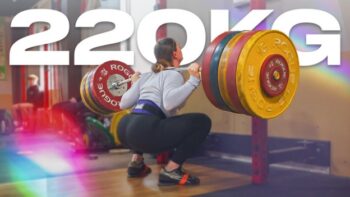
As if that’s not impressive enough, Reeves’s best squat is 220/485. I’m not talking about a powerlifting squat. I’m talking about a rock-bottom Olympic lifting squat, well below parallel, with no knee wraps and no spotters.
Recapping Evolution of Women's Weightlifting
Let’s rewind to the Women’s US Nationals in 1981. More than half of the competitors could not clean & jerk their bodyweight. Today, women are lifting more than double their bodyweight in the clean & jerk.
Over the past 45 years, women’s results have skyrocketed, while men’s have remained stagnant and, in some cases, even declined. So, how did we get to the point where the top women lifters are surpassing men? I’m not just talking about your average or slightly above-average male lifter. I’m talking about men who have placed in the top three of their weight class at national competitions.
I don’t mean to sound like a male chauvinist, but it just doesn’t seem possible, and yet it’s happening. Have we been lied to all these years? Are women really physically weaker than men? The results say otherwise.
Let’s start with the obvious question. Are they all taking PEDs? It’s a fair question, since the same question has been asked of the top men’s lifters. But the fact is, very few are failing drug tests. You can accuse anyone of taking steroids, but without proof, it remains nothing more than an accusation.
Of course, there are other factors, but nothing that isn’t obvious.
1 — Improved training methods.
2 — Better knowledge of nutrition and supplementation.
3 — Better medical technology.
4— Largely due to CrossFit, the sport of Olympic weightlifting is far more popular than it was in the 1970s and 1980s, with far more women participating.
5 — Today, there are far more gyms catering to Olympic lifting, whereas years ago, most gyms were geared toward bodybuilding and general fitness. During my competitive years in the sport (1981–1989), there were few gyms with the proper equipment and space to perform the Olympic lifts.
But none of the above reasons can fully explain how some women have reached such a high level in the sport that they can outlift many male lifters.
Obviously, genetics plays a part in it, but it always has. For some, it’s hereditary; for others, it’s simply a God-given ability. During my years of competing in Olympic Weightlifting, I trained side by side with highly ranked National-level athletes, guys who qualified for the Olympic trials. I trained every bit as hard as they did, but I could not achieve what they did. They simply had a talent level I didn’t have.
There is nothing special or out of the ordinary about Olivia Reeves’ training schedule. She has three to four training sessions per week, each lasting no more than 1 1/2 hours, focusing mainly on the two Olympic lifts and squats, with occasional variations. She has adhered to this training schedule for nine years, with very few changes. Consistency + dedication + incredible talent = Big Results!
So I ask once more, how is it possible that women are surpassing men in weightlifting? I have no answer. Do you? Will we one day see women competing against men in national competitions?
It might not be as far-fetched as it sounds. Please leave your comments below.
Please Share If You Liked This Article
Mark Morthier is the host of Yesterday’s Sports, a podcast dedicated to reliving memorable sports moments from his childhood days and beyond. He grew up in New Jersey just across from New York City, so many of his episodes revolve around the great sport’s teams of the 70s for the New York area.
He is also an author of No Nonsense, Old School Weight Training (Second Edition): A Guide for People with Limited Time and Running Wild: (Growing Up in the 1970s)
Please Note – As an Amazon Associate I earn from qualifying purchases
Resources
More From Yesterday's Sports
1972/1973 NBA Champion New York Knicks – A Total Team Effort
After winning the NBA Championship in 1970, the Knicks returned...
Read MoreHow The 1996 New York Yankees Shocked Baseball and Saved The Bronx
After winning four American League Pennants and two World Series...
Read More1972 Los Angeles Lakers: Beating 17 Years of Frustration
From 1949 to 1954, the Minneapolis Lakers won five NBA...
Read MoreJim Schmitz: USA Olympic Weightlifting Coach
Born in Ukiah, California, in 1945, Coach Jim Schmitz has...
Read More