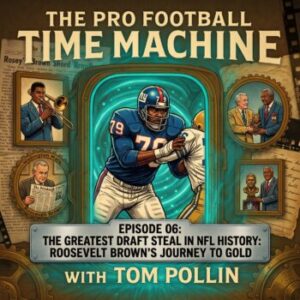
The Greatest Draft Steal in NFL History: Roosevelt Brown’s Journey to Gold

We all know who the first-round draft busts are in NFL history. We get top 10 lists, most that mention the same players, every year, two to three weeks before the NFL Draft.

A better question to ask at this time of year is, what is the direct opposite of a first round bust? First round gold? As in gold jacket?

Fortunately, there is an easy answer to that question. In 1953, the New York Giants struck out on their first, second and third round picks but in the 27th round with the 322 pick overall, they struck a vein of pure gold. New York selected a future Pro Football Hall of Fame tackle out of Morgan State: Roosevelt “Rosey” Brown.

By the time Brown retired after the 1965 season after 13 years of battles on the line of scrimmage, he had been an eight-time All-Pro, a nine-time Pro Bowler and was the anchor on offense for New York’s 1956 Championship team.

In 1975, “Rosey” received the ultimate honor for a player when he was inducted into the Pro Football Hall of Fame.

A Choice Between the Trombone or Football

Rosey Brown grew up in Charlottesville, VA. He described his childhood In a November 8, 1964, article in the New York Times.

“I was always a big boy. When I was 6, my mother put me in school and I took a test. I must have passed it because they put me in third grade. No first grade and no second grade. That meant I graduated from high school when I was 15 and from college at 19. When I played my first game for the Giants, in 1953, I was still 19.”

However, Brown’s path to the NFL almost never happened. Brown was forbidden from playing football by his father after his older brother Frank died from an injury he sustained on the football field.

Brown’s father wanted to see Rosey work on being a musician than using his physical talents to excel on the football field. Brown was playing trombone in the Jefferson High School band when the school’s football coach, Robert W. Smith, noticed him.

Fortunately, Smith was able to talk Brown into playing, but for the first season it was without his father’s knowledge. Brown played without injury his sophomore season while towering over the opposition. He spent his junior and senior seasons being a dominant force on the offensive line.

The New York Giants’ Stroke of Luck

Based on his accomplishments in high school, both in the classroom and on the field, Brown should have had his pick of national college programs to play for. However, because of Jim Crow laws and the racial attitudes of the time, Brown ended up going to Morgan State in Baltimore, a historically black university, on a full football scholarship.

Brown earned all-conference honors at offensive tackle in 1951 and 1952 but was completely off the radar of mainstream newspapers. However, he did catch the attention of The Pittsburgh Courier, one of the most successful African American newspapers in the country.

The Courier had been naming black All-America teams since 1925 and Brown was named to the team at tackle after his 1952 season. That was the extent of his postseason honors, but it was enough.

Brown’s lack of national profile turned out to be a stroke of luck for New York. From the first NFL Draft in 1936 to 1963, when NFL teams began forming scouting partnerships, teams didn’t throw the resources into player evaluation that they do today, despite picking through 30 rounds.

In 1953, the height of college scouting consisted of a team’s brain trust closed up in a room with newspapers collected from all over the country piled on tables around them.

As the draft dragged into the 27th round, the New York draft team was tired and running out of ideas. Then someone picked up a copy of The Pittsburgh Courier. According to Wellington Mara, then the team’s vice president, “We took him. It didn’t seem to make much difference who we took then.”

What Makes a Pro Football Hall of Fame Left Tackle?

When Brown arrived at training camp, he was 6 feet 3 inches tall and 255 pounds, impressive physically but raw. What Brown did bring to his first camp was the physical tools to be a special player.

Ed Kolman, the Giants offensive line coach, had to teach Brown everything about technique during his first training camp, including the correct stance for an offensive lineman in the NFL.

Once schooled on playing with proper technique, Brown was able to bring his physical gifts to the fore.

He used his excellent balance and reflexes to become an unbeatable pass blocker as well as a devastating run blocker. He was also fast enough to pull from the tackle position and lead a ball carrier downfield.

No matter what he was called on to do, success came from Brown’s commitment to being the anonymous key to the Giants success on offense.

He once said, “The backs who carry the ball, they get the credit, the headlines, the big money. But they know and we know that they wouldn’t be anything if it wasn’t for us who give them the blocks.”

The Cornerstone of the New York Giants Glory Years

Brown was a key part of an extended string of success that New York enjoyed in the late 1950s to early 1960s. In his rookie season the Giants finished with a 3-9 record but were putting together a powerhouse team with a roster of players like quarterback Charlie Connerly, Kyle Rote, Frank Gifford on offense and a defense that included Emlen Tunnell and Tom Landry.

That core would earn New York an NFL Championship in 1956, their first since 1938, with a 47-7 blowout victory over the Western Division champion Chicago Bears.

Unfortunately, the Giants weren’t able to ride their big left tackle to another championship during his career. They were Eastern Division champions in five of the next seven seasons but fell to the Western Division champs each time.

In 1958 and 1959, New York lost to the Johnny Unitas led Baltimore Colts. The team’s 1958 battle is still considered by many to be the greatest game ever played.

In 1961 and 1962, Vince Lombardi’s Green Bay Packers began their dynastic run through the 1960s with a pair of NFL Championship Game wins over the Giants.

In 1963, New York led the NFL in scoring with a 34 points per game average. That team travelled to Wrigley Field to take on a Chicago Bears defense that had only allowed 10.3 points per game. Brown earned lineman of the game honors for his work against Chicago’s fearsome front but the Giants as a team fell short 13-10.

Post-Career Recognition

When Rosey Brown retired after the 1965 season, he had played in 161 of the 166 games the Giants played over the course of his 13 year career. His overall impact was summed up by his peers.

Lombardi said of Brown, “When you think of great tackles in professional football, you must think of Rosey Brown.”

Teammate Frank Gifford also publicly recognized Brown’s importance to the Giants.

”I wouldn’t be in the Hall of Fame if it weren’t for him,” Gifford said. ”The longest run of my career was on a pitchout against Washington. Rosie made a block at the line of scrimmage. I cut it up, and then I’m running downfield and I look up and I see No. 79 in front of me, and he wiped out another guy.”

Upon his retirement Brown worked for the Giants as an offensive line coach and later scouted college offensive linemen for the team.

While he continued his life giving back to the game he loved, football returned that love. Brown was named to the NFL’s 1950s All-Decade Team. In 1994, he was named to the NFL’s 75th Anniversary All-Time Team. Of course, in 1975 Brown joined George Connor, Dante Lavelli and Lenny Moore for enshrinement in the Pro Football Hall of Fame.

After Brown died on June 9, 2004, of a heart attack while working in his garden, he received two more prestigious honors from the game that he gave his life to. In 2010, Brown was a member of the inaugural class of the New York Giants Ring of Honor and in 2019, was named to the NFL 100 All-Time team.

Roosevelt “Rosey” Brown received a lifetime of respect as a person and honors for his performance on the gridiron. Not bad for a 27th round trombone player.

Please Share If You Liked This Article

Facebook
Twitter
LinkedIn
Reddit
Email

Please Note – As an Amazon Associate I earn from qualifying purchases

Get notified of new content, podcasts, and our awesome giveaways!!!!

    We respect your privacy. Unsubscribe at any time.

    More Posts From Pro Football Time Machine

    Leave a Comment