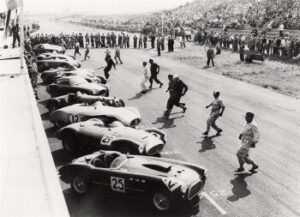

June 12, 1955 – Tragedy occurred at one of the racing world’s greatest spectacles, the Le Mans automobile race. 83 spectators ended up dying as a result of a flaming race car that rampaged off of the track after an accident at the highly attended 24-hour endurance race in France.
One of the deaths was the car’s pilot, French driver Pierre Bouillin, who raced under the name Pierre Levegh. The French government investigation reported that spectators were protected by a 5-foot-high earthen embankment but the driver Levegh was racing for the lead near the pit-stop area, he swerved to avoid fellow racer Mike Hawthorn’s Jaguar as it moved toward the pits.
Levegh’s car, going about 150 miles per hour, came up too fast on Lance Macklin’s Austin-Healey as it was catapulted upward, and seemingly exploded allowing over 60% of the vehicle’s debris to spray into the crowd of onlookers in the grandstands.
Besides the deaths, there were also nearly 180 more people reported as injured from the wreck. Levegh complained that the course was too narrow near the pit-stop area and the grandstand. Eerily he was correct in his proclamation.
The race continued on despite the tragic accident as ironically Hawthorn ended up winning the endurance race in record time.
To find more great daily sports history make sure to check out the Sports Jersey Dispatch and Pigskin Dispatch.
More From Sports History Network

Brief Overview of Women’s Weightlifting History
The first USA Women’s National Championships were held on May 23, 1981, in Waterloo,

The Changing Role of Sports Mascots
Sports history is usually told through championships, box scores, coaches and athletes. Yet another

Remembering Tampa Bay’s First Two Seasons
In 1976 and 1977, the Tampa Bay Buccaneers experienced what is probably the worst

The Evolution of Betting Activity Around Major Sports Events
Sports betting has existed for centuries and has evolved alongside some of the world’s

How The 1996 New York Yankees Shocked Baseball and Saved The Bronx
After winning four American League Pennants and two World Series in six years (1976–1981),

How Sports Betting Changed From Cash Windows to Digital Payouts
For much of the twentieth century, sports betting was tied to physical places and

Roulette formats available in online gaming platforms
The casino industry is undergoing a digital revolution, transforming traditional table games into cutting-edge

How Sport Learned to Prove It Was Fair: A Short History
Every contest rests on a single fragile assumption: that the result was honest. From