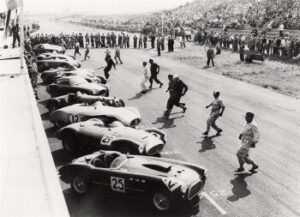

June 12, 1955 – Tragedy occurred at one of the racing world’s greatest spectacles, the Le Mans automobile race. 83 spectators ended up dying as a result of a flaming race car that rampaged off of the track after an accident at the highly attended 24-hour endurance race in France.
One of the deaths was the car’s pilot, French driver Pierre Bouillin, who raced under the name Pierre Levegh. The French government investigation reported that spectators were protected by a 5-foot-high earthen embankment but the driver Levegh was racing for the lead near the pit-stop area, he swerved to avoid fellow racer Mike Hawthorn’s Jaguar as it moved toward the pits.
Levegh’s car, going about 150 miles per hour, came up too fast on Lance Macklin’s Austin-Healey as it was catapulted upward, and seemingly exploded allowing over 60% of the vehicle’s debris to spray into the crowd of onlookers in the grandstands.
Besides the deaths, there were also nearly 180 more people reported as injured from the wreck. Levegh complained that the course was too narrow near the pit-stop area and the grandstand. Eerily he was correct in his proclamation.
The race continued on despite the tragic accident as ironically Hawthorn ended up winning the endurance race in record time.
To find more great daily sports history make sure to check out the Sports Jersey Dispatch and Pigskin Dispatch.
More From Sports History Network

How Tragic Stadium Accidents Led to Nationwide Safety Protocols
Have you ever paused during a thrilling game to consider the unseen safeguards keeping

How New England’s History Is Influencing Patriots Super Bowl Odds in 2026
Sportsbooks don’t price New England like a typical market. They price the Patriots with

Laws, Lines, and Leaps: The Evolution of Sports Gambling Culture
It’s been a wild ride for sports gambling, from back-alley bets to billion-dollar industries,

Super Bowl LX: A History-Making Super Bowl?
Once the Super Bowl game is done and dusted, there will be plenty of

Larry Csonka and Larry Brown – They Took a Licking but Kept on Ticking
In the 1970s, John Cameron Swayze would advertise Timex wristwatches with the slogan, “They

Pete Maravich Becomes NCAA’s All-Time Scoring Leader — January 31, 1970
On January 31, 1970, college basketball witnessed a moment that would echo through the

More Than Cheers: From Face Paint to Fireworks in Sports Fan Culture
Sports are rarely just about the game. From packed stadiums echoing with chants to

Ancient Grit: The Evolution of Combat from Olympia to Rome
Ancient Greeks transformed raw violence into a structured cult. In 708 BC, the introduction