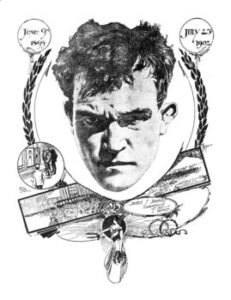

May 13, 1905 – World heavyweight boxing champion James J. Jeffries retired undefeated after 7 title defenses. The Pugilistic Champion would return to the ring some five years later in 1910 only to be defeated by Jack Johnson.
Jeffries was a champ beloved by the crowds. He was big and powerful, and this physical specimen appears to fans that he could never be knocked off by opponents. He also used a unique technique of fighting. The style, taught to him by his trainer, former Welterweight and Middleweight Champion Tommy Ryan, had Jeffries fight out of a crouched position with his left arm extended forward.
With this, he was able to absorb tremendous punishment while wearing his opponents down to the point of exhaustion, and then go on the offensive. It was said by many fighting experts at the time that he would be the king of the ring in any era because he was just that talented at boxing.
To find more great daily sports history make sure to check out the Sports Jersey Dispatch and Pigskin Dispatch.
More From Sports History Network

Brief Overview of Women’s Weightlifting History
The first USA Women’s National Championships were held on May 23, 1981, in Waterloo,

The Changing Role of Sports Mascots
Sports history is usually told through championships, box scores, coaches and athletes. Yet another

Remembering Tampa Bay’s First Two Seasons
In 1976 and 1977, the Tampa Bay Buccaneers experienced what is probably the worst

The Evolution of Betting Activity Around Major Sports Events
Sports betting has existed for centuries and has evolved alongside some of the world’s

How The 1996 New York Yankees Shocked Baseball and Saved The Bronx
After winning four American League Pennants and two World Series in six years (1976–1981),

How Sports Betting Changed From Cash Windows to Digital Payouts
For much of the twentieth century, sports betting was tied to physical places and

Roulette formats available in online gaming platforms
The casino industry is undergoing a digital revolution, transforming traditional table games into cutting-edge

How Sport Learned to Prove It Was Fair: A Short History
Every contest rests on a single fragile assumption: that the result was honest. From